Should You Reaffirm a Camper or Motorhome When You File Chapter 7 Bankruptcy?

Published
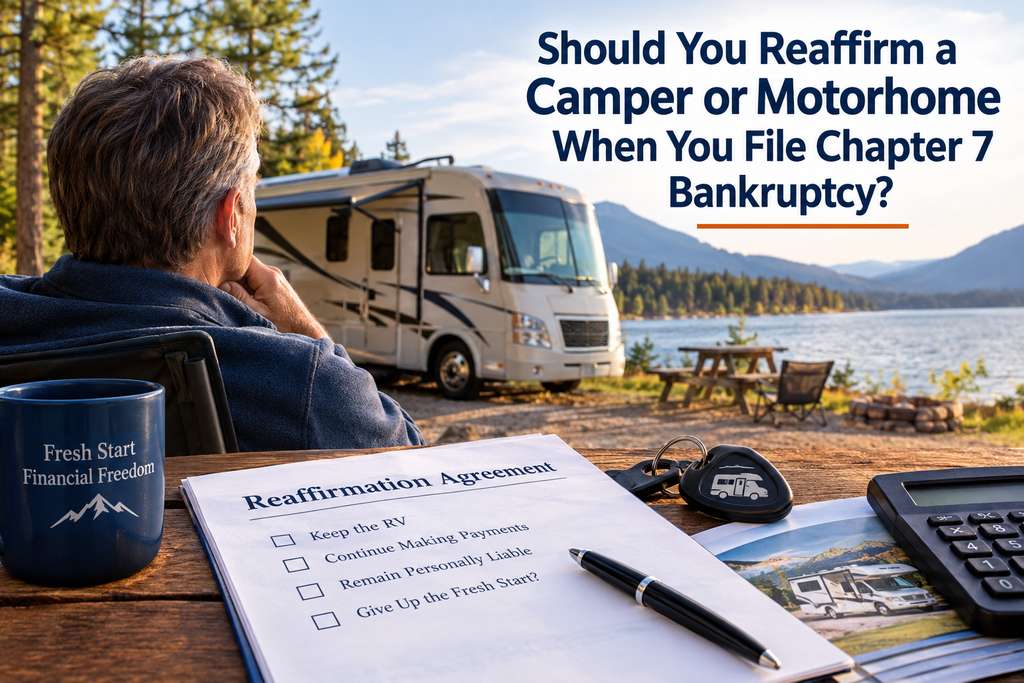
If you are considering filing Chapter 7 bankruptcy and you have a camper, travel trailer, fifth-wheel, or motorhome with a loan on it, one of the questions you will have to answer is whether you should reaffirm the debt and keep the RV.
In my experience representing thousands of people in bankruptcy, this is a decision that deserves a great deal of thought.
A camper or motorhome is usually considered a recreational vehicle, luxury item, or “toy.” That makes it very different from a vehicle you need to get to work or a home where you live.
If you want to keep an expensive recreational vehicle after filing Chapter 7, you should expect the bankruptcy trustee and, where applicable, the bankruptcy court to look closely at the numbers.
Table of Contents
- What Does It Mean to Reaffirm the RV Loan?
- Why Is a Camper or Motorhome Different From Your Automobile?
- The Bankruptcy Court May Look at the Numbers
- What If You Actually Live in the Motorhome?
- RVs Are Depreciating Assets
- The Interest Can Be Expensive
- How Often Do You Really Use Your RV?
- Buyer’s Remorse Is Commonly Discussed in the RV Industry
- Bankruptcy May Give You a Way Out
- Sometimes Giving Back the Camper Is the Smartest Choice
- What About Keeping the Camper Without Reaffirming?
- My Advice to Clients With a Camper or Motorhome
- The Bottom Line
What Does It Mean to Reaffirm the RV Loan?
When you reaffirm a debt, you are agreeing that you will remain personally responsible for the debt even though you are receiving a Chapter 7 discharge.
For example, suppose you owe $75,000 on a motorhome. You file Chapter 7 and otherwise would receive a discharge of that debt. If you sign a reaffirmation agreement, you are voluntarily agreeing to remain personally liable for the $75,000 debt, subject to the terms of the reaffirmation agreement. The bankruptcy filng took you off the hook, signing the reaffirmation agreement puts you back on the hook as though you had never filed bankruptcy.
The U.S. Bankruptcy Court explains that reaffirmation means the debtor remains personally liable for the debt and continues making payments in exchange for keeping the collateral. Reaffirmation is voluntary.
That is an important distinction.
You are giving up one of the most valuable benefits of Chapter 7 bankruptcy—the discharge of your personal liability for the debt.
If you reaffirm the debt and later stop making the payments, the creditor will be able to repossess the RV, sell it at a private dealer auction and pursue you personally for the remaining debt, including costs of repossession such as repo fees, towing, storage, preparation for auction, etc.
Why Is a Camper or Motorhome Different From Your Automobile?
When I discuss reaffirmation with a client who has a normal automobile loan, the discussion is often relatively straightforward.
You need your car to get to work, take your children to school, go to medical appointments, buy groceries and take care of the necessities of everyday life.
A camper or motorhome is different.
For most people, it is a recreational vehicle that is used for vacations, weekends, camping trips, hunting trips or a few family outings during the year.
That does not mean there is anything wrong with owning one.
But bankruptcy is about more than whether you enjoy your camper. The question is whether it makes financial sense to continue paying a substantial secured debt on a recreational vehicle when you are asking the Bankruptcy Court for a discharge of your other debts.
If you can afford to make a $500, $1,000, $1,500 or $2,000 monthly payment on a camper, the obvious question is:
Why isn’t that money available to pay your unsecured creditors?
That is particularly important when considering whether a Chapter 13 bankruptcy, rather than a Chapter 7, may be appropriate.
The Bankruptcy Court May Look at the Numbers
A reaffirmation agreement is not simply a matter of signing a piece of paper and continuing to make your payments.
The Bankruptcy Code requires disclosures concerning your income and expenses. If the numbers show that the reaffirmed payment creates a presumption of undue hardship, additional scrutiny can occur. The U.S. Courts explain that a reaffirmation agreement must show that the debtor has sufficient income after expenses to make the payment; otherwise, a presumption of undue hardship arises.
That is why I am often very cautious when a client tells me:
“I want to keep my $80,000 motorhome and reaffirm the loan.”
My next question is usually:
Why?
If the answer is that the motorhome is the family’s home, that is one thing.
If the answer is that they use it for two weekends every summer, that is something entirely different.
What If You Actually Live in the Motorhome?
There is an important exception to the general rule.
I have had clients who actually live in their motorhome or camper.
For those clients, the RV isn’t really a “toy.” It is their home.
If someone is living in a motorhome and paying $900 a month for the RV while comparable housing would cost $1,500 or $2,000 a month, there may be a very legitimate economic reason to keep it.
The same analysis can apply to someone who lives in a travel trailer or fifth-wheel as their primary residence.
In that situation, I am not looking at the RV simply as a recreational purchase. I am looking at it as a person’s housing.
That can make a substantial difference in the analysis.
RVs Are Depreciating Assets
Another problem with keeping a camper or motorhome is depreciation.
Just like an automobile, an RV is generally a depreciating asset.
You can spend $100,000 on a new motorhome, drive it home from the dealership, and discover that it is worth substantially less than what you paid for it.
Unlike a house, you generally should not expect a motorhome to appreciate in value simply because you own it.
The RV Industry Association’s own cost-of-ownership analysis takes depreciation and residual value into account when calculating the economic cost of owning an RV.
This creates a particularly difficult situation when you finance an RV for a long period of time.
You may owe substantially more on the loan than the RV is worth.
The Interest Can Be Expensive
RV loans can also be surprisingly expensive.
I have seen camper and motorhome loans with interest rates of 12% or more and repayment periods extending as long as 15 to 20 years.
At that point, you need to look at the total amount you will actually pay—not just the monthly payment.
For example, consider a hypothetical $80,000 loan at 12% interest for 15 years.
The monthly principal and interest payment would be approximately $960, but the total payments over 15 years would be approximately $172,800.
In other words, an $80,000 purchase can turn into more than $170,000 of payments before considering insurance, storage, maintenance, fuel, campground fees and other expenses.
That is a tremendous amount of money to spend on an asset that is depreciating.
And the longer the loan, the longer you can remain upside down on the loan.
How Often Do You Really Use Your RV?
This is another question I ask my clients.
How many days a year do you actually use the camper or motorhome?
The RV Industry Association’s 2025 RV Owner Demographic Profile reports that the median RV is used approximately 30 days per year.
Thirty days a year means that, for many owners, the RV sits unused for approximately 11 months of the year.
And while it is sitting in the driveway or at a storage facility, you may still be paying:
- The RV loan
- Interest
- Insurance
- Storage fees
- Maintenance
- Registration
- Repairs
- Winterization
- Tires
- Battery maintenance
- Campground fees when you actually use it
- Fuel
If you are paying $1,000 a month for an RV that you use 30 days a year, you are paying $12,000 a year before many of those other expenses are even considered.
Buyer’s Remorse Is Commonly Discussed in the RV Industry
There is also a significant amount of anecdotal evidence of RV owners experiencing buyer’s remorse.
A March 2025 article in RV Travel reported a claim that approximately 70% of RV owners regretted their purchases, based on the experiences and observations of RV content creators MJ and Izzy of Endless RVing.
I would not tell a client that “70% of RV owners regret buying an RV” as though that were an established scientific statistic. I have not found a representative industry survey supporting that exact number.
But the reasons people report regretting their purchases are familiar:
They bought the wrong size.
They underestimated the cost.
They discovered that their tow vehicle wasn’t adequate.
They didn’t use it nearly as much as they expected.
They became tired of paying for storage and maintenance.
They discovered that the RV depreciated much faster than they expected.
And, perhaps most importantly, the excitement of purchasing a new camper eventually wore off.
That is something I have seen many times when clients come to my office for bankruptcy.
Bankruptcy May Give You a Way Out
If you have a camper or motorhome that you can no longer afford, bankruptcy may provide an opportunity to get out from under the debt.
In a Chapter 7 bankruptcy, you generally have the choice of dealing with the secured creditor by surrendering the collateral rather than reaffirming the debt.
The important distinction is that surrendering the RV is not the same thing as simply stopping your payments and hoping the creditor goes away.
You properly identify your intention to surrender the collateral and make the property available to the creditor.
If the underlying debt is dischargeable and you surrender the collateral, your Chapter 7 discharge generally eliminates your personal liability for the remaining debt. The creditor’s lien rights in the collateral are a separate matter—the creditor can generally take the RV that secures the debt.
In other words, if you owe $80,000 on a camper that is worth $55,000, you generally do not want to find yourself continuing to pay an $80,000 debt simply because you are emotionally attached to the camper.
You need to look at the economics.
Sometimes Giving Back the Camper Is the Smartest Choice
I know that can be difficult for people to hear.
Nobody wants to give up something they purchased for family vacations.
But bankruptcy is often about making difficult financial decisions.
If your camper is sitting in storage nine or ten months a year, is worth substantially less than what you owe, has a high-interest loan with years of payments remaining, and is consuming money that your family needs for necessities, you should seriously consider whether keeping it makes sense.
The purpose of a Chapter 7 bankruptcy is to give you a fresh financial start.
It may make little sense to emerge from bankruptcy with a large monthly payment on a depreciating recreational vehicle that you rarely use.
What About Keeping the Camper Without Reaffirming?
This is an area where you should be very careful.
A bankruptcy discharge eliminates personal liability for a dischargeable debt, but it does not automatically eliminate a valid lien against the collateral. A secured creditor may still have rights against the RV as their lien will survive the bankruptcy discharge and they will have the right to repossess it and recover what they can at auction.
There are circumstances in which a debtor may be able to retain collateral without reaffirming, but you should not assume that simply continuing to make voluntary payments will always protect you from repossession.
Your particular loan documents, the creditor’s policies, the Bankruptcy Code, amount owed, age and condition of the collateral, applicable local practice and the facts of your case all matter.
That is why I recommend discussing the issue with your bankruptcy attorney before deciding what to do.
My Advice to Clients With a Camper or Motorhome
When a client comes into my office with a camper or motorhome loan, I do not automatically tell them to surrender it.
I ask questions.
How much do you owe?
What is it worth today?
What is the interest rate?
How many years remain on the loan?
What is the monthly payment?
How often do you actually use it?
How much are you paying for storage?
Is it your home?
Could you afford the payment after bankruptcy without sacrificing necessities?
And perhaps the most important question:
If you didn’t already own this RV, knowing everything you know today, would you borrow this amount of money to buy it?
That last question can be very revealing.
The Bottom Line
For most Chapter 7 debtors, I believe a camper or motorhome should be looked at very differently from a necessary automobile or a primary residence.
It is usually a recreational asset.
It is usually depreciating.
It may be used only a few weeks a year.
It may require substantial storage, insurance and maintenance expenses.
And it may have a very expensive, long-term loan attached to it.
If you are struggling with debt, continuing to pay thousands of dollars a year toward a depreciating recreational vehicle may not be the best use of your money.
In many cases, surrendering the camper or motorhome and receiving a discharge of your personal liability for the debt can be a much better financial decision than reaffirming the loan.
There are exceptions—particularly when the motorhome or camper is actually your home and the payment is substantially less than the cost of alternative housing.
But don’t let the fact that you have made payments on the RV for several years convince you that you have to keep it.
If you are considering bankruptcy and have a camper, travel trailer, fifth-wheel or motorhome, bring the loan statement and current value of the RV with you when you meet with your bankruptcy attorney.
We can look at the numbers together and determine whether keeping the RV makes financial sense or whether bankruptcy provides an opportunity to get out from under the debt.