Forced-Placed Automobile Insurance and Bankruptcy: What Michigan Debtors Need to Know

Published
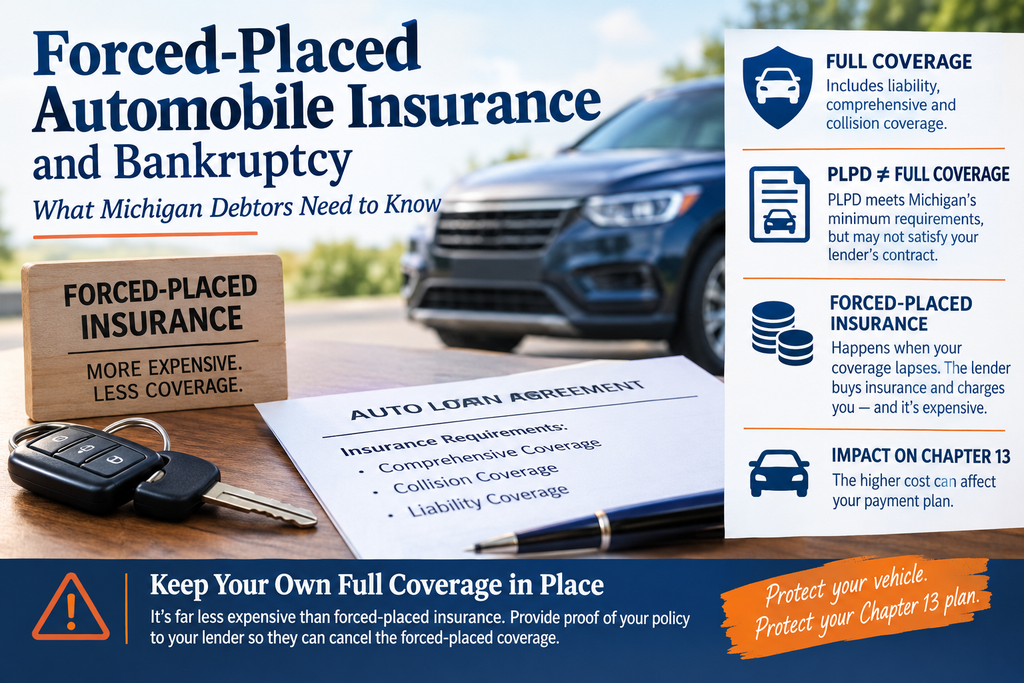
One issue that comes up surprisingly often in my bankruptcy practice is forced-placed automobile insurance. Many people do not realize that their automobile lender can purchase insurance on their vehicle if their own insurance coverage lapses.
This can become particularly important when you are in a Chapter 13 bankruptcy because the cost of forced-placed insurance can be substantially higher than the insurance you could purchase yourself. That additional expense can affect your Chapter 13 payment plan.
Table of Contents
- What Is Forced-Placed Automobile Insurance?
- Why Does the Lender Require Full Coverage?
- Michigan No-Fault Insurance and “Full Coverage” Are Not the Same Thing
- Why Do Lenders Know When Your Insurance Lapses?
- Why Is Forced-Placed Insurance So Expensive?
- Forced-Placed Insurance and Chapter 13 Bankruptcy
- A Common Mistake I See
- What Should You Do If the Lender Has Already Purchased Forced-Placed Insurance?
- If You Are Filing Chapter 13, Deal With It Immediately
What Is Forced-Placed Automobile Insurance?
When you finance or lease an automobile, the lender has a financial interest in that vehicle. The vehicle is the lender’s collateral. Your loan or lease agreement almost always requires you to maintain automobile insurance that protects that collateral.
Typically, the contract requires you to maintain comprehensive and collision coverage on the vehicle for as long as you owe money to the lender.
If you allow your insurance to lapse, the finance company may receive notice that the required coverage is no longer in place. The lender can then purchase insurance on the vehicle and charge the cost to you.
This is commonly called forced-placed insurance, force-placed insurance, or lender-placed insurance.
The purpose is not to provide you with the same insurance coverage you would ordinarily purchase for yourself. The primary purpose is to protect the lender’s interest in its collateral.
Why Does the Lender Require Full Coverage?
Suppose you purchase a vehicle for $35,000 and finance the purchase. The lender has loaned you money based upon the vehicle being available as collateral.
If the vehicle is destroyed in an accident and you have no collision insurance, the lender could be left with a $35,000 loan secured by a vehicle that is worth little or nothing.
The same problem exists if the vehicle is stolen or damaged by fire, hail, falling objects, or another covered event.
That is why your automobile finance contract generally requires you to maintain insurance protecting the vehicle.
The contract will usually require that the lender be listed as the loss payee or otherwise have its interest protected under the insurance policy.
Michigan No-Fault Insurance and “Full Coverage” Are Not the Same Thing
This is where I see a lot of confusion.
Michigan automobile insurance requirements can be complicated, and many people use the phrase “full coverage” without really knowing what it means.
Michigan requires automobile owners to carry certain no-fault insurance coverage. Liability coverage is also required.
Some people refer to a basic automobile policy as PLPD, meaning:
- Personal Liability coverage; and
- Property Damage coverage.
PLPD and no-fault coverage protect you against certain liabilities and provide required benefits, but they do not necessarily protect the vehicle itself.
That is the important distinction when you have an automobile loan.
What Is Comprehensive Coverage?
Comprehensive coverage generally protects your vehicle against damage or loss from things other than a collision.
Depending upon the policy, this can include such things as:
- Theft
- Fire
- Hail
- Falling objects
- Vandalism
- Certain weather-related damage
- Other specified non-collision losses
What Is Collision Coverage?
Collision coverage generally pays for covered damage to your vehicle resulting from a collision, subject to your deductible.
For example, if you are involved in an accident and your vehicle is damaged, collision coverage is the portion of your automobile policy that generally protects the vehicle itself.
What Does “Full Coverage” Mean?
“Full coverage” is not a precise insurance term with one universal definition. In ordinary conversation, however, people generally use it to describe an automobile policy that includes the required liability/no-fault coverages plus comprehensive and collision coverage.
That distinction is extremely important if you have a car loan.
You may have a perfectly valid Michigan automobile insurance policy with PLPD and no lapse in your required insurance, but your lender may still consider you uninsured for purposes of the collateral coverage required under your loan contract if you do not have comprehensive and collision coverage.
Why Do Lenders Know When Your Insurance Lapses?
Automobile finance companies generally require you to provide proof of insurance when you purchase the vehicle.
The lender also commonly receives electronic information from insurance companies regarding the status of the policy.
Consequently, the finance company may learn relatively quickly that your insurance has been cancelled, has expired, or no longer provides the coverage required under the loan agreement.
If the lender does not receive proof that you have obtained replacement coverage, it may purchase insurance on the vehicle.
That is when the problem of forced-placed insurance begins.
Why Is Forced-Placed Insurance So Expensive?
The lender is not shopping for the cheapest insurance policy available to you.
The lender is purchasing coverage to protect its financial interest in the collateral after you have failed to maintain the insurance required by your contract.
The resulting premium can therefore be substantially more expensive than the insurance you could obtain yourself.
The lender will generally add the cost of the forced-placed insurance to your account.
You can end up owing considerably more each month simply because your own automobile insurance was allowed to lapse.
Forced-Placed Insurance and Chapter 13 Bankruptcy
This issue can become especially important when you file a Chapter 13 bankruptcy.
If you want to keep your vehicle, your Chapter 13 plan generally has to provide for the obligations associated with that vehicle, including amounts that must be paid to the automobile lender.
If the lender has obtained forced-placed insurance because you failed to maintain the required coverage, that additional expense can become part of the amount you have to deal with in your Chapter 13 case.
In practical terms, this can increase the amount of money necessary to keep the vehicle and can therefore affect your Chapter 13 plan payment.
This is one of those situations where a relatively simple problem — an insurance lapse — can turn into a much more expensive bankruptcy problem.
A Common Mistake I See
One of the most common misunderstandings I encounter is a client telling me:
“I have insurance on the car.”
That may be true.
But the more important question is:
Do you have the insurance coverage required by your automobile finance contract?
If you have only PLPD and the lender requires comprehensive and collision coverage, you may not have the coverage the lender requires even though you technically have an active automobile insurance policy.
That can result in the lender purchasing forced-placed insurance.
What Should You Do If the Lender Has Already Purchased Forced-Placed Insurance?
If you discover that your automobile lender has placed insurance on your vehicle, I recommend addressing the problem immediately.
First, contact your insurance agent and determine exactly what coverage you have.
If you do not have comprehensive and collision coverage, find out what it will cost to add that coverage.
In most situations, purchasing your own required full coverage is substantially less expensive than allowing the lender’s forced-placed insurance to continue.
Once you have obtained the appropriate coverage, make sure the automobile finance company receives proof of your insurance.
Do not assume that because you purchased the policy, the lender automatically knows about it.
Send the lender the insurance information and confirm that it has been received. You want the lender to recognize that you have restored the coverage required by your contract so that the forced-placed insurance can be cancelled.
You should also ask the lender what, if anything, remains owing for the period during which the forced-placed insurance was in effect.
If You Are Filing Chapter 13, Deal With It Immediately
If you are considering filing Chapter 13, or you have already filed, do not ignore an automobile insurance problem.
If your lender has placed expensive insurance on your vehicle, tell your bankruptcy attorney.
The attorney needs to know about the additional charges because they can affect the amount necessary to keep the vehicle and, depending upon the circumstances of your case, the Chapter 13 plan.
More importantly, you should obtain your own insurance as quickly as possible.
My Advice to Michigan Bankruptcy Clients
If you are financing a vehicle, do not let your automobile insurance lapse.
Make sure you understand the difference between the insurance you are required to carry under Michigan law and the insurance your automobile lender requires under your contract.
PLPD may satisfy certain Michigan insurance requirements, but that does not necessarily satisfy your lender’s requirement that you maintain comprehensive and collision coverage on the financed vehicle.
If you receive a notice that your insurance has lapsed, act immediately.
Purchase the required coverage yourself, provide proof of insurance to the automobile finance company, and confirm that the lender has cancelled the forced-placed coverage.
It is almost always better to pay for your own automobile insurance than to allow the lender to purchase expensive forced-placed insurance and add that cost to your automobile loan.
For someone in a Chapter 13 bankruptcy, this is particularly important. An insurance problem that might otherwise be relatively easy to fix can become another expense that has to be dealt with through your bankruptcy plan.
If you are considering bankruptcy in Michigan and have questions about your vehicle, automobile insurance, or a Chapter 13 payment plan, I recommend discussing the situation with an experienced bankruptcy attorney before making any decisions about your vehicle or your insurance coverage.