Financing a Vehicle While You Are in a Chapter 13 Bankruptcy in Michigan

Published
One of the questions I frequently receive from people who are already in a Chapter 13 bankruptcy is:
“Can I buy a car while I am in Chapter 13?”
The answer is generally yes, but you cannot simply walk into a dealership, sign a financing agreement, and drive away without dealing with the bankruptcy court.
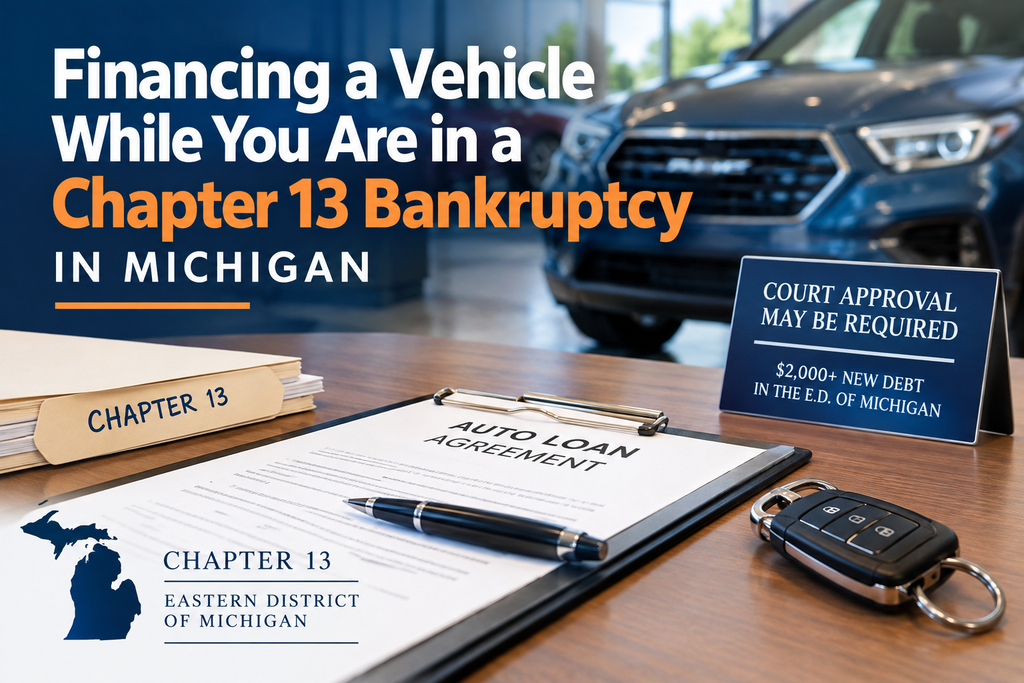
In the Eastern District of Michigan, our local Chapter 13 practice generally requires a debtor to obtain a court order before incurring new debt in excess of $2,000. A vehicle purchase will ordinarily fall within that requirement.
This does not mean that buying a car during Chapter 13 is impossible. It simply means that the purchase needs to be handled properly.
Table of Contents
- Why Do I Need Court Approval to Buy a Car?
- Start the Process Before You Buy the Vehicle
- What Information Will the Chapter 13 Trustee Want?
- Information About the New Vehicle
- You Will Need Current Income Documentation
- Can I Pick Whatever Car I Want?
- Don’t Sign First and Ask Permission Later
- Our Chapter 13 Vehicle Worksheet
- Plan Ahead
Why Do I Need Court Approval to Buy a Car?
When you filed Chapter 13, you submitted a budget showing your income, expenses and proposed Chapter 13 plan payment. The bankruptcy court and Chapter 13 trustee need to make sure that taking on a new automobile loan will not interfere with your ability to make your Chapter 13 payments.
The trustee will therefore want to know why you need another vehicle, what vehicle you want to purchase, how much it will cost, what the financing terms are, and whether you can afford the new payment.
This is especially important when the proposed vehicle payment is higher than the payment you currently have.
The fact that a car dealer says you qualify for a loan does not necessarily mean that the bankruptcy court will approve it.
Start the Process Before You Buy the Vehicle
This is one of the most important things for a Chapter 13 debtor to understand.
Do not wait until you are sitting in the dealership’s finance office to tell your bankruptcy attorney that you need a vehicle.
The approval process can take time.
In many cases, the Chapter 13 trustee will stipulate to the debtor incurring the new debt. When the trustee agrees, obtaining the necessary order can be relatively straightforward.
But that is not always the case.
Sometimes the trustee will require additional information or will not agree to the proposed financing. If a stipulation cannot be obtained, a motion may have to be filed with the bankruptcy court.
Once a motion is required, notice must be provided to the Chapter 13 trustee and the creditors, and a period of time must pass to allow interested parties an opportunity to object. Depending upon the circumstances, this can take considerably longer than a simple trustee stipulation.
That is why I tell my Chapter 13 clients to contact my office before they start shopping seriously for a vehicle.
What Information Will the Chapter 13 Trustee Want?
The trustee will generally want enough information to determine whether the proposed vehicle purchase is reasonable and whether the debtor can afford the new obligation.
Our office uses a Chapter 13 Vehicle Worksheet to gather this information.
The worksheet begins by asking about the debtor’s current automobile. We want to know the make, model and year, whether the vehicle is leased or financed, the current interest rate, the monthly payment and whether that payment is being made directly to the creditor or through the Chapter 13 plan.
The worksheet then asks an important question:
Why do you need another vehicle?
There are a number of possible reasons, including an expired lease, a vehicle that no longer runs, an accident, a repossession, or the need for a second vehicle. If the debtor was involved in an accident, the worksheet also asks whether the vehicle had full-coverage insurance.
That information matters. There is a significant difference between someone who needs a replacement vehicle because their existing vehicle was totaled and someone who simply wants to trade an older vehicle for a newer and more expensive one.
Information About the New Vehicle
The trustee and court will also want specific information about the proposed vehicle.
Our worksheet asks for:
- Make, model and year
- Whether it is a purchase or lease
- Total purchase price
- Length of the loan or lease
- Interest rate
- Down payment
- Source of the down payment
- Name of the automobile dealer
- Finance company
- Whether the payments will be made directly to the creditor or through the Chapter 13 plan
These are not minor details. They are the basic terms necessary for the trustee and court to evaluate the proposed new debt.
What if the New Payment Is Higher?
This is one of the questions that can become particularly important.
If the new automobile payment is going to be higher than your existing payment, you should be prepared to explain how you will afford the increase.
Our worksheet specifically asks the debtor to explain how the increased payment will be paid if the new monthly payment exceeds the old one.
For example, perhaps your income has increased since your Chapter 13 was filed. Perhaps another monthly expense has disappeared. Or perhaps you have a legitimate reason why the proposed vehicle expense is necessary.
The trustee will want to see that the numbers make sense.
You Will Need Current Income Documentation
It is not enough simply to tell your attorney what you think you can afford.
Our worksheet requires a current paystub for each individual in the Chapter 13 case, along with the proposed loan or lease documentation.
The proposed purchase or lease agreement—or even a good-faith estimate from the dealer—is useful.
But the documentation needs to contain the important financial terms, including:
- Length of the loan or lease
- Total purchase or lease price
- Interest rate
- Down payment
- Monthly payment
- Name of the lender or finance company
Do not send us a piece of paper from the dealership that does not contain these numbers and expect us to be able to process the request.
The more complete the information is at the beginning, the easier it is to determine whether the proposed financing can be approved.
Can I Pick Whatever Car I Want?
Not necessarily.
Just because a debtor can obtain financing does not mean that the bankruptcy court will automatically approve the transaction.
The issue is not simply whether the debtor can qualify for the loan. The trustee and court also have to consider the debtor’s Chapter 13 budget and ability to continue making the required plan payments.
This is one reason I recommend being realistic when selecting a vehicle.
If you are in Chapter 13 because you have been struggling financially, buying a substantially more expensive vehicle with a large monthly payment may create a problem that you did not have before.
On the other hand, sometimes a more expensive payment is entirely reasonable because the existing vehicle has become unreliable or unsafe, or because circumstances have changed since the Chapter 13 case was filed.
The important thing is to document the situation and provide the trustee with the information needed to evaluate it.
Don’t Sign First and Ask Permission Later
I have seen debtors get themselves into trouble by finding a vehicle they like, signing the financing documents, and only afterward informing their bankruptcy attorney.
That is backwards.
If you are in Chapter 13 and need a vehicle, call your bankruptcy attorney before you sign the purchase agreement or financing documents.
Your attorney can tell you what information is needed and can help determine the best way to proceed.
In many cases, the trustee will agree to the proposed financing and the necessary order can be obtained without significant difficulty. But if a motion is necessary, you do not want to discover that after you have already committed yourself to buying a particular vehicle.
Our Chapter 13 Vehicle Worksheet
To make the process easier, my office has prepared a worksheet specifically for Chapter 13 debtors who need to purchase or lease a vehicle.
You can download the worksheet here:
The worksheet is designed to collect the information that we need to begin the process. It also explains the documentation that must accompany the request.
Please remember that every question needs to be answered. An incomplete worksheet can delay the process. The worksheet specifically states that if a question is not answered, the request cannot be processed.
Plan Ahead
A Chapter 13 bankruptcy does not mean that you are prohibited from buying a vehicle.
But buying a vehicle during Chapter 13 is different from buying one when you are not in bankruptcy.
You have to consider the bankruptcy court, the Chapter 13 trustee, your existing plan payment and your overall budget.
Most importantly, give yourself enough time.
If the trustee will stipulate to the new debt, the process can often be handled without a contested hearing. If a motion is necessary, however, notice has to be given and creditors must have an opportunity to object. That can take time.
So if your car is beginning to fail, your lease is coming to an end, or you know that you will need another vehicle, don’t wait until your current vehicle is sitting in the driveway with a dead engine to begin the process.
Contact my office first. We can review your situation, gather the necessary information, communicate with the Chapter 13 trustee and determine what needs to be done to obtain approval for the new vehicle debt.
Law Offices of Walter Metzen
30448 Woodward Avenue
Royal Oak, Michigan 48073
Phone: (313) 962-4656
Email: detroitbankruptcylawyer@gmail.com
I have represented people in Chapter 13 bankruptcy cases throughout the Eastern District of Michigan for more than 30 years. If you are considering purchasing a vehicle while you are in Chapter 13, I would be happy to discuss the process with you before you go to the dealership.