When a Judgment Creditor Intercepts Your Tax Refund After You File Bankruptcy

Published
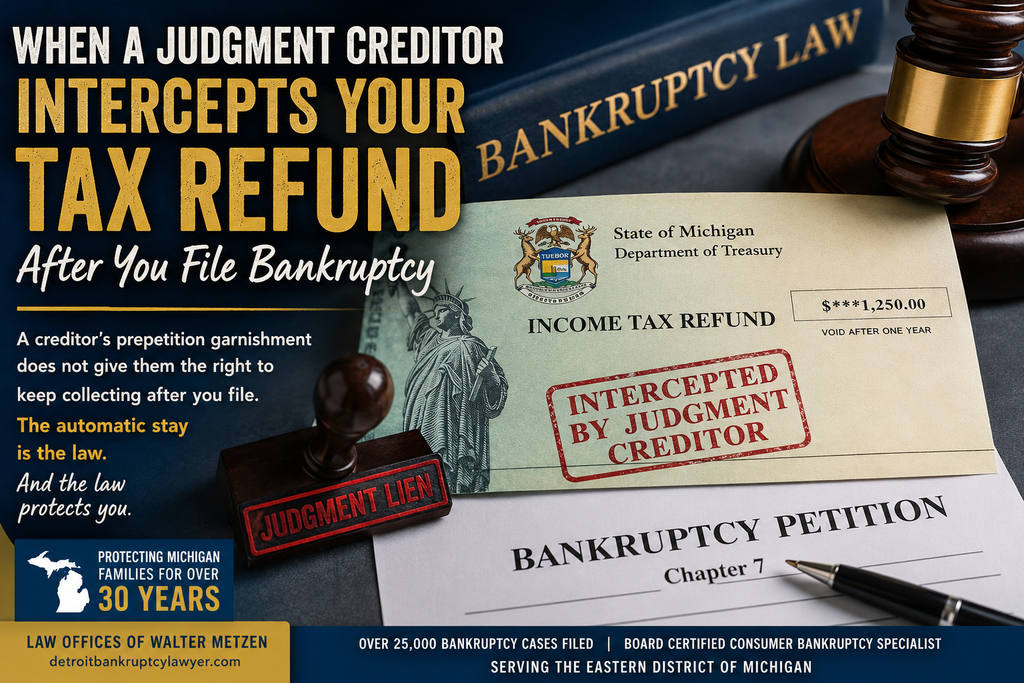
One of the things that occasionally surprises my bankruptcy clients is that filing bankruptcy does not always mean that every problem involving a creditor immediately disappears.
Sometimes the problem is a creditor who already obtained a judgment before the bankruptcy was filed.
And sometimes that creditor has gone one step further and obtained a garnishment of the debtor’s Michigan income tax refund.
Then the client files bankruptcy.
The bankruptcy case is underway.
And the Michigan Department of Treasury sends the tax refund to the judgment creditor anyway.
What happens then?
This is an important issue because the fact that a creditor had a judgment or even a perfected garnishment lien before the bankruptcy does not necessarily give that creditor the right to continue collecting money after the bankruptcy filing.
Table of Contents
The automatic stay goes into effect when bankruptcy is filed
When a bankruptcy petition is filed, the automatic stay generally takes effect immediately.
The automatic stay is one of the most powerful protections provided by the Bankruptcy Code. Among other things, it prohibits the continuation of collection proceedings against a debtor and prohibits the enforcement of a judgment obtained before the bankruptcy case was filed.
That means a creditor who was pursuing collection before bankruptcy cannot simply continue doing the same thing after the bankruptcy petition is filed.
This includes certain garnishments.
Michigan law permits a judgment creditor to garnish a state income tax refund. Once the appropriate garnishment is served on the State, the Michigan Department of Treasury can be required to intercept the debtor’s refund and send the money through the garnishment process.
The problem arises when the debtor files bankruptcy after the garnishment has been initiated but before the tax refund has actually been paid to the creditor.
“But I had the garnishment before the bankruptcy!”
This is the argument I sometimes hear from creditors.
The creditor will say:
“We obtained the judgment before bankruptcy.”
Or:
“The tax garnishment was already in place before the bankruptcy was filed.”
Or:
“We had a perfected lien before the debtor filed bankruptcy.”
Those facts may be important in determining the creditor’s rights to the money under bankruptcy law.
But they do not necessarily answer the separate question of whether the creditor violated the automatic stay.
That distinction is extremely important.
In a 2014 decision from the United States Bankruptcy Court for the Eastern District of Michigan, In re Tabatha Manuel, Judge Mark Randon dealt with essentially this situation.
The creditor had obtained a judgment against the debtor and served a garnishment on the Michigan Department of Treasury before the debtor filed Chapter 7 bankruptcy. The debtor subsequently notified the creditor about the bankruptcy and specifically asked that the tax garnishment be released.
The creditor refused.
The State later sent $664 to the creditor pursuant to the garnishment.
The creditor refused to return the money.
The debtor then asked the Bankruptcy Court to find a violation of the automatic stay.
The creditor’s lien may have been perfected before bankruptcy
The Manuel court acknowledged an important point.
Under Michigan law, the creditor’s garnishment lien had been perfected before the bankruptcy filing because the writ had been served on the State.
But the court explained that the existence of that perfected lien did not resolve the automatic-stay question.
In other words, having a valid lien before bankruptcy and having the right to continue collecting on that lien after bankruptcy are two different questions.
The court specifically noted that the timing of lien perfection may affect whether the garnished funds constitute property of the bankruptcy estate.
But the automatic stay is broader than simply protecting property of the bankruptcy estate. It also protects the debtor from continued collection activity on prepetition claims.
That is a distinction that judgment creditors sometimes overlook.
The creditor has an affirmative duty to stop the garnishment
Perhaps the most important part of the Manuel decision is what the court said about the creditor’s responsibility after receiving notice of the bankruptcy.
The creditor cannot simply sit back and say:
“The garnishment was already in place, so we didn’t do anything.”
The court rejected that reasoning.
The court explained that a Michigan non-periodic tax garnishment continues until the creditor receives the money owed or the garnishment is otherwise terminated or released.
Consequently, once the creditor learned about the bankruptcy, it had an affirmative obligation to take action to stop the garnishment.
That is a very important point.
Doing nothing can itself be a violation of the automatic stay.
A creditor cannot necessarily avoid responsibility simply by allowing a garnishment that was started before bankruptcy to continue operating after bankruptcy.
What if the creditor says it never “affirmatively” collected the money?
That argument did not work in Manuel.
The Bankruptcy Court held that the creditor violated the automatic stay by accepting the funds postpetition pursuant to the prepetition garnishment.
The creditor knew that the debtor had filed bankruptcy. It knew about the automatic stay. It nevertheless failed to release the garnishment and accepted the money when it was subsequently received from the State.
The court characterized the violation as willful.
And this is another misconception about “willful” violations of the automatic stay.
A creditor does not necessarily have to intend to violate the Bankruptcy Code.
The court explained that once a creditor has knowledge of the bankruptcy, deliberately engaging in conduct that violates the stay can constitute a willful violation. A specific intent to break the law is not required.
What can the debtor do?
If you have filed bankruptcy in the Eastern District of Michigan and discover that a judgment creditor has intercepted your Michigan income tax refund, do not assume that the creditor is automatically entitled to keep the money.
The first thing I would want to determine is:
- When was the judgment entered?
- When was the tax garnishment issued?
- When was the garnishment served on the Michigan Department of Treasury?
- When was the bankruptcy petition filed?
- When did the creditor receive notice of the bankruptcy?
- When did the State actually intercept the refund?
- When did the creditor receive the money?
- Was the garnishment released after the bankruptcy was filed?
- Was the underlying debt ultimately discharged?
- Was the creditor authorized by the Bankruptcy Court to continue collection?
Those dates can make a significant difference.
The creditor may have to return the money
In Manuel, the Bankruptcy Court ordered the creditor to pay the debtor the $664 that had been received through the postpetition tax garnishment.
The court also awarded $500 in punitive damages because it found that the creditor had acted with reckless disregard of the debtor’s rights under the Bankruptcy Code.
The Bankruptcy Code can also provide for recovery of actual damages, including attorney fees, when an individual is injured by a willful violation of the automatic stay, and punitive damages may be appropriate in the proper circumstances.
Of course, every case is different. The existence of a prepetition lien, the nature of the debt, the timing of the garnishment, whether the debt is dischargeable, and other circumstances can all affect the analysis.
Don’t ignore an intercepted tax refund
I have seen over the years how important a tax refund can be to a family that is struggling financially.
For some families, a tax refund is the money they were counting on to catch up on the mortgage, pay an overdue utility bill, repair a vehicle, or simply get through the next few months.
That is why an intercepted tax refund can be especially frustrating after someone has taken the significant step of filing bankruptcy.
If you filed bankruptcy in the Eastern District of Michigan and a judgment creditor intercepted your Michigan income tax refund after your bankruptcy was filed, I would not simply assume that the creditor was entitled to keep it because there was a judgment or garnishment that existed before the bankruptcy.
The dates matter.
The paperwork matters.
And the distinction between a creditor’s prepetition lien rights and its postpetition conduct under the automatic stay matters.
The Manuel decision demonstrates that a creditor may have had a valid prepetition garnishment and still violate the automatic stay by failing to release that garnishment and accepting the debtor’s tax refund after the bankruptcy was filed.
If this has happened to you, bring the garnishment paperwork, your bankruptcy petition, your tax refund information, and any correspondence from the creditor to your bankruptcy attorney.
This is not something I would recommend simply ignoring.
A bankruptcy filing is supposed to provide a debtor with a breathing spell from collection activity. When a creditor continues collecting after the bankruptcy case has begun, the Bankruptcy Code provides remedies that may be available to the debtor.