How Junk Fees and “Drip Pricing” Are Draining Family Income

Published
In my last article, I discussed the many ways in which ordinary families are seeing their income drained away before they ever have an opportunity to save money or get ahead financially.
There is another part of this problem that deserves attention: junk fees, convenience fees, service charges, processing fees, facility fees, wellness fees, automatic gratuities and credit-card surcharges.
Individually, many of these charges may appear insignificant.
A $2.50 convenience fee doesn’t seem like something that would cause a family financial problems.
Neither does a $5 service charge.
Neither does a 3% credit-card surcharge.
Neither does an automatic gratuity added to a restaurant bill.
But add them together.
And then add them to every other increase in the cost of living.
That is when the problem becomes much more serious.
Table of Contents
- What Is “Drip Pricing”?
- The Restaurant Bill Doesn’t Always End Where You Think It Does
- And Now There Is the Credit-Card Surcharge
- Three Percent Doesn’t Sound Like Much
- The Problem With Micro-Transactions
- Fees Have Become a Business Model
- What Does This Have to Do With Bankruptcy?
- The Real Damage Is the Loss of Disposable Income
- The Family Budget Has a Breaking Point
- Pay Attention to the Final Price
- Bankruptcy Is Often the Result of a Long Financial Decline
What Is “Drip Pricing”?
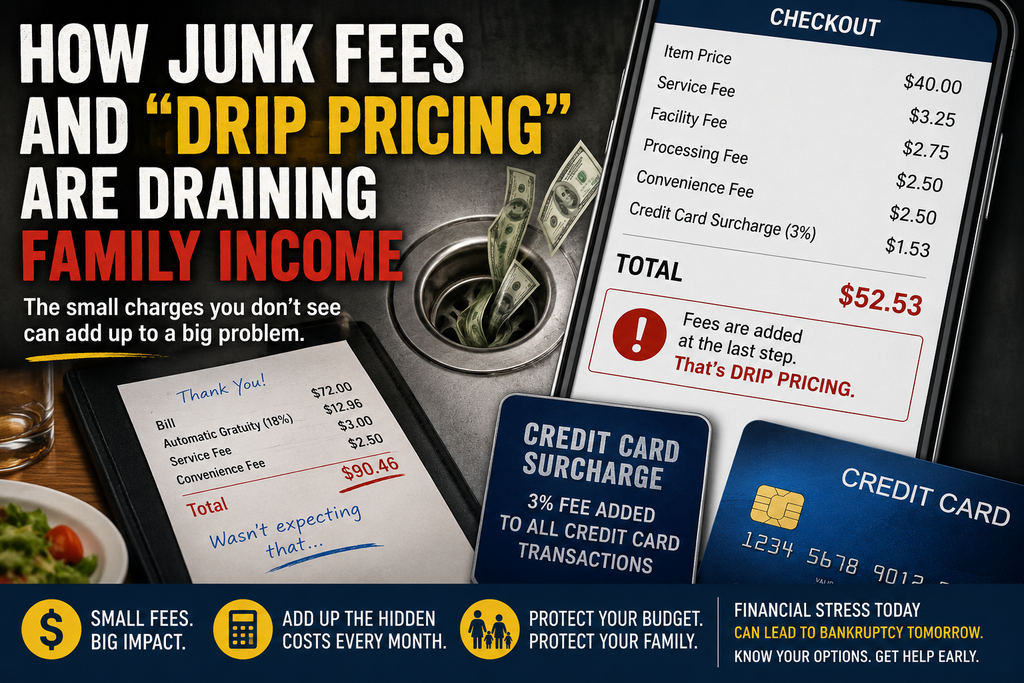
“Drip pricing” is a term used to describe a pricing practice in which a consumer sees one price at the beginning of a transaction and additional mandatory charges are revealed later.
You might see a $40 ticket.
Then a service fee.
Then a facility fee.
Then a processing fee.
Then a convenience fee.
By the time you are ready to pay, that $40 purchase may have become $52 or $55.
The psychological effect is important.
The consumer made the decision to buy when the price appeared to be $40.
The additional charges are revealed later, when the consumer has already invested time in the transaction and may be reluctant to start over.
Technology makes this particularly easy.
Prices can be displayed one way in advertising and then additional charges can be added during the checkout process. In some industries, pricing can also be adjusted dynamically based upon demand, timing, inventory or other factors.
The Federal Trade Commission has specifically addressed deceptive “drip pricing” and junk-fee practices. Its rule concerning live-event tickets and short-term lodging took effect in May 2025 and requires covered businesses to disclose the total price more prominently and disclose required charges before the consumer is asked to pay. The FTC has also said that it will continue to pursue deceptive fee practices in other industries on a case-by-case basis.
But consumers encounter these fees far beyond hotels and concert tickets.
The Restaurant Bill Doesn’t Always End Where You Think It Does
I have noticed this personally when eating at restaurants and bars.
You sit down.
You look at the menu.
You order your food.
You look at the prices.
You may calculate approximately what the bill is going to be.
Then the check arrives.
And suddenly there is a service charge.
Or a convenience fee.
Or a credit-card processing charge.
Or an automatic gratuity.
Sometimes there is a percentage added to the bill that you were not expecting when you ordered the meal.
Some establishments clearly disclose these charges. Others make the disclosure much less noticeable.
And there is an important distinction between a restaurant honestly telling you at the beginning of the transaction that there will be a mandatory charge and a fee that only becomes apparent when you receive the check.
The problem is not simply the amount of the fee.
The problem is that consumers make purchasing decisions based upon the price they believe they are paying.
And Now There Is the Credit-Card Surcharge
Another change that many consumers have noticed is the growing number of businesses adding a fee for paying with a credit card.
For years, consumers became accustomed to using Visa and Mastercard without seeing a separate charge for using the card.
That changed.
Beginning in 2013, Visa and Mastercard rules were changed following litigation involving merchants. The change permitted merchants, subject to certain rules and disclosure requirements, to impose surcharges on credit-card transactions. Michigan specifically notes that merchants have been permitted to impose credit-card surcharges since 2013.
Why?
Because accepting a credit card costs the merchant money.
The merchant pays an interchange or processing cost associated with accepting the card. Rather than simply absorbing that expense as part of doing business, a merchant can, under applicable rules and law, pass some or all of that cost on to the customer.
In Michigan, there is currently no state law prohibiting or restricting credit-card surcharges. Michigan’s consumer-protection guidance notes that typical merchant processing costs generally range from approximately 1.5% to 3.5% of a transaction.
That is why you are increasingly seeing signs that say something like:
“3% fee for credit-card transactions.”
It is important, however, to understand that a merchant cannot simply charge whatever it wants and call it a credit-card surcharge. Visa and Mastercard have rules governing these charges, including disclosure requirements and limits. Mastercard’s current rules, for example, state that its maximum surcharge cap is 4%, while the actual surcharge may also be limited by the merchant’s cost of accepting the card.
For the average consumer, however, the practical experience is simple:
You thought you were paying $100. You end up paying $103.
And that happens over and over again.
Three Percent Doesn’t Sound Like Much
Let’s look at the mathematics.
Suppose a family spends $3,000 per month on purchases that are paid by credit card and are subject to a 3% surcharge.
Three percent of $3,000 is:
$90 per month.
That’s:
$1,080 per year.
And that is just the credit-card surcharge.
Now add $10 or $20 in miscellaneous service and convenience fees each month.
Add automatic gratuities.
Add delivery fees.
Add ticket fees.
Add facility fees.
Add subscription charges.
Add ATM fees.
Add overdraft or late fees.
Add the occasional “processing fee.”
Suddenly, the family isn’t dealing with one $1,000 expense.
They are dealing with dozens or hundreds of small expenses that collectively consume thousands of dollars of disposable income.
That is what I mean when I talk about the draining of family income.
The Problem With Micro-Transactions
There is something psychologically different about spending $5 at a time compared with spending $500.
Most people notice the $500.
They may not notice the $5.
But if you spend $5 ten times a week, that’s approximately $2,600 a year.
If you spend $10 ten times a week, that’s approximately $5,200 a year.
The individual transaction doesn’t look catastrophic.
The cumulative transaction can be.
And this is where I believe consumers need to pay attention to what I would call micro-draining of household income.
It isn’t necessarily one company taking a large amount of money from you.
It can be many companies taking a small amount.
Everywhere you turn.
Fees Have Become a Business Model
There is nothing inherently wrong with a business charging a fee.
Businesses have expenses.
Restaurants have employees.
Credit-card companies charge merchants.
Concert venues have operating costs.
Hotels have housekeeping expenses.
Businesses are entitled to make a profit.
The problem occurs when the advertised price and the actual price become two different things.
If something costs $55, tell me it costs $55.
Don’t tell me it costs $45 and wait until I’m ready to enter my credit-card number before telling me it is actually $55.
The FTC has recognized this basic problem in its rules governing covered ticket and lodging transactions: mandatory charges generally must be incorporated into the displayed total price, with limited exceptions, and excluded charges must be disclosed before payment.
I think consumers understand this intuitively.
People don’t necessarily object to paying a reasonable price.
They object to being told one price and discovering another price at the checkout screen.
What Does This Have to Do With Bankruptcy?
This is where my interest in the subject becomes different from that of a consumer advocate.
I am a bankruptcy attorney.
For more than three decades, I have sat across the desk from people who have reached the point where their income simply doesn’t cover their obligations.
Usually, bankruptcy is not caused by one $5 fee.
It is caused by the accumulation of financial pressures.
The mortgage or rent goes up.
The car payment goes up.
Insurance goes up.
Groceries cost more.
Utilities cost more.
Credit-card interest continues to accumulate.
The family uses credit cards to make up the difference.
And then there are the hundreds of small expenses that seem insignificant at the time.
Eventually, there is no longer enough money left at the end of the month.
The family starts putting groceries on a credit card.
Then gasoline.
Then a utility bill.
Then a car repair.
Then a medical bill.
The credit-card balances increase.
The minimum payments increase.
And now the family is paying interest on yesterday’s expenses while trying to pay for today’s expenses.
That is the beginning of a very dangerous financial cycle.
The Real Damage Is the Loss of Disposable Income
When I meet with someone considering bankruptcy, I don’t just look at the size of their credit-card balances.
I want to know why the balances became so large.
Was there a divorce?
A job loss?
A medical problem?
A failed business?
A foreclosure?
A vehicle repossession?
Or did the family simply reach the point where its monthly income wasn’t enough to pay its monthly expenses?
Sometimes the answer is a combination of all of these.
And when I prepare a bankruptcy budget, I often see something very important:
There isn’t much left.
The family may have a decent household income.
But after housing, transportation, food, insurance, utilities, taxes, child-related expenses and debt payments, there isn’t enough money left to deal with life’s inevitable surprises.
The small fees matter because they further reduce that already limited margin.
The Family Budget Has a Breaking Point
Consider a household that has only $300 of disposable income each month after paying its basic expenses.
That’s $3,600 a year.
Now imagine that the household is gradually losing $100, $150 or even $200 per month to expenses that weren’t obvious when the family initially made its budget.
The family doesn’t necessarily recognize the problem as one big financial event.
Instead, the checking account is simply empty sooner than it should be.
The credit card gets used more often.
The balance increases.
Eventually the minimum payment becomes another monthly expense.
And now the family has even less disposable income.
This creates a vicious cycle.
Less disposable income leads to more credit-card use. More credit-card use leads to higher balances. Higher balances lead to larger minimum payments. Larger minimum payments leave even less disposable income.
That is how people can eventually find themselves considering bankruptcy.
Pay Attention to the Final Price
My advice to consumers is simple.
Look at the final price.
Not the advertised price.
Not the price on the menu.
Not the price on the website.
Not the price before you click “checkout.”
Look at what actually comes out of your bank account or gets charged to your credit card.
If you regularly pay a 3% credit-card surcharge, calculate what that costs you over a year.
If your restaurant routinely adds a service charge, look at what that costs you over a year.
If you pay convenience fees for tickets, online payments, delivery or other services, add them up.
You may be surprised.
And if you are already using credit cards to pay for ordinary household expenses because your paycheck doesn’t stretch far enough, don’t ignore that warning sign.
Bankruptcy Is Often the Result of a Long Financial Decline
One of the misconceptions I frequently encounter is that people who file bankruptcy must have made one enormous financial mistake.
That simply isn’t true.
Sometimes bankruptcy is the result of years of financial erosion.
One fee doesn’t cause bankruptcy.
One restaurant bill doesn’t cause bankruptcy.
One 3% surcharge doesn’t cause bankruptcy.
But when every purchase costs a little more than expected, every recurring bill increases, and the family repeatedly uses credit to make up the difference, the financial pressure eventually becomes overwhelming.
That is why I believe the discussion about junk fees and drip pricing is also a discussion about bankruptcy.
Every dollar that leaves a family’s budget is a dollar that cannot be used to pay the mortgage, make the car payment, buy groceries, save for an emergency or pay down debt.
The individual charges may be small.
The cumulative effect isn’t.
And when a family’s income is already stretched to the breaking point, sometimes it is the accumulation of these seemingly insignificant expenses that helps push the household from simply struggling financially to needing a fresh start through bankruptcy.
If you find yourself using one credit card to pay another, relying on credit cards for groceries and gasoline, or watching your balances increase every month despite making your payments, don’t wait until the situation becomes a crisis.
The time to understand your options is before you lose control of the situation.