The Silent Sucking of Money: How Subscriptions Are Draining Your Bank Account

Published
When I talk with people about bankruptcy, we usually talk about the big expenses.
The mortgage.
The car payment.
Credit cards.
Medical bills.
Taxes.
Student loans.
But there is another problem I see more and more today that is much less obvious.
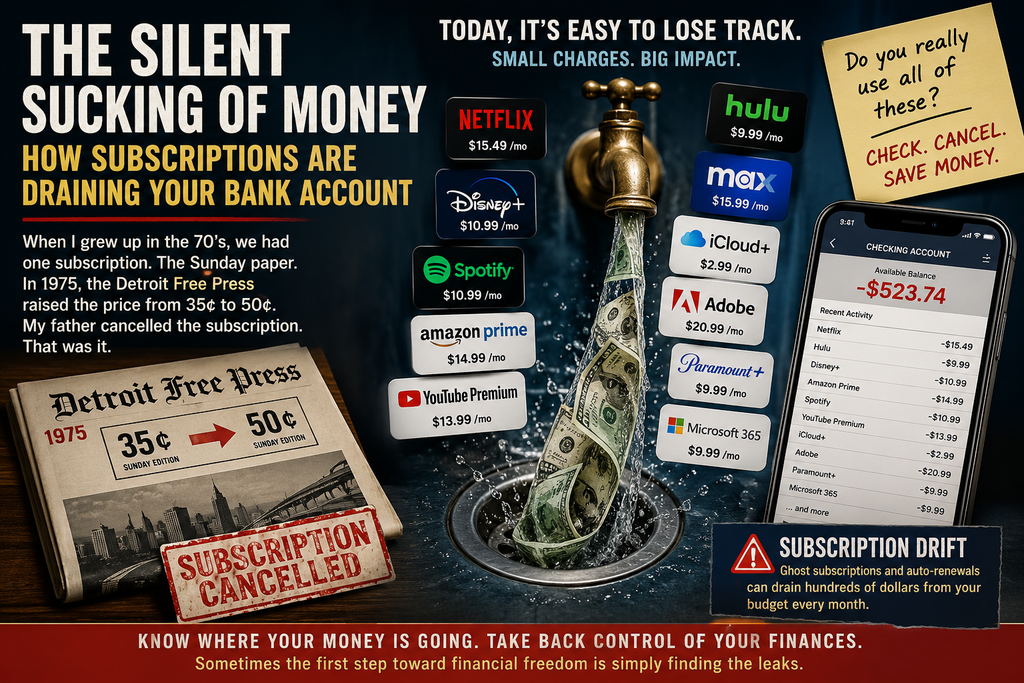
Money is quietly leaving people’s bank accounts every month through subscriptions.
And many people don’t even realize how much they are spending.
I call it the silent sucking of money.
It doesn’t happen with one giant purchase. Instead, $7.99 comes out of the checking account here. $14.99 comes out there. Another $9.99 comes out next week. Then there is $19.99 for something else.
Individually, none of these charges seems particularly significant.
Add them all together, however, and they can represent hundreds of dollars every month.
Table of Contents
- When I Grew Up, Subscriptions Were Rare
- Welcome to the Subscription Economy
- The Problem Isn’t Always the Amount — It’s the Number of Charges
- Subscription Drift
- The “Ghost” Subscription
- Auto-Renewal Makes It Easy to Forget
- Subscriptions Can Become a Bankruptcy Problem
- Take a Subscription Inventory
- The Subscription Trap Is Especially Dangerous for People Living Paycheck to Paycheck
- The World Has Changed Since the 1970s
- What I Tell My Bankruptcy Clients
- Sometimes the Problem Is Bigger Than Subscriptions
- The Bottom Line
When I Grew Up, Subscriptions Were Rare
I grew up in the 1970s.
Things were very different then.
My family didn’t have subscriptions to dozens of different services. In fact, as I recall, we had one subscription to anything.
The Sunday newspaper.
And even that subscription didn’t last forever.
In 1975, the Detroit Free Press raised the price of its Sunday edition from 35 cents to 50 cents because of rising newsprint and operating costs.
My father cancelled the subscription.
That was it.
Our one and only subscription was gone.
Television was free. You put an antenna on the roof or on the television and watched the available channels.
There was no Netflix.
No Hulu.
No Disney+.
No Amazon Prime.
No Spotify.
No YouTube Premium.
No cloud-storage subscription.
No monthly subscription for an app that helps you edit photographs.
No subscription to a fitness app.
No monthly fee for the privilege of having software on your computer.
And certainly no situation where you could sign up for a “free trial,” forget about it, and discover months later that you’ve been paying $12.99 every month.
The concept of a subscription was relatively simple.
Today, it is everywhere.
Welcome to the Subscription Economy
Almost everything can be turned into a recurring monthly charge.
Entertainment is probably the most obvious example.
A typical household might have:
- Netflix
- Hulu
- Disney+
- Max
- Peacock
- Paramount+
- Amazon Prime
- Spotify
- YouTube Premium
- SiriusXM
And that’s just entertainment.
Then there are subscriptions for:
- Cloud storage
- Cellphone services
- Internet security
- Password managers
- Computer software
- Photo editing
- Microsoft 365
- Adobe products
- Fitness programs
- Meal delivery
- Grocery delivery
- Pet products
- Shaving products
- Clothing
- Coffee
- Vitamins and supplements
- Online newspapers and magazines
- Dating services
- Gaming
- Smart-home services
- Automobile features
- Home-security systems
And increasingly, even products that we used to buy once are becoming things we rent through subscriptions.
That’s an important change.
The Problem Isn’t Always the Amount — It’s the Number of Charges
Let’s say you have 12 subscriptions averaging $15 per month.
That’s $180 every month.
Over a year, that’s $2,160.
Now imagine a household with 20 subscriptions averaging $15 per month.
That’s $300 per month.
That’s $3,600 per year.
And $300 a month may not feel like $3,600 when the money is leaving the checking account in small pieces.
That’s the trick.
A $9.99 charge doesn’t get the same attention as a $300 bill.
But 20 charges of $9.99, $14.99, $19.99 and $24.99 can add up very quickly.
Subscription Drift
There is a name for what is happening.
I call it subscription drift.
You sign up for something because you want it.
Maybe it’s a streaming service because your favorite show is on it.
Maybe it’s a fitness app because you intend to exercise more.
Maybe it’s cloud storage because your computer tells you that you’re running out of space.
Maybe it’s a software program you need for a particular project.
Maybe you sign up for a free trial.
And then life happens.
You stop using it.
You forget about it.
The subscription continues.
A few months later, you have another subscription.
Then another.
Then another.
Before long, you’ve accumulated a collection of recurring charges that you don’t really think about anymore.
The “Ghost” Subscription
Perhaps the most troubling category is what I call the ghost subscription.
It’s a recurring charge that is still coming out of your account even though you have forgotten about the service.
You may not even recognize the company name on your bank statement.
Maybe you signed up two years ago.
Maybe the company changed its billing name.
Maybe you originally signed up through Apple or Google.
Maybe the subscription began as a free trial.
Maybe you haven’t used the service in a year.
But the charge keeps coming.
Month after month.
That’s a ghost.
And there can be more than one.
Auto-Renewal Makes It Easy to Forget
The subscription business model is built around convenience.
That’s part of what makes it so effective.
You don’t have to remember to pay every month.
The company already has your credit card or checking account information.
The money simply comes out automatically.
And that’s convenient — until you don’t want the service anymore.
The subscription doesn’t care whether you’re using it.
It doesn’t care whether you forgot about it.
It doesn’t care whether your financial situation has changed.
It simply renews.
Some companies also increase prices over time.
You may have started at $7.99 or even free for the first 6 months.
Then the price becomes $9.99.
Then $12.99.
You may receive an email notifying you of the increase, but if you’re busy and don’t pay attention, the subscription continues.
Subscriptions Can Become a Bankruptcy Problem
This is where the issue becomes particularly important.
When someone comes into my office considering bankruptcy, we’re trying to determine where their money is going.
We look at income.
We look at housing expenses.
We look at transportation.
We look at food.
We look at insurance.
We look at taxes.
We look at credit-card payments.
And we look at the monthly bank statements.
Sometimes the bank statements tell a story the person doesn’t realize they’re telling.
There are recurring charges everywhere.
And when you’re already struggling to make ends meet, $100, $200 or $300 a month can make a substantial difference.
Of course, eliminating subscriptions isn’t going to solve every bankruptcy problem.
If someone has $100,000 in credit-card debt and is unemployed, cancelling Netflix isn’t going to fix the problem.
But that’s not really the point.
The point is that small recurring expenses become significant when you have enough of them.
And when you’re struggling financially, you need to know where every dollar is going.
Take a Subscription Inventory
If you are having financial problems, I recommend doing something very simple.
Take the last three months of your bank and credit-card statements and look for every recurring charge.
Don’t rely on your memory.
Look at the statements.
Make a list.
Ask yourself:
Do I know what this charge is?
Do I still use this service?
Do I still need it?
How much am I paying every month?
When was the last time I actually used it?
You may be surprised by what you find.
You may discover subscriptions you forgot you had.
You may find services you thought you cancelled.
You may find duplicate services.
You may discover that your “cheap” subscriptions aren’t cheap when you add them all together.
The Subscription Trap Is Especially Dangerous for People Living Paycheck to Paycheck
If you have plenty of disposable income, paying $10 or $15 for something you rarely use may not matter much.
But if you’re already using your credit cards to buy groceries, paying one credit card with another, or falling behind on your mortgage or car payment, those recurring charges deserve attention.
The problem is that subscriptions can create the illusion that they’re harmless.
It’s only $8.99.
It’s only $12.99.
It’s only $19.99.
But when you have 15 or 20 “only” charges, you may be spending several thousand dollars a year.
That’s money that could be going toward your mortgage.
Your car.
Your groceries.
Your emergency savings.
Or paying down debt.
The World Has Changed Since the 1970s
I don’t want to suggest that everything was better in the 1970s.
It wasn’t.
There are many things today that are dramatically better.
We have incredible technology.
We have access to information that would have been unimaginable when I was growing up.
We can watch almost any movie or television program we want.
We can listen to virtually any song ever recorded.
We can store thousands of photographs in the cloud.
We can have groceries delivered to our front door.
All of that has value.
But there is a downside.
The modern economy has become extremely good at separating us from our money without requiring us to consciously make another purchase.
That’s the part that concerns me.
When my father decided that 50 cents was too much for the Sunday newspaper, he cancelled it.
Today, you might make that decision once and then have 20 different companies automatically withdrawing money from your account every month.
That’s a very different financial environment.
What I Tell My Bankruptcy Clients
One of the first things I tell people who are experiencing financial difficulty is this:
You need to know where your money is going.
Not approximately.
Exactly.
Look at your bank statements.
Look at your credit-card statements.
Look at your Apple and Google subscriptions.
Look at PayPal.
Look at Amazon.
Look at your email for renewal notices.
And then start cancelling the things you don’t need.
Don’t just look at the large expenses.
Look at the little ones.
Because the little ones are often the ones that hide in plain sight.
Sometimes the Problem Is Bigger Than Subscriptions
If you go through your expenses and discover that you’re spending $250 a month on subscriptions, cancelling those services may free up some money.
But if you’re still unable to pay your mortgage, car payment, credit cards, medical bills or other obligations, there may be a much larger financial problem.
That’s where an honest examination of your financial situation becomes important.
Bankruptcy isn’t right for everyone.
But neither is continuing to use credit cards to pay for ordinary living expenses when you can’t afford to do so.
If you’re constantly borrowing money to make it through the month, the problem isn’t necessarily that you need to find another credit card.
The problem may be that your debts have become larger than your ability to pay them.
The Bottom Line
When I was growing up, my family had one subscription.
The Sunday newspaper.
When the price went from 35 cents to 50 cents, my father cancelled it.
Today, we live in a world where virtually everything can become a subscription.
And because those payments are automatic, it’s easy to lose track of them.
That’s subscription drift.
And when those forgotten recurring charges continue month after month, they become ghost subscriptions — silently taking money from your checking account while you’re busy living your life.
So take a look.
Pull out those bank statements.
Find the recurring charges.
Add them up.
You may be surprised.
And if you’re already struggling financially, don’t underestimate the importance of stopping the silent sucking of money from your household budget.
Sometimes the first step toward getting control of your finances is simply finding out where your money is going.