Making Over $100,000 and Still Living Paycheck to Paycheck: Why More Middle-Class Families Are Turning to Bankruptcy

Published
For many years, when people thought about someone who might need to file bankruptcy, they pictured a person who was unemployed, had very little income, and simply could not pay the bills.
That is not the picture I am seeing in my bankruptcy practice today.
I am seeing something very different.
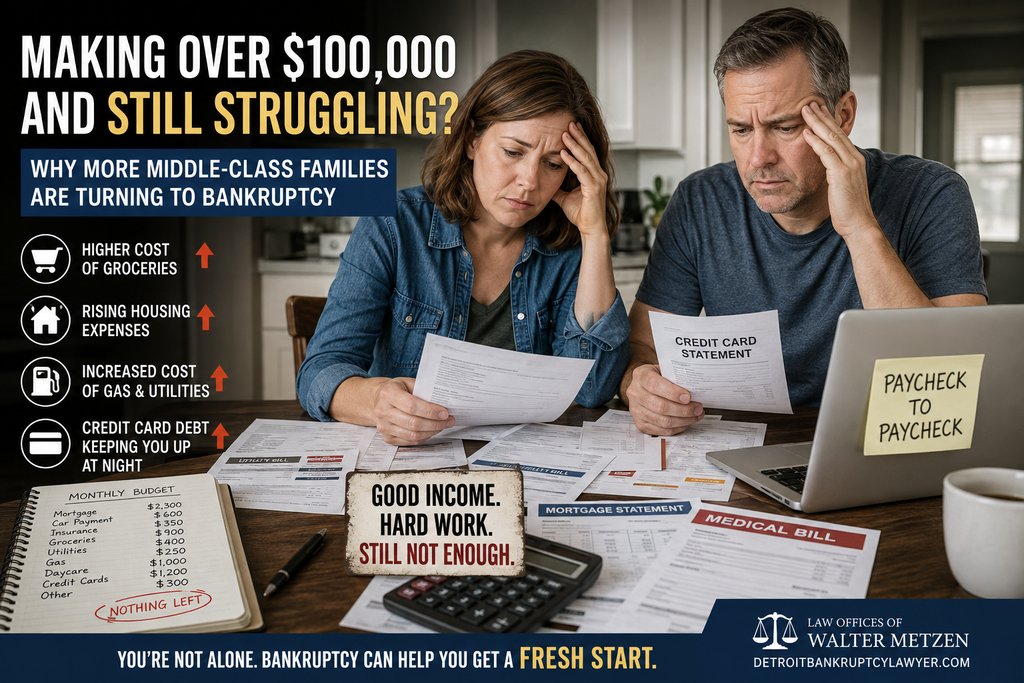
I am seeing two-income families earning well over $100,000 a year who are struggling to make ends meet.
I am seeing families where both husband and wife have good jobs. They have a house. They have two cars. They have health insurance. They have children. They go to work every day.
And yet, they are living paycheck to paycheck.
When an unexpected expense comes along, there is no money available to pay it.
The family puts the expense on a credit card.
Then another expense comes along.
Another credit card is used.
Eventually, the credit cards become maxed out, the interest charges become overwhelming, and the family finds itself in a situation that it never imagined possible.
Table of Contents
- Six Figures Doesn’t Go as Far as It Used To
- The Problem Is Not Necessarily That People Earn Too Little
- Inflation Doesn’t Have to Be 10% to Hurt
- Groceries Are a Good Example
- Credit Cards Can Hide the Problem—For a While
- Bankruptcy Filings Are Rising Again
- I Am Seeing More Families Who “Look Fine” on Paper
- The Middle Class Is Not Immune From Financial Distress
- The Bankruptcy Means Test Doesn’t Simply Say “You Make Too Much”
- Sometimes the Biggest Problem Is the Debt, Not the Income
- Don’t Wait Until the Last Dollar Is Gone
- A Bankruptcy Consultation Is Not a Commitment to File
Six Figures Doesn’t Go as Far as It Used To
One of the biggest changes I have seen is the changing meaning of a “good income.”
A household earning $100,000 or $125,000 a year may sound financially comfortable.
But what matters is not simply the amount of money coming into the household.
What matters is how much is left after paying the bills.
Consider a married couple with two children earning a combined $120,000.
Their gross monthly income is approximately $10,000.
That sounds like a lot of money.
But that is gross income, not take-home pay.
After federal and state taxes, Social Security, Medicare, health insurance, retirement contributions and other payroll deductions, the amount actually available to spend can be substantially less.
Then the mortgage or rent has to be paid.
Then the car payments.
Then automobile insurance.
Then utilities.
Then groceries.
Then gasoline.
Then health-care expenses.
Then daycare or other expenses associated with raising children.
Then property taxes.
Then credit-card payments.
Then student loans.
Then home repairs.
Then everything else that comes with simply maintaining a household.
Suddenly, $10,000 a month doesn’t seem quite so large.
And if the family has accumulated $40,000, $50,000 or $75,000 in credit-card debt, the minimum payments alone can consume a substantial portion of the family’s monthly income.
The Problem Is Not Necessarily That People Earn Too Little
This is an important distinction.
Many of the people I see are not irresponsible people.
They are not people who have never worked.
They are not people who have never made a decent living.
In many cases, they are people who have done exactly what they were told they were supposed to do.
They went to work.
They bought a home.
They raised their children.
They purchased vehicles.
They tried to save money.
They tried to contribute to retirement.
They paid their bills.
But the cost of maintaining that lifestyle has increased dramatically.
The Federal Reserve’s most recent survey of household economic well-being found that price increases remained the most commonly reported financial concern, and it also found that many households were coping with financial difficulties by cutting expenses or paying bills late.
That is something I hear from clients all the time.
“We make good money. I don’t understand how we got into this situation.”
I understand how they got there.
The math has changed.
Inflation Doesn’t Have to Be 10% to Hurt
There is another misunderstanding about inflation.
People sometimes hear that inflation has fallen and assume that prices have gone back down.
They haven’t.
A reduction in the rate of inflation does not mean that the price of groceries, housing, insurance, gasoline or other necessities has returned to what it was several years ago.
It simply means that prices are increasing more slowly.
As of July 2026, the Consumer Price Index was still 3.4% higher than it was a year earlier. Food prices were still increasing, while other major household expenses continued to put pressure on family budgets.
The result is that families have experienced years of higher prices compounded on top of higher prices.
A family may have received raises during that period.
But if the cost of everything they buy has also increased, the raise may not translate into greater financial security.
Sometimes it simply allows the family to keep up.
Groceries Are a Good Example
Ask someone what has happened to their grocery bill over the last several years.
They know.
They see it every week.
You don’t need an economist to explain it.
The grocery receipt explains it.
Food prices are only one part of the problem. Housing, insurance, utilities, automobiles, repairs, medical expenses and other necessities all compete for the same limited household income.
And when there isn’t enough money left at the end of the month, families frequently turn to credit.
That is where the problem can become much worse.
Credit Cards Can Hide the Problem—For a While
Credit cards can make a family appear financially stable even when the household budget is already broken.
The mortgage gets paid.
The groceries get purchased.
The car gets repaired.
The children get what they need.
Everything appears to be under control.
But instead of paying for those expenses with income, the family is borrowing money to pay for them.
The credit-card balance goes from $10,000 to $20,000.
Then $20,000 becomes $30,000.
Eventually, the family may be making thousands of dollars a month in credit-card payments and still watching the balances barely decline.
At that point, the family isn’t really paying for today’s expenses anymore.
It is paying for yesterday’s expenses.
And that can become an impossible cycle.
Bankruptcy Filings Are Rising Again
The increase in bankruptcy filings is not just something I am seeing in my office.
The national numbers confirm that bankruptcy filings have been increasing.
According to the United States Courts, there were 608,511 bankruptcy filings during the 12-month period ending June 30, 2026, an increase of 12.2% from the 542,529 filings during the preceding year.
Non-business filings—primarily consumer bankruptcy cases—increased approximately 12%, from 519,486 to 581,570.
The number of Chapter 7 filings increased from 333,321 to 382,161 during that same period.
The trend continued into the summer. Epiq AACER reported 51,925 individual bankruptcy filings in July 2026, an 11% increase from July 2025. Individual Chapter 7 filings increased 12% year over year.
These numbers do not tell us that every person filing bankruptcy is middle class or upper middle class.
They don’t.
But they do demonstrate that consumer bankruptcy filings have been steadily increasing after reaching historic lows following the pandemic.
I Am Seeing More Families Who “Look Fine” on Paper
This is perhaps the most important point I want to make.
Income alone does not tell you whether someone is financially healthy.
I can sit across the desk from a husband and wife and see two people who appear to be doing very well financially.
They may have a combined income of $150,000.
They may own a $400,000 or $500,000 home.
They may drive relatively new vehicles.
They may have good jobs.
But if they owe $80,000 in unsecured debt and have only a few hundred dollars left over at the end of each month, their financial situation may be much more precarious than it appears.
One transmission failure.
One major medical bill.
One job interruption.
One significant home repair.
One divorce.
One reduction in overtime.
One unexpected expense.
And the entire budget can collapse.
The Middle Class Is Not Immune From Financial Distress
There is a tendency to believe that bankruptcy is something that happens to “other people.”
People with lower incomes.
People who made bad decisions.
People who don’t work.
People who live beyond their means.
Sometimes those things are factors.
But they are certainly not the whole story.
Bankruptcy is a legal remedy available to people who have become unable to deal with their debts.
And people can become financially distressed for many different reasons.
Sometimes it is medical debt.
Sometimes it is divorce.
Sometimes it is a failed business.
Sometimes it is a job loss.
Sometimes it is a foreclosure.
Sometimes it is excessive credit-card debt.
And increasingly, I am seeing families whose fundamental problem is simply that their expenses have grown faster than their ability to pay them.
The Bankruptcy Means Test Doesn’t Simply Say “You Make Too Much”
I also hear this concern frequently:
“We make too much money to file bankruptcy.”
That is not necessarily true.
Bankruptcy eligibility is more complicated than simply looking at a family’s gross annual income.
The bankruptcy means test considers household size, income, allowable expenses and other factors. The median-income figures used in the means test are also periodically updated. The U.S. Trustee Program’s current figures for cases filed on or after July 15, 2026 reflect the latest Census Bureau and IRS data.
A family earning $100,000 is not automatically disqualified from bankruptcy.
Neither is a family earning $150,000.
And a family earning $200,000 is not necessarily financially healthy.
Every family’s situation has to be examined individually.
Sometimes the Biggest Problem Is the Debt, Not the Income
I have talked with many people who tell me:
“If we could just get rid of the credit-card payments, we could afford our regular monthly expenses.”
That is a very different situation from someone who cannot afford their household expenses even without debt.
If a family earns $12,000 a month but is paying $3,000 or $4,000 a month toward unsecured debt, eliminating that debt may completely change the family’s financial picture.
That is one of the reasons bankruptcy can be a powerful financial tool.
It can stop the collection activity and, when the applicable legal requirements are met, discharge eligible unsecured debt.
The goal isn’t simply to eliminate debt.
The goal is to give a financially distressed family the opportunity to start over with a budget that actually works.
Don’t Wait Until the Last Dollar Is Gone
One of the biggest mistakes I see is waiting too long.
People are embarrassed.
They are convinced they should be able to solve the problem themselves.
They transfer balances.
They take out loans.
They borrow from retirement accounts.
They refinance.
They take cash advances.
They use one credit card to make the minimum payment on another.
They keep going because they believe the next month will somehow be better.
Sometimes it is.
But sometimes it isn’t.
And by the time they finally seek legal advice, they have exhausted their savings and retirement accounts and accumulated even more debt.
There is no prize for waiting until you have nothing left.
A Bankruptcy Consultation Is Not a Commitment to File
Talking with a bankruptcy attorney does not mean you have to file bankruptcy.
Sometimes the answer is bankruptcy.
Sometimes it isn’t.
The important thing is to understand your options before you make financial decisions that may make the situation worse.
If you are a family earning $100,000, $150,000 or even substantially more and you are finding yourself living paycheck to paycheck, don’t assume that bankruptcy cannot apply to you.
And don’t assume that because you have a good income, you cannot be financially distressed.
I see it every day.
Good jobs. Good incomes. Good families. And budgets that simply don’t work anymore.
The question isn’t whether you look successful from the outside.
The question is whether your income is sufficient to pay your living expenses and your debts—and whether there is a realistic path to becoming financially stable again.
If there isn’t, it may be time to look at all of your options, including bankruptcy.
After more than 30 years of practicing bankruptcy law and representing thousands of consumers in the Detroit metropolitan area, I have learned one thing:
Financial problems do not always happen because people don’t work hard enough. Sometimes the numbers simply stop working.
And when the numbers stop working, bankruptcy may provide the legal and financial fresh start that allows a family to begin working toward a more secure future.