How to Object to a Garnishment in Michigan — And How Bankruptcy Can Stop It

Published
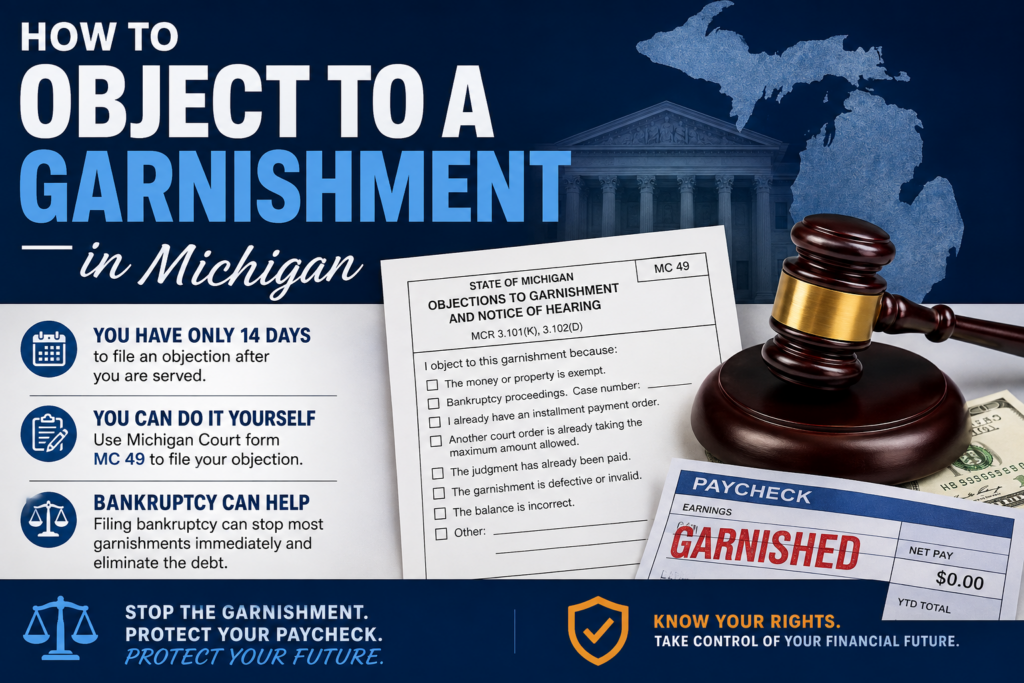
One of the most frightening things that can happen when you are already struggling financially is to discover that money is being taken directly from your paycheck or your bank account.
A garnishment can make an already difficult financial situation even worse. The good news is that Michigan law gives you a procedure for objecting to a garnishment when there is a legitimate legal reason to do so. In many situations, you can file the objection yourself without hiring an attorney.
There is also another option that many people do not realize: filing bankruptcy can stop most garnishments very quickly and, if the underlying debt is dischargeable, eliminate the debt altogether.
I have handled thousands of bankruptcy cases over the years, and garnishments are one of the most common reasons people finally decide that they need to do something about their debt.
Table of Contents
- First, understand what a garnishment is
- You have only 14 days to object if you want the objection to stop the garnishment
- You can file the objection yourself
- Step 1 — Identify the court and case
- Step 2 — Determine why you are objecting
- Bankruptcy can be much more powerful than simply objecting to the garnishment
- 3. You already have an installment payment order
- 4. Another court order is already taking the maximum amount allowed
- 5. The judgment has already been paid
- 6. The garnishment itself is defective or invalid
- What if the creditor says I owe more than I really do?
- Step 3 — Put the date you received the garnishment on the form
- Step 4 — Sign and date the form
- Step 5 — Serve the appropriate parties
- What happens after you file?
- Sometimes the better question is not “How do I stop this garnishment?” but “How do I eliminate the debt?”
- How quickly can bankruptcy stop a garnishment?
- What I tell people who call my office about a garnishment
First, understand what a garnishment is
A garnishment generally occurs after a creditor has obtained a judgment against you.
For example, if you owe a credit card company money and the creditor sues you, obtains a judgment and then obtains a garnishment, your employer may be required to take money from your paycheck and send it toward the judgment.
A bank account can also be garnished. In that situation, your bank is the “garnishee” and may be required to turn money in your account over to the creditor.
Michigan uses different forms for different types of garnishments, including periodic wage garnishments and non-periodic garnishments such as bank accounts. The Michigan courts provide the forms and instructions for dealing with these garnishments.
You have only 14 days to object if you want the objection to stop the garnishment
This is extremely important.
Under Michigan Court Rule 3.101(K), an objection generally must be filed within 14 days after you are served with the garnishment. If you file within that 14-day period, the garnishee generally must continue withholding money but cannot release the withheld funds to the creditor until further order of the court.
If you wait longer than 14 days, you can still file an objection in some circumstances, but the objection does not automatically suspend the garnishment. The money may continue going to the creditor while your objection is being considered.
So, if you receive a garnishment notice, do not put it in a drawer and hope the problem goes away.
You can file the objection yourself
Michigan has an official form called MC 49 — Objections to Garnishment and Notice of Hearing.
Michigan Court Form MC 49 — Objections to Garnishment and Notice of Hearing
The Michigan courts also publish instructions explaining how to complete and file the form.
There is generally no filing fee for an objection to a garnishment, except in probate court cases.
Here is how I would approach completing the MC 49.
Step 1 — Identify the court and case
At the top of the MC 49, you will enter the information from the garnishment paperwork you received.
You will need the:
- Court name and address
- Court telephone number
- Case number
- Name and contact information for the plaintiff or judgment creditor
- Your name and contact information
- Name of the garnishee — usually your employer for a wage garnishment or your bank for a bank garnishment
- Information concerning the creditor’s attorney, if one is listed
Use the information exactly as it appears on the garnishment paperwork.
The official MC 49 form contains spaces for this information.
Step 2 — Determine why you are objecting
This is the most important part of the form.
The MC 49 provides several specific grounds for objecting to a garnishment.
1. The money or property is exempt
You can object if the money or property being garnished is protected from garnishment under applicable law.
This can be particularly important with bank-account garnishments because certain types of funds may receive legal protection.
You should carefully review the garnishment paperwork and the applicable exemption rules before checking this box.
2. Bankruptcy proceedings
The MC 49 specifically provides a box for an objection based on bankruptcy proceedings.
If you have filed bankruptcy, you can provide your bankruptcy case number in this section. The Michigan court form specifically recognizes bankruptcy as a basis for objecting to a garnishment.
This brings me to what I believe is an extremely important point.
Bankruptcy can be much more powerful than simply objecting to the garnishment
If you are being garnished because you owe a credit card, medical bill, personal loan, deficiency balance or another ordinary unsecured debt, simply fighting the garnishment may not solve the underlying problem.
You may stop this garnishment only to have another creditor garnish you later.
Bankruptcy can address the debt itself.
When a bankruptcy case is filed, the automatic stay generally prohibits creditors from continuing collection activity, including garnishment, while the bankruptcy case is pending. Michigan Legal Help specifically explains that once bankruptcy is filed, creditors generally must stop collecting the debt and cannot garnish for a debt that has been discharged.
In other words, instead of playing defense every time another creditor obtains a judgment and starts taking money from your paycheck, bankruptcy can provide a much broader solution.
And if the debt is one that is dischargeable in bankruptcy, the bankruptcy may eliminate the debt entirely.
There are exceptions. Certain debts, such as some child support obligations, certain taxes, and some other debts are not automatically eliminated in bankruptcy. There are also circumstances in which the automatic stay does not apply or is limited. That is why I always recommend having an attorney determine whether bankruptcy will actually solve your particular garnishment problem.
3. You already have an installment payment order
The MC 49 also allows you to object if you have an installment payment order signed by a judge.
You will need to provide the date of the installment payment order, the court and the case number.
The form specifically provides a place for this information.
4. Another court order is already taking the maximum amount allowed
If the maximum amount that can legally be withheld from your paycheck is already being withheld under another court order, that can provide a basis for an objection.
Again, this is a situation where you should have documentation available to support what you are telling the judge.
5. The judgment has already been paid
If you have already paid the judgment in full, you can object on that basis.
Bring proof of payment to the hearing.
6. The garnishment itself is defective or invalid
You can also object if the writ of garnishment was not properly issued or is otherwise invalid.
For example, there may be an error concerning the judgment, the amount claimed, the service of the garnishment or another procedural requirement.
Michigan’s court rules specifically limit objections to defects or invalidity in the garnishment proceeding, the amount stated as owing, or the other grounds listed in the rule. The MC 49 is not a vehicle for simply arguing that you disagree with the original lawsuit or judgment.
What if the creditor says I owe more than I really do?
The MC 49 also gives you the ability to object to the creditor’s written statement if you believe the balance of the judgment is wrong.
This can be important because judgments can accumulate interest and costs, and mistakes sometimes occur.
If the balance is wrong, explain why and bring documentation supporting your position.
Step 3 — Put the date you received the garnishment on the form
The MC 49 asks you to identify the date you were served with the writ of garnishment or written statement.
Do not guess at this date.
Look at when you actually received the paperwork. The 14-day deadline is important.
Step 4 — Sign and date the form
Once you have completed the form, sign and date it.
The Michigan court’s instructions tell you to make four copies of the completed objection and file the copies with the court that issued the garnishment. If you mail the objection, the instructions say to include a postage-paid, self-addressed envelope so the court can return copies with the hearing information.
Step 5 — Serve the appropriate parties
The procedure differs depending upon whether the case is in district court or circuit court.
For a district court case, the court generally handles service of the objection.
For a circuit court case, the Michigan instructions tell you to serve the plaintiff and the garnishee by first-class mail after receiving the copies with the hearing information completed. If the plaintiff has an attorney, you serve the attorney rather than the plaintiff. You then complete the Certificate of Mailing and file the required copy with the court.
The important point is that filing the form is only part of the process. Make sure you follow the service instructions that apply to your particular court.
What happens after you file?
The court will schedule a hearing.
Under the Michigan Court Rules, notice of the hearing is to be sent within seven days after the objection is filed, and the hearing is generally to take place within 21 days after the objection is filed.
You should attend the hearing and bring documents that support your objection.
If you claim that the money is exempt, bring documentation showing where the money came from.
If you claim that the judgment has been paid, bring proof of payment.
If you claim that the balance is wrong, bring your records.
Do not simply show up and tell the judge that you cannot afford the garnishment.
Being unable to afford a garnishment, by itself, is generally not one of the grounds for an MC 49 objection. Michigan’s official instructions specifically state that the form cannot be used simply because you are unable to pay the judgment.
Sometimes the better question is not “How do I stop this garnishment?” but “How do I eliminate the debt?”
This is where I think many people make a mistake.
Suppose you have a $10,000 credit card judgment and your employer is taking $300 or $400 from every paycheck.
You can certainly investigate whether there is a legal basis for objecting to the garnishment.
But if the judgment is valid and there is no exemption or other legal defect, you may ultimately lose the objection.
You are still left with the $10,000 debt.
And the creditor may continue collecting until the judgment is satisfied.
Bankruptcy can change the entire situation.
If the debt is dischargeable, a Chapter 7 bankruptcy can potentially eliminate the debt rather than simply giving you a temporary solution to the garnishment.
Chapter 13 can also stop garnishments and provide a court-supervised method of dealing with debts when Chapter 7 is not appropriate or when a debtor needs the additional protections available under Chapter 13.
How quickly can bankruptcy stop a garnishment?
One of the reasons people call my office after receiving a garnishment is that they are worried about their next paycheck.
Once a bankruptcy case is properly filed, the automatic stay generally takes effect immediately. The bankruptcy filing is electronically transmitted through the bankruptcy court system, and creditors are required to comply with the automatic stay.
That can make bankruptcy a very effective way of stopping an ongoing wage garnishment.
There are, however, important exceptions and special rules. For example, certain domestic-support obligations are treated differently, and the automatic stay can be limited in certain repeat-filing situations.
That is why you should not assume that every garnishment automatically disappears simply because someone tells you to “file bankruptcy.”
You need to determine what type of debt is being garnished, what type of garnishment you have, whether the debt is dischargeable, and whether the automatic stay applies.
What I tell people who call my office about a garnishment
If you are being garnished, don’t panic.
But don’t ignore it either.
The first thing I want to know is why you are being garnished and what kind of debt is involved.
If there is a legitimate basis for objecting to the garnishment, Michigan provides a relatively straightforward procedure that you can use yourself. The MC 49 form is available from the Michigan courts, and the Michigan courts provide instructions for completing and filing it.
But if the garnishment is simply the result of a valid judgment for debt that you cannot afford to pay, you should at least consider whether bankruptcy makes more sense.
An objection may stop a particular garnishment. Bankruptcy may stop the garnishment and eliminate the underlying debt.
That is a very important difference.
I have practiced bankruptcy law for more than 30 years and have handled more than 25,000 consumer bankruptcy cases. If you are facing a garnishment in Michigan, I would be happy to discuss your situation with you and determine whether an objection, bankruptcy, or another approach makes the most sense.
This article is for general information and is not legal advice. Garnishment and bankruptcy laws contain important exceptions, and the proper procedure depends upon the facts of your particular case.