Published
One of the questions I hear most often from people who call my office is, “How do I know if it is time to file bankruptcy?”
There is no single number or formula that answers that question. For some people, bankruptcy becomes necessary after a job loss or unexpected medical bills. For others, it happens gradually. The credit cards get a little higher every month, the minimum payments keep increasing, and eventually there is simply not enough money left at the end of the month to pay everything.
I have been representing people in bankruptcy for more than 30 years, and I have seen this happen thousands of times. One thing I have learned is that people frequently wait too long to get advice.
You do not have to be broke, unemployed, or completely out of options to talk to a bankruptcy attorney. In fact, it is often better to talk to an experienced bankruptcy attorney while you still have choices.
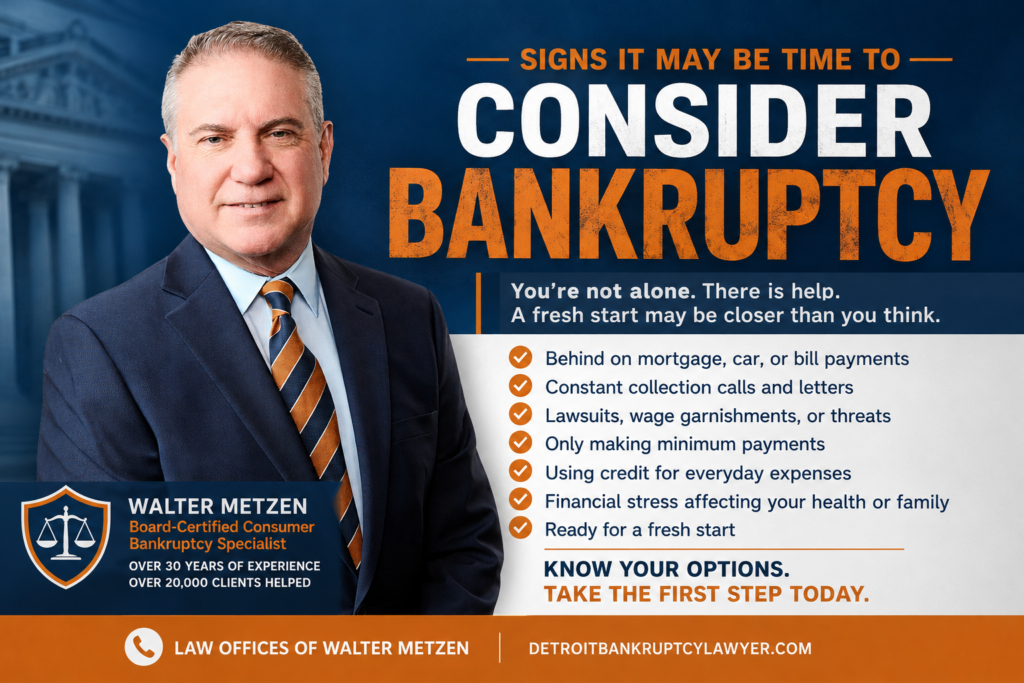
Here are some of the signs that it may be time to consider bankruptcy.
Table of Contents
- 1. You are falling behind on your mortgage or car payments
- 2. The creditor calls and collection letters never seem to stop
- 3. You have been sued or your wages are being garnished
- 4. You are making the minimum payment every month but your balances aren’t going down
- 5. You are using one credit card to pay another
- 6. You are using your retirement savings to pay your bills
- 7. You have tried everything else and nothing has worked
- 8. Your income has dropped and your old debt payments no longer fit your budget
- 9. You are borrowing from Peter to pay Paul
- 10. Your debt is affecting your family, your sleep, or your peace of mind
- 11. You are afraid to answer the telephone or open your mail
- 12. You are ready for a fresh start
1. You are falling behind on your mortgage or car payments
Mortgage and car payments are different from ordinary credit card debt because your house or vehicle secures the debt. If you fall far enough behind, the mortgage company can eventually foreclose and a car lender can repossess your vehicle.
That does not necessarily mean you have to lose your home or your car.
Chapter 13 bankruptcy can provide a way to stop a foreclosure and give you an opportunity to catch up on past-due mortgage payments over time. In the right circumstances, it can also help you deal with a delinquent car loan.
If you are already receiving foreclosure notices or are several payments behind on your mortgage, do not wait until the day before the sheriff’s sale to call an attorney.
I have helped many people deal with foreclosure problems through Chapter 13 bankruptcy. The earlier you understand your options, the more options you generally have.
2. The creditor calls and collection letters never seem to stop
If your telephone rings and you immediately know it is probably another collection agency, that is a pretty good indication that your debt has become a problem.
Collection calls, letters, emails, and text messages can become exhausting. More importantly, they are a symptom of the underlying problem: you do not have enough money to pay the debts as they are coming due.
When you file bankruptcy, the automatic stay generally stops most collection activity. Creditors are generally prohibited from continuing collection calls, lawsuits, garnishments, and other collection efforts while the stay is in effect, subject to certain exceptions.
For many of my clients, the first noticeable benefit of filing bankruptcy is simply being able to answer their telephone without worrying about who is calling.
3. You have been sued or your wages are being garnished
A lawsuit from a creditor is serious. A judgment followed by a wage garnishment can be even more serious because money is being taken directly from your paycheck.
If you are already being garnished, you should not assume that there is nothing you can do.
Bankruptcy can stop many wage garnishments and other collection actions. Depending on the circumstances, bankruptcy may also provide a way to deal with the judgment itself.
I have written separately about how bankruptcy can stop a garnishment in Michigan.
If you receive a lawsuit, judgment, garnishment notice, or other legal paperwork from a creditor, do not put it in a drawer and hope it goes away. Get legal advice.
4. You are making the minimum payment every month but your balances aren’t going down
This is one of the biggest warning signs I see.
Suppose you have $30,000, $40,000, or $50,000 in credit card debt. You make every minimum payment. You have never intentionally stopped paying. But when you look at the balances a year later, you have made thousands of dollars in payments and the balances have barely changed.
That is not a financial plan. That is a treadmill.
High interest rates can make it extremely difficult to make meaningful progress on credit card debt. You can spend years making payments and still owe a substantial amount of money.
Bankruptcy can eliminate many types of unsecured debt, including qualifying credit card debt, medical bills, and personal loans.
5. You are using one credit card to pay another
If you are transferring balances, taking cash advances, using one credit card to make the minimum payment on another, or opening new accounts simply to keep up with your existing bills, something needs to change.
The same is true if you are using credit cards or payday loans to pay for basic necessities such as groceries, gasoline, rent, or utilities.
Credit is supposed to help you manage your finances—not allow you to borrow enough money to survive until the next paycheck.
When you have reached the point where you need to borrow money to make your regular debt payments, it is a good time to sit down with a bankruptcy attorney and look at the entire financial picture.
6. You are using your retirement savings to pay your bills
I have had clients tell me, “I don’t want to file bankruptcy, so I took $20,000 out of my retirement account to pay my credit cards.”
I understand why someone would do that. Nobody wants to file bankruptcy.
But you need to be very careful about sacrificing your retirement to pay unsecured creditors.
Many retirement accounts receive significant protection under bankruptcy law. Using retirement money to pay debts that might otherwise be discharged in bankruptcy can sometimes leave you with both the debt problem and a much smaller retirement account.
Before you liquidate a 401(k), IRA, or other retirement account to pay creditors, talk to a bankruptcy attorney about your options.
7. You have tried everything else and nothing has worked
Maybe you have already tried debt consolidation.
Maybe you hired a debt settlement company.
Maybe you transferred balances to a lower-interest credit card.
Maybe you negotiated payment arrangements with your creditors.
Maybe you borrowed money from family.
There is nothing wrong with trying to solve your financial problems without bankruptcy. In fact, I encourage people to understand all of their options.
But if you have tried these solutions and your debt continues to grow, it may be time to consider whether bankruptcy would provide a better and more permanent solution.
One of the things I do in my initial consultation is look at the alternatives and determine whether bankruptcy actually makes sense for the individual client. Sometimes it does. Sometimes it doesn’t.
8. Your income has dropped and your old debt payments no longer fit your budget
A job loss, reduction in hours, business problems, divorce, or other major financial change can turn a manageable financial situation into an impossible one very quickly.
The problem may not be that you have been irresponsible. Sometimes the numbers simply no longer work.
If your household income has dropped substantially while your mortgage, car payment, credit cards, medical bills, and other obligations have remained the same, you need to look at the situation realistically.
A bankruptcy case can sometimes discharge unsecured debt through Chapter 7 or provide a structured repayment plan through Chapter 13.
9. You are borrowing from Peter to pay Paul
This is an old expression, but it describes a very common bankruptcy situation.
You pay the electric bill with a credit card. Then you use your paycheck to make the credit card payment. Then you put groceries on another credit card. Then you take money from your savings to make the car payment.
Eventually there is no more money to move around.
If your financial strategy has become “Which bill can I afford not to pay this month?”, it is time to take a serious look at the overall situation.
10. Your debt is affecting your family, your sleep, or your peace of mind
Financial problems do not stay on a spreadsheet.
They follow you home.
They can affect your marriage, your relationship with your children, your ability to sleep, and your enjoyment of everyday life. I have had clients tell me that they have been lying awake at night trying to figure out which bills they can pay.
That is not how you should have to live.
Bankruptcy is a legal process designed to deal with financial problems. It is not a moral judgment about you or your family.
11. You are afraid to answer the telephone or open your mail
This may sound like a small thing, but it isn’t.
If you are avoiding your mail because you are afraid of another collection letter, ignoring phone calls because you know they are creditors, or refusing to look at your bank account because you are afraid of what you will see, your financial situation is probably causing you more stress than it should.
The answer may not necessarily be bankruptcy. But it is time to get professional advice.
Knowing exactly where you stand is much better than living in fear of what might happen next.
12. You are ready for a fresh start
Sometimes the biggest sign is simply that you are tired of fighting the same financial battle every month.
You want to know what your life will look like without $1,000 or $2,000 or $3,000 in monthly credit card payments.
You want to stop worrying about garnishments.
You want to keep your home.
You want to get your finances under control.
You want to start saving money again.
You want to move forward.
That is what bankruptcy is designed to do. Bankruptcy is not supposed to be the end of your financial life. It is often a tool for getting your financial life back on track.
You Don’t Have to Decide Alone
One of the biggest misconceptions I encounter is that someone needs to know whether they should file bankruptcy before they call a bankruptcy attorney.
You don’t.
That is what the consultation is for.
When you meet with me, we can look at your income, your debts, your assets, your mortgage, your vehicles, your tax situation, and your overall financial circumstances. We can then discuss whether Chapter 7, Chapter 13, or an alternative to bankruptcy makes the most sense for you.
I have been practicing bankruptcy law for more than 30 years and have filed more than 20,000 consumer bankruptcy cases in the Metro Detroit area. I am a Board-Certified Consumer Bankruptcy Specialist, and bankruptcy is what I do every day.
If you recognize yourself in several of the signs above, don’t wait until the situation gets worse.
Call me. Let’s sit down and look at your options.
You may discover that bankruptcy isn’t right for you. Or you may discover that it is exactly the fresh start you have been looking for.
Either way, the first step is finding out where you stand.