Bankruptcy Case Closed Without a Discharge Because You Failed to Complete the Second Bankruptcy Course

Published
One of the most frustrating situations that can occur in a bankruptcy case is when a debtor goes through the entire bankruptcy process, attends the required meeting with the bankruptcy trustee, provides all of the required documents, waits for the bankruptcy case to be completed—and then discovers that the case has been closed without a discharge.
Why?
Because the debtor failed to complete the second required bankruptcy course.
This is something that happens more often than you might think.
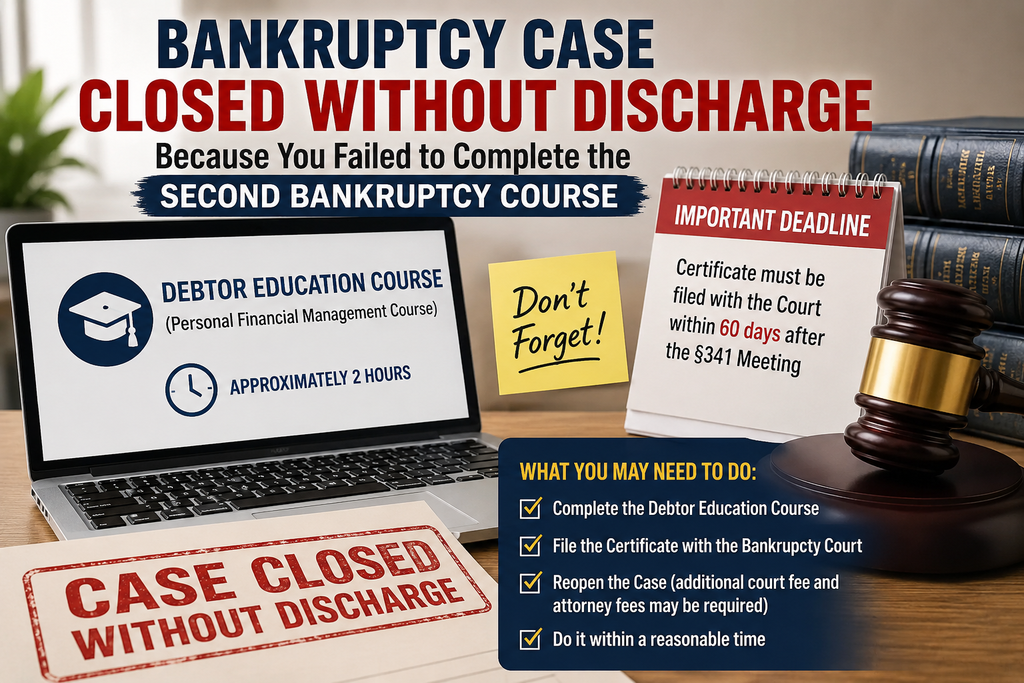
I have seen cases where everything else in the bankruptcy has been completed properly, but the debtor simply forgot to take the required Debtor Education Course, also known as the Personal Financial Management Course. Unfortunately, forgetting to take this approximately two-hour course can have serious consequences.
Table of Contents
- There Are Two Bankruptcy Courses
- The Second Course Is Mandatory
- My Office Reminds Clients About This Requirement
- What Happens If You Don’t Take the Course?
- Can the Bankruptcy Case Be Reopened?
- Don’t Wait If Your Case Has Already Closed
- What If I Already Took the Course?
- Don’t Let a Two-Hour Course Destroy the Benefit of Your Bankruptcy
There Are Two Bankruptcy Courses
When you file bankruptcy, there are two separate educational requirements.
The first is the pre-bankruptcy credit counseling course. This course must generally be completed before your bankruptcy case is filed.
The second is the Debtor Education Course, sometimes called the Personal Financial Management Course. This course is taken after the bankruptcy case is filed.
These are two completely different requirements.
The United States Bankruptcy Code states that individual bankruptcy filers are required to complete both pre-bankruptcy credit counseling and post-bankruptcy debtor education.
Completing the first course does not satisfy the second course requirement.
The Second Course Is Mandatory
For most individual Chapter 7 and Chapter 13 debtors, completing the Personal Financial Management Course is a requirement for receiving a bankruptcy discharge. The requirement comes from the Bankruptcy Code, including 11 U.S.C. §§ 727(a)(11) and 1328(g).
The Eastern District of Michigan specifically advises Chapter 7 debtors that they must complete the financial management education after filing bankruptcy in order to receive a discharge.
In a Chapter 7 case, the certificate generally must be completed and filed within 60 days after the first date set for the §341 Meeting of Creditors.
In other words, this is not an optional class.
It is not something that you can simply decide not to do because you have already completed your bankruptcy paperwork.
It is one of the requirements for receiving your discharge.
My Office Reminds Clients About This Requirement
At my office, we make a point of reminding our bankruptcy clients about the second course.
We know that people have busy lives. After filing bankruptcy, clients often believe that the hardest part is over once they have attended their Meeting of Creditors.
But there is still one very important thing that needs to be taken care of.
Complete the second bankruptcy course.
The course is generally about two hours and is designed to provide information concerning personal financial management.
My office routinely reminds clients to complete the course and make sure that the certificate of completion is properly submitted to the bankruptcy court.
The bankruptcy court also sends debtors a Notice of Requirement to File Statement of Completion of Course in Personal Financial Management. The notice provides important information concerning the requirement and the deadline.
So if you receive this notice, do not put it in a drawer and forget about it.
Take the course.
What Happens If You Don’t Take the Course?
This is where the problem becomes serious.
If you fail to complete the course and the required certificate is not filed by the applicable deadline, your bankruptcy case can be closed without a discharge.
The Eastern District of Michigan Bankruptcy Court specifically warns that if a Chapter 7 debtor fails to timely file the Personal Financial Management Certificate, the case will be closed without a discharge. The court also states that a fee must be paid to reopen the case.
Think about what that means.
You may have:
- Filed your bankruptcy petition;
- Completed all of your bankruptcy schedules;
- Attended your Meeting of Creditors;
- Cooperated with the bankruptcy trustee;
- Provided the trustee with requested documents;
- Waited for your discharge; and
- Done everything else required of you.
And then the case closes without a discharge simply because you didn’t complete a roughly two-hour financial management course.
That can be an extremely expensive mistake.
Can the Bankruptcy Case Be Reopened?
In many circumstances, a bankruptcy case that has been closed without a discharge because the financial management certificate was not filed can be reopened so that the debtor can complete the remaining requirement and seek the discharge.
However, reopening the case is not free.
There can be an additional bankruptcy court filing fee, along with additional attorney fees for preparing and filing the necessary documents to reopen the case and complete the discharge process.
The Eastern District of Michigan specifically warns that a debtor who fails to timely file the Personal Financial Management Certificate will have to pay another filing fee to have the case reopened.
That is money that could have been avoided simply by completing the course on time.
Don’t Wait If Your Case Has Already Closed
If you discover that your bankruptcy case has already been closed without a discharge because you failed to complete the second course, do not ignore it.
Contact your bankruptcy attorney as soon as possible.
The longer you wait, the more complicated the situation can become. The appropriate procedure for reopening the case should be evaluated based upon the circumstances of your particular bankruptcy case.
Most importantly, you should address the problem within a reasonable time after the case closes rather than allowing months or years to pass.
The goal is to get the case reopened, complete the required financial management course if it has not already been completed, properly file the certificate with the court, and obtain the discharge if you otherwise qualify for one.
What If I Already Took the Course?
Sometimes there is another possibility.
You may have actually completed the course but the bankruptcy court never received the certificate.
Approved debtor education providers may be permitted to notify the bankruptcy court electronically that the debtor completed the course.
If you believe you completed the course but your bankruptcy case was nevertheless closed without a discharge, contact your attorney and the course provider immediately.
Don’t assume that everything was properly filed.
The important thing is to determine what the bankruptcy court’s docket actually shows and then take the appropriate steps to correct the problem.
Don’t Let a Two-Hour Course Destroy the Benefit of Your Bankruptcy
Bankruptcy is a legal process with many requirements and deadlines.
The discharge is one of the primary reasons people file bankruptcy. It is the court order that eliminates qualifying debts and gives the debtor the fresh financial start that bankruptcy is designed to provide.
Failing to complete a required two-hour financial management course is simply not worth jeopardizing that discharge.
My advice to every bankruptcy client is simple:
When your attorney tells you to complete the second bankruptcy course, do it as soon as possible.
Don’t wait until the deadline.
Don’t assume that somebody else will remind you.
Don’t assume that because you attended your Meeting of Creditors your bankruptcy case is finished.
And don’t assume that because you completed the first credit counseling course, you have completed the educational requirements.
You have two separate requirements.
Complete the second course. Make sure the certificate is properly filed. Then you can move forward toward receiving your bankruptcy discharge.
If you have already received a notice that your bankruptcy case was closed without a discharge because you failed to complete the Personal Financial Management Course, contact your bankruptcy attorney promptly. There may still be a way to reopen the case and complete the process, but additional court costs and attorney fees may be involved.
The best solution, however, is much simpler:
Take the course. File the certificate. Get your discharge.