Nearly 1 in 10 Americans Need Affirm or Klarna to Buy Groceries: What Does It Say About Household Debt?

Published
I have been practicing bankruptcy law for more than 30 years, and I have seen many changes in the way people borrow money.
Credit cards used to be the primary way that people financed purchases they could not afford to pay for immediately. Today, there is another form of borrowing that has become increasingly common: Buy Now, Pay Later, or BNPL.
Companies such as Affirm and Klarna allow consumers to purchase something today and pay for it over a series of installments.
That may sound harmless when you are buying a television, a computer or a piece of furniture.
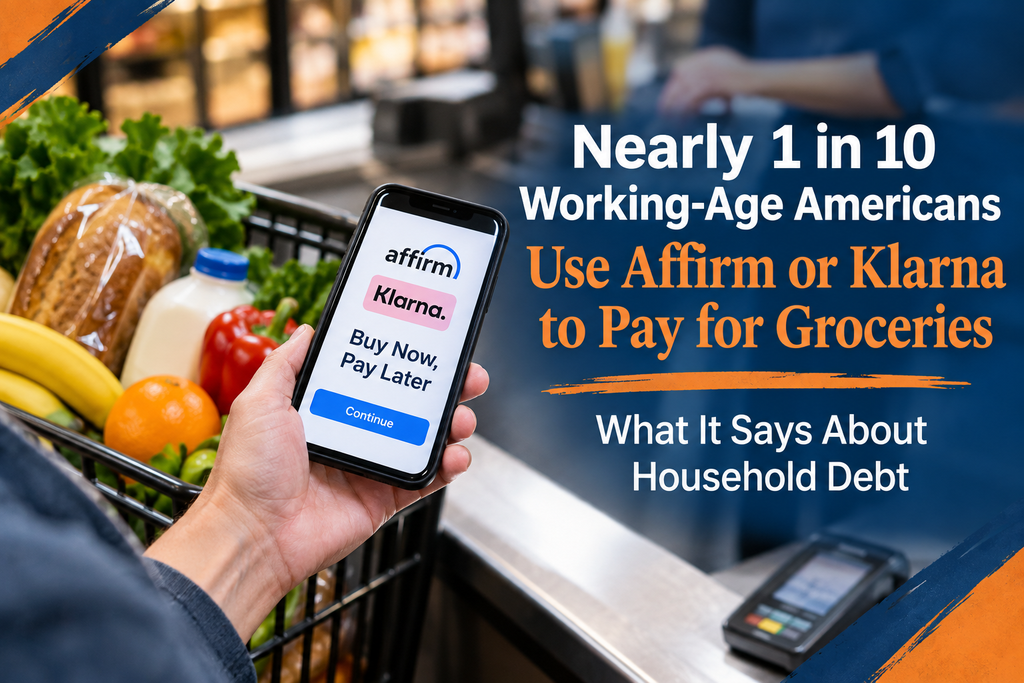
But something caught my attention recently: people are increasingly using Buy Now, Pay Later financing to buy groceries.
Table of Contents
- Americans Are Financing Their Groceries
- Why Would Someone Finance a Grocery Bill?
- The Problem With “Pay Later”
- BNPL Can Look Different From Traditional Credit-Card Debt
- What Happens When the Payments Become Too Much?
- How Does Bankruptcy Treat Affirm, Klarna and Other BNPL Debt?
- The Bigger Issue Is Not the Grocery Loan
- Don’t Ignore the Warning Signs
- Bankruptcy Is About More Than Credit Cards
Americans Are Financing Their Groceries
According to the Federal Reserve’s 2025 Survey of Household Economics and Decisionmaking, 16% of American adults reported using Buy Now, Pay Later during the previous 12 months. Among those BNPL users, 20% said they had used BNPL to purchase groceries or food delivery.
An Urban Institute study looking specifically at working-age Americans found an even more striking result: nearly 1 in 10 working-age adults used Buy Now, Pay Later to pay for groceries in 2025. And among those who used BNPL for groceries, approximately 35% reported missing a BNPL payment.
This is important because groceries aren’t normally a luxury purchase.
You need to eat.
When someone finances a television, a vacation or a new piece of furniture, there is at least an argument that the purchase could have been postponed.
You can’t postpone feeding your family indefinitely.
Why Would Someone Finance a Grocery Bill?
There are several possible explanations.
Grocery prices have increased substantially over the past several years. At the same time, many households have significant obligations for housing, automobiles, insurance, medical expenses, utilities and credit-card payments.
Sometimes the problem isn’t that a person is spending extravagantly.
The problem is that there simply isn’t enough money left at the end of the month.
The Federal Reserve found that among people who used BNPL for groceries or food delivery, 45% said the main reason for using BNPL was that it was the only way they could afford the purchase.
That statistic is particularly significant from a bankruptcy lawyer’s perspective.
There is a big difference between using financing because you want to spread out the cost of a purchase and using financing because you don’t have enough money to pay for necessities.
The Problem With “Pay Later”
The attraction of BNPL is obvious.
Suppose your grocery bill is $400.
Instead of paying $400 today, you may be able to divide the purchase into several smaller payments.
The problem is that the grocery store doesn’t give you free food.
You are simply moving part of today’s grocery bill into the future.
And next week, you still have to buy groceries.
Then another BNPL payment comes due.
Then another credit-card payment comes due.
Then the car payment, mortgage or rent, utilities and insurance have to be paid.
This is how a household can gradually become trapped in a cycle of making payments on yesterday’s purchases while trying to find enough money to pay for today’s necessities.
BNPL Can Look Different From Traditional Credit-Card Debt
One reason BNPL can be attractive is that the payments are usually fixed and the transaction may be advertised as interest-free if payments are made on time.
But “interest-free” does not necessarily mean “free.”
Late payments can result in fees depending upon the particular BNPL provider and agreement.
The Federal Reserve reported that 26% of BNPL users in 2025 made at least one late payment, and 17% were charged extra for paying late. The Federal Reserve also found that people using BNPL for groceries or food delivery were particularly likely to experience a late-payment charge or an overdraft/NSF fee.
The Federal Reserve’s data showed that 43% of BNPL users who used the product for groceries or food delivery either paid late or incurred an overdraft/NSF fee, compared with 21% of BNPL users overall.
That doesn’t mean that everyone who uses Klarna or Affirm for groceries is in financial trouble.
But it does demonstrate something I see regularly in bankruptcy practice: when people begin borrowing to pay for basic living expenses, there may be a much larger household-budget problem underneath the individual transaction.
What Happens When the Payments Become Too Much?
Let’s say a family has accumulated:
- $12,000 in credit-card debt;
- $4,000 in medical bills;
- $3,000 in personal loans;
- several BNPL accounts;
- a car payment;
- a mortgage or rent;
- and ordinary household expenses.
At first, every individual payment may seem manageable.
The problem is the total.
A person may have enough income to make each payment individually but not enough income to make all of the payments and still purchase groceries, pay utilities and maintain a reasonable household budget.
That is when people sometimes begin using one form of credit to pay another obligation.
And that is a warning sign.
How Does Bankruptcy Treat Affirm, Klarna and Other BNPL Debt?
For bankruptcy purposes, the important question is not whether a debt is called “Buy Now, Pay Later,” “installment financing,” “personal loan” or something else.
The actual terms and circumstances of the obligation matter.
If you are considering filing Chapter 7 or Chapter 13 bankruptcy and you have outstanding BNPL obligations, you need to disclose them just like you would disclose your credit cards, personal loans, medical bills and other debts.
Don’t assume that a relatively small Klarna or Affirm balance doesn’t matter because it is only $100, $300 or $500.
A bankruptcy petition requires complete disclosure of your debts.
And if you have multiple BNPL accounts, the cumulative amount can become significant.
The Bigger Issue Is Not the Grocery Loan
As a bankruptcy attorney, I would be less concerned about the individual $200 grocery transaction than I would be about why the person needed to finance the groceries in the first place.
If your income comfortably covers your normal household expenses and you occasionally use BNPL because it is convenient, that is one situation.
If you are using Affirm, Klarna or another BNPL service because you don’t have enough money in your checking account to buy groceries, that is a different situation.
It may be a sign that your household has reached the point where the monthly debt payments are consuming money that should be going toward basic living expenses.
And that is precisely the type of financial problem that people often come to my office to discuss.
Don’t Ignore the Warning Signs
Using Buy Now, Pay Later to purchase groceries doesn’t automatically mean that you need to file bankruptcy.
But I would consider the following to be warning signs:
You are using credit to buy necessities.
You are taking out one loan to pay another.
You are making only minimum payments on your credit cards.
You are repeatedly carrying BNPL balances from one pay period to the next.
You are overdrawing your checking account when automatic payments come due.
You have stopped saving because all of your income is going toward debt payments.
You are using credit cards or BNPL because there isn’t enough money left after paying your regular monthly bills.
When several of these things are happening at the same time, it may be time to take a serious look at the entire household budget rather than simply trying to find another way to finance the next grocery trip.
Bankruptcy Is About More Than Credit Cards
Many people who come to see me initially think bankruptcy is only for someone who has $50,000 or $100,000 in credit-card debt.
That’s not necessarily the case.
Sometimes the problem is the combination of several different types of debt and a household income that simply cannot support the monthly payments.
BNPL accounts such as Affirm and Klarna are relatively new compared with traditional credit cards, but the underlying problem isn’t new at all.
When your income isn’t sufficient to pay your necessary living expenses and your debt payments, borrowing more money generally doesn’t solve the problem. It simply moves the problem into the future.
If you are using Buy Now, Pay Later to buy groceries, I would encourage you to step back and look at the entire financial picture.
The question isn’t whether you can afford today’s groceries.
The question is whether your income is sufficient to pay for today’s groceries, tomorrow’s groceries and all of the debt payments you have already committed yourself to making.
That is a very different question—and an important one.
The information in this article is for general informational purposes and is not legal advice. Every bankruptcy case is different, and the treatment of particular debts depends upon the facts and circumstances of the individual case.
Sources: Federal Reserve, 2025 Survey of Household Economics and Decisionmaking; Urban Institute, 2025 analysis of how families pay for groceries.