The Rise of 84-Month and Longer Car Loans: Is the Monthly Payment Hiding the Real Cost?

Published
If you have purchased a new car or truck recently, you have probably noticed something that would have seemed unusual not that many years ago: 84-month car loans have become commonplace, and even longer financing terms are now available.
For many consumers, the question when buying a vehicle is simple:
“Can I afford the monthly payment?”
That is certainly an important question. But there is another question that is just as important:
“How much is this vehicle really going to cost me by the time I finish paying for it?”
Those two questions can produce very different answers.
Table of Contents
- The Car Payment Has Become the Focus
- Why Would Anyone Take an 84-Month Loan?
- The Longer the Loan, the More Interest You Pay
- The Bigger Problem: You May Still Owe Money When You Need Another Vehicle
- And Then the Cycle Starts Again
- This Can Become a Serious Financial Problem
- What Does This Have to Do With Bankruptcy?
- The Bankruptcy Problem Can Become Even More Complicated
- Look Beyond the Monthly Payment
- The 84-Month Loan May Not Be the Problem — But It Is a Warning Sign
- A Growing Problem for Consumers
- Before You Sign the Papers
- The Bottom Line
The Car Payment Has Become the Focus
Vehicle prices have increased dramatically over the last several years. At the same time, interest rates remain considerably higher than they were when many consumers purchased their previous vehicles.
The result is predictable.
Instead of reducing the price of the vehicle, consumers and automobile dealers have increasingly stretched the financing over a longer period of time.
A five-year, or 60-month, automobile loan used to be fairly typical. Today, 72-month loans are common, 84-month loans are increasingly common, and financing terms extending beyond 84 months are no longer unusual.
According to Experian, the average new-vehicle loan term was approximately 69 months in the fourth quarter of 2025. More importantly, nearly 30% of new-vehicle loans were in the 73-to-84-month range, and another 2.31% were longer than 85 months.
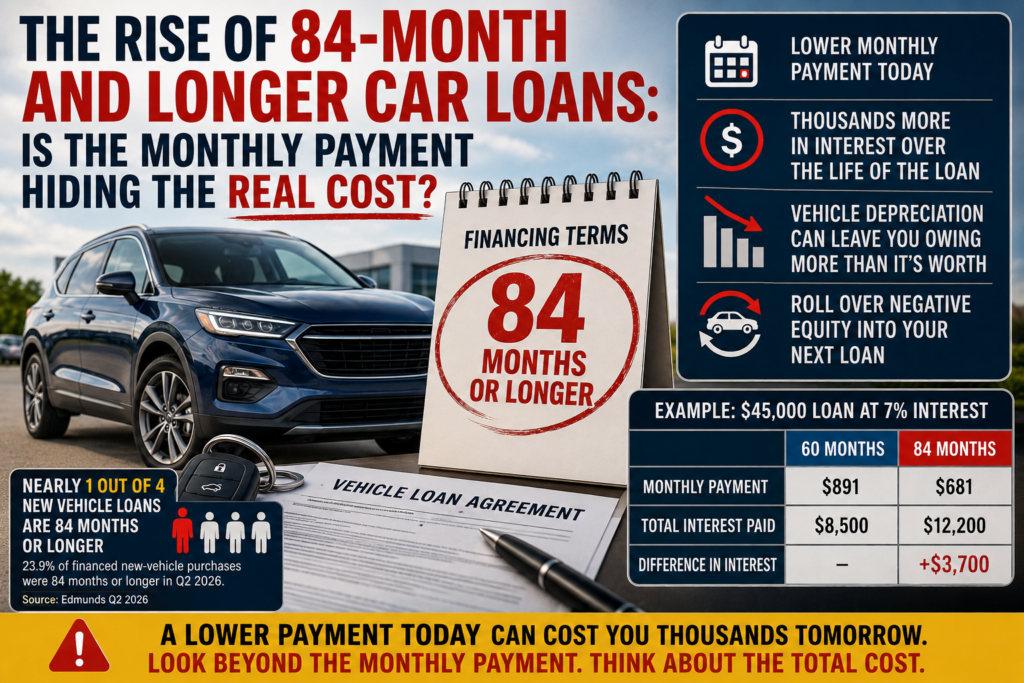
More recent Edmunds data show just how far this trend has gone. In the second quarter of 2026, 23.9% of financed new-vehicle purchases were financed for 84 months or longer. That means nearly one out of every four financed new vehicles was being financed for seven years or more.
And the trend isn’t limited to new vehicles. Experian reports that more than 35% of new-vehicle loans in the first quarter of 2026 extended beyond six years, while more than 31% of used-vehicle loans did the same.
Why Would Anyone Take an 84-Month Loan?
The answer is usually the same:
The monthly payment.
Suppose someone wants to purchase a $50,000 vehicle.
The buyer may look at a 60-month loan and discover that the payment is too high. The dealer may then offer a 72-month loan. If that payment is still too high, the dealer can offer an 84-month loan.
Suddenly, the vehicle appears to be affordable.
But nothing about the vehicle became less expensive.
The price didn’t go down.
The interest rate didn’t necessarily go down.
The amount borrowed didn’t go down.
The only thing that changed was the amount of time the buyer has to pay the money back.
And that extra time comes with a price.
The Longer the Loan, the More Interest You Pay
Consider a simplified example.
Suppose you finance $45,000 at 7% interest.
With a 60-month loan, your payment would be approximately $891 per month, and you would pay approximately $8,500 in interest over the life of the loan.
Stretch that same $45,000 over 84 months and the payment drops to approximately $681 per month.
That $210 monthly savings can make the vehicle look considerably more affordable.
But the total interest paid increases to approximately $12,200.
You have reduced your monthly payment by about $210, but you have increased the interest expense by roughly $3,700.
And that is before considering the fact that the vehicle is depreciating throughout the entire period.
The longer loan therefore solves one problem — the monthly payment — while creating another problem: you are paying for the vehicle for a very long time.
Experian recently illustrated the same basic problem using a $46,000 financed amount. At an interest rate of approximately 6.37%, extending the loan from 48 months to 84 months reduced the payment substantially, but increased the total interest expense by thousands of dollars.
The Bigger Problem: You May Still Owe Money When You Need Another Vehicle
There is another issue that concerns me even more from the standpoint of my bankruptcy practice.
What happens when you need to replace the vehicle before the 84-month loan is paid off?
Most people don’t keep a vehicle for seven years simply because they have a seven-year loan.
Life happens.
The vehicle may be involved in an accident.
It may develop expensive mechanical problems.
The family may grow.
The consumer may change jobs and need a different vehicle.
Or the consumer may simply decide that it is time for something newer.
The problem is that the vehicle may have depreciated substantially while the consumer still owes a significant amount on the loan.
This creates negative equity.
For example, imagine that you purchase a $50,000 vehicle and finance $50,000.
Three years later, perhaps the vehicle is worth $30,000, but you still owe $35,000.
You are $5,000 underwater.
If you trade the vehicle in, where does that $5,000 go?
In many cases, it gets rolled into the next vehicle loan.
Now you are not financing just the new vehicle.
You are financing the new vehicle plus the unpaid balance from the old vehicle.
And Then the Cycle Starts Again
This is where I believe we need to pay particular attention.
A consumer purchases a $50,000 vehicle.
They finance it for 84 months because that is what makes the payment affordable.
Three or four years later, they want or need another vehicle.
But they still owe more than the vehicle is worth.
So the dealer says:
“Don’t worry. We can roll the remaining balance into your new loan.”
The consumer now finances another $45,000 or $50,000 vehicle, plus perhaps $5,000 or $10,000 of negative equity from the previous vehicle.
The new loan may now be $55,000 or $60,000.
To make the payment manageable, the consumer takes another 72-, 84- or even longer-term loan.
And the cycle begins again.
This Can Become a Serious Financial Problem
The problem isn’t simply that the consumer is paying too much interest.
The problem is that the consumer can become permanently behind the depreciation curve.
The vehicle continues to depreciate while the loan balance remains substantial.
Recent data demonstrate how significant this problem has become. J.D. Power reported in 2026 that nearly 31% of used-vehicle trade-ins were carrying negative equity, while 84-month-plus financing accounted for 12.8% of new-vehicle sales in March 2026.
Other recent data are even more concerning. Dealertrack data reported by MarketWatch indicated that 57% of auto loans originated in July 2026 had an amount financed that was greater than the vehicle’s value at the time of purchase.
That is not necessarily because the automobile itself is a bad investment. Cars and trucks are depreciating assets. The problem occurs when the debt associated with the vehicle exceeds the value of the vehicle and the consumer does not have enough income or savings to absorb the difference.
What Does This Have to Do With Bankruptcy?
As a bankruptcy attorney, I see the consequences when a household’s monthly debt payments become too large for its income.
An $800 or $900 car payment may be manageable when everything else in the household’s finances is going well.
But what happens when the mortgage or rent increases?
What happens when health insurance premiums increase?
What happens when a child starts college?
What happens when the consumer loses overtime?
What happens when there is a major home repair?
What happens when the consumer’s income drops?
Suddenly, that automobile payment becomes one more substantial monthly obligation that the household cannot comfortably handle.
And unlike many unsecured debts, an automobile loan is secured by the vehicle.
The consumer cannot simply stop making the payments without risking repossession.
The Bankruptcy Problem Can Become Even More Complicated
When someone files bankruptcy while owing substantially more on a vehicle than it is worth, the situation can become complicated.
In a Chapter 7 bankruptcy, the debtor generally has to decide whether to surrender the vehicle, redeem it if legally and financially feasible, or reaffirm the debt when the requirements for reaffirmation are satisfied.
In a Chapter 13 bankruptcy, there may be additional options depending upon the circumstances of the case, including the possibility of dealing with certain vehicle loans through the Chapter 13 plan.
But bankruptcy is not a magic solution to the fundamental economic problem created by purchasing more vehicle than the household can afford.
The better solution is to recognize the problem before it becomes a bankruptcy problem.
Look Beyond the Monthly Payment
One of the biggest mistakes a consumer can make when purchasing a vehicle is to focus exclusively on the monthly payment.
Instead of asking:
“Can I afford $675 a month?”
ask:
“How much will I actually pay for this vehicle?”
And then ask:
“How much will I still owe when this vehicle is three or four years old?”
Those questions can completely change the way you look at the transaction.
A $680 payment may sound much better than an $890 payment.
But if that lower payment requires you to make payments for seven years and costs thousands of dollars more in interest, you need to understand exactly what you are buying.
The 84-Month Loan May Not Be the Problem — But It Is a Warning Sign
There are circumstances where a longer automobile loan may make sense.
For some consumers, a longer term may be necessary to purchase a reliable vehicle that they genuinely need for work or family obligations.
The problem arises when the longer loan is being used simply to make an otherwise unaffordable vehicle appear affordable.
That is an important distinction.
If you need an $800-per-month vehicle but can only afford a $600 payment, an 84-month loan doesn’t necessarily mean you can afford the $800 vehicle.
It may simply mean that you have borrowed the money for a longer period of time.
And eventually, the bill comes due.
A Growing Problem for Consumers
I have practiced consumer bankruptcy law in Michigan for more than 30 years, and I have seen many different forms of consumer debt come and go.
What concerns me about today’s automobile financing environment is the combination of:
- Higher vehicle prices;
- Higher interest rates;
- Larger loan balances;
- Longer loan terms;
- Large monthly payments;
- Negative equity;
- And consumers rolling unpaid balances from one vehicle into the next.
When these trends occur at the same time, the financial margin for error becomes very small.
A household may be able to make its car payment today.
The question is whether it can continue making that payment when something unexpected happens.
Before You Sign the Papers
Before purchasing a vehicle, I recommend looking at more than the monthly payment.
Ask the dealer or lender for the following:
How much am I borrowing?
What is the interest rate?
How many months will I be making payments?
What will my total payments be over the life of the loan?
How much interest will I pay?
What will I owe after three years?
What will I owe after four years?
And perhaps most importantly:
If I have to replace this vehicle in three or four years, am I likely to owe more than it is worth?
Those are much more important questions than simply asking whether the payment fits into this month’s budget.
The Bottom Line
The automobile industry has become very good at making expensive vehicles appear affordable by stretching the payments over longer and longer periods of time.
Today, nearly one out of every four financed new-vehicle purchases is being financed for 84 months or longer.
That should get our attention.
An 84-month loan can reduce the monthly payment, but it does not reduce the price of the vehicle. In fact, it generally increases the amount of interest the consumer pays.
And when that long-term loan is combined with vehicle depreciation and negative equity, consumers can find themselves in a difficult cycle: trade in the vehicle before the loan is paid off, roll the remaining balance into the next vehicle, and start another long-term loan.
For some families, that cycle can eventually contribute to the kind of financial distress that leads them to consider bankruptcy.
The lesson is simple:
Don’t buy a vehicle based solely on whether you can afford the monthly payment.
Make sure you understand what the vehicle is going to cost you over the entire life of the loan — and understand how much you may still owe if you need to replace the vehicle before that loan is paid off.
A lower monthly payment can sometimes be helpful.
But a lower monthly payment does not necessarily mean you are getting a better deal.