Paying Your Car or Truck Payment After Filing Bankruptcy

Published
One of the most common questions I hear from clients immediately after filing bankruptcy is:
“Why can’t I make my car payment online anymore?”
This can be very alarming. You have been making your car payment online every month, and then you file bankruptcy. Suddenly, the finance company disables your online payment account or you can no longer access the payment portal.
The first thing many people think is:
“Did my bankruptcy include my car? Are they going to repossess my vehicle?”
Usually, the answer is no.
In most Chapter 7 bankruptcy cases, my clients are filing bankruptcy because they need relief from unsecured debts—credit cards, medical bills, personal loans, payday loans, online loans and similar debts. They still need their automobile or truck to get to work, take their children to school, go to the doctor and carry on their everyday lives.
The fact that you filed bankruptcy does not mean you have to give up your vehicle.
Table of Contents
- Why Can’t I Make My Car Payment Online After Filing Bankruptcy?
- Your Car Loan Is Still Listed in the Bankruptcy
- The Most Important Thing: Don’t Stop Making Your Payments
- Why Would the Finance Company Want You to Keep the Vehicle?
- What Should You Do If Your Online Payment Doesn’t Work?
- What Happens After the Bankruptcy Discharge?
- Don’t Confuse Your Bankruptcy With Losing Your Car
Why Can’t I Make My Car Payment Online After Filing Bankruptcy?
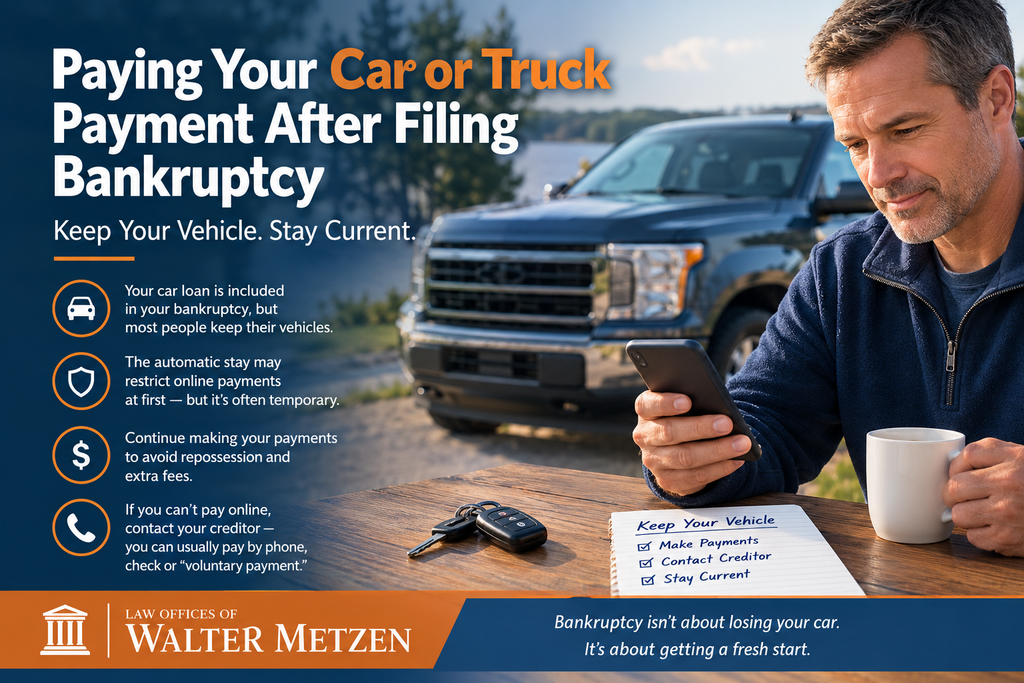
The problem is usually caused by the automatic stay.
When a bankruptcy case is filed, the automatic stay goes into effect. This generally prevents creditors from taking collection action against the debtor while the bankruptcy case is pending.
The automobile finance company or leasing company receives notice of the bankruptcy filing. As part of its response to the bankruptcy filing, the creditor may shut down or restrict the debtor’s ability to make payments through its normal online payment system.
This sometimes happens automatically.
It can be confusing because the debtor has done nothing wrong. The debtor is simply trying to continue making the car payment.
I have had many clients call me very concerned because they suddenly cannot log into the finance company’s website or cannot make their normal electronic payment.
That does not necessarily mean that the finance company wants your vehicle back.
Your Car Loan Is Still Listed in the Bankruptcy
There is an important distinction between including your car loan in the bankruptcy and giving up your car.
Bankruptcy law requires you to disclose and list your debts. You cannot simply leave a car loan off your bankruptcy petition because you want to keep the car.
The car loan must be listed.
But listing the loan in the bankruptcy does not automatically mean that you must surrender the vehicle.
If you want to keep your vehicle, you generally need to continue making the required payments and comply with the requirements applicable to your particular Chapter 7 or Chapter 13 case.
In a Chapter 7 case, this may involve a reaffirmation agreement, a redemption, or in some circumstances continuing to make payments and retaining the vehicle under applicable law and the creditor’s policies.
Every case is different, particularly depending upon whether you are current on the loan and whether the vehicle is leased or financed.
The Most Important Thing: Don’t Stop Making Your Payments
If you want to keep your car or truck, do not assume that filing bankruptcy means you can stop making the payments.
If you are current on your vehicle financing and intend to keep the vehicle, you should continue making the required payments.
If the creditor has temporarily disabled your online payment account, contact the creditor and ask how you can make a payment.
Sometimes the creditor will restore online payment access after the bankruptcy case is processed. In other situations, you may have to make what the creditor calls a “voluntary payment.”
The terminology can be confusing.
The important thing is that you make the payment and keep the loan current.
Why Would the Finance Company Want You to Keep the Vehicle?
There is a very practical reason that your automobile finance company generally prefers that you keep making your payments.
They would rather receive your monthly payment than repossess your vehicle.
Repossession is expensive.
If a lender repossesses a vehicle, there can be towing and repossession expenses, storage charges, auction expenses and other costs associated with taking and selling the vehicle.
Then the vehicle has to be sold, usually at an auction.
The lender may recover substantially less than the balance owed on the loan.
For that reason, when a debtor is current on a vehicle loan and wants to keep the vehicle, the lender generally has a financial incentive to continue the lending relationship rather than immediately repossessing the vehicle.
That does not mean a creditor is required to let you keep a vehicle regardless of the circumstances. If you stop making payments or otherwise default on the loan, the situation can change very quickly.
What Should You Do If Your Online Payment Doesn’t Work?
If you have filed Chapter 7 bankruptcy and suddenly discover that you cannot make your normal online car payment, don’t panic and don’t simply skip the payment.
Call the finance company.
Explain that you filed bankruptcy and that you want to keep the vehicle and continue making the payments.
Ask the creditor:
- How can I make my current payment?
- Can I make the payment by telephone?
- Can I send a check or money order?
- Can you restore my online payment access?
- Do you require the payment to be designated as a voluntary payment?
Keep a record of your payments.
If you are working with a bankruptcy attorney, let your attorney know what happened. Your attorney can also help determine whether there are additional issues involving reaffirmation, the automatic stay or the creditor’s treatment of your account.
What Happens After the Bankruptcy Discharge?
In many cases, the payment process becomes much easier after the bankruptcy case is completed and the discharge is entered.
The creditor may restore online access to your account, allowing you to resume making payments through the same website or electronic payment system you used before bankruptcy.
Sometimes you may have to contact the creditor to have the online account reinstated.
The fact that you could not make an online payment immediately after filing bankruptcy does not necessarily mean that there is a problem with your vehicle loan.
It is often simply a consequence of the creditor’s procedures following the bankruptcy filing.
Don’t Confuse Your Bankruptcy With Losing Your Car
This is one of the most important things I want my clients to understand.
Filing bankruptcy does not mean that you automatically lose your car or truck.
In fact, most of my clients who file Chapter 7 bankruptcy need their vehicle and intend to keep it.
The bankruptcy is being filed to eliminate or reorganize the debts that are causing the financial problem—not to take away the transportation you need to earn a living.
But you must handle the vehicle loan correctly.
If you want to keep your vehicle, stay current with your payments. If the finance company temporarily prevents you from making an online payment, contact them and find out how they want you to make the payment.
Don’t assume that you don’t have to pay simply because you filed bankruptcy.
And don’t assume that you are losing your vehicle simply because the online payment system has been shut off.
Those are two very different things.
If You Have Questions About Your Car Loan and Bankruptcy
If you are considering filing bankruptcy and are worried about what will happen to your car, truck or leased vehicle, this is something you should discuss with your bankruptcy attorney before filing.
There are important differences between financing and leasing a vehicle, being current or behind on payments, reaffirming a loan, surrendering a vehicle and continuing payments after filing.
I have represented thousands of people in Michigan bankruptcy cases, and one of the most important parts of the process is making sure my clients understand what is going to happen to the property they need to keep.
If you are considering bankruptcy and need to keep your vehicle, don’t guess about what will happen. Get the answer before you file.