Online Scams Are Destroying Lives — And Bankruptcy May Help Victims Who Are Left With Massive Debt

Published
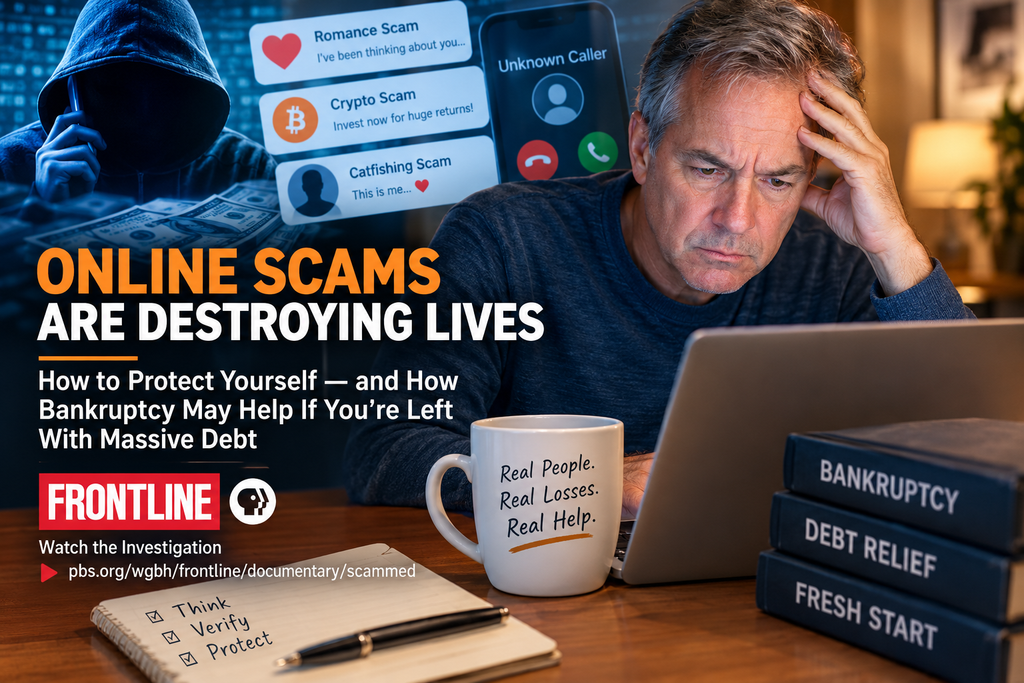
Last night, I watched a remarkable FRONTLINE documentary on PBS called Scammed, which examines the enormous and rapidly growing worldwide industry of online scams.
The program was particularly disturbing because it demonstrated just how organized these operations have become. We are no longer talking about some individual sitting in a basement sending out a few fraudulent emails. There are now enormous criminal enterprises operating around the world, including scam compounds that function almost like small cities or industrial operations, with large numbers of people making telephone calls, sending text messages and communicating with victims online — many of them specifically targeting people in the United States.
The documentary premiered on September 29, 2026, and is a joint investigation by FRONTLINE and The Associated Press into the global criminal industry behind online scams. FRONTLINE reports that the investigation examined how scam compounds operate, how technology is used to facilitate the scams and why so many victims have difficulty recovering their money.
Table of Contents
- Anyone Can Become a Victim
- The Scammers Are Professionals
- Romance Scams
- Catfishing Scams
- Cryptocurrency Investment Scams
- Other Types of Scams
- The Financial Damage Can Be Catastrophic
- Can Bankruptcy Help a Scam Victim?
- Why Don’t the Police Simply Get the Money Back?
- How Can You Protect Yourself?
- What If You Have Already Been Scammed?
Anyone Can Become a Victim
One of the most important things I took away from the documentary is that anyone can become a victim of an online scam.
It is easy to look at someone who has been scammed and say, “I would never fall for something like that.”
I would not say that.
Over my more than 30 years practicing bankruptcy law, I have represented people from all walks of life. Some of my clients who have become victims of scams are intelligent, successful and financially sophisticated people. They did not lose their money because they were stupid.
They lost their money because professional criminals spent enormous amounts of time manipulating them.
These criminals are good at what they do.
The FBI reported that Americans filed more than one million internet-crime complaints in 2025, with reported losses approaching $21 billion. Cryptocurrency-related complaints alone involved more than $11 billion in reported losses. Americans age 60 and older reported approximately $7.7 billion in losses.
And those numbers almost certainly do not represent the entire problem. Many victims are embarrassed, ashamed or afraid to tell their families or the authorities what happened.
The Scammers Are Professionals
Today’s scams can be extraordinarily sophisticated.
A scammer may spend weeks or months establishing a relationship with a victim. The criminal may have photographs, a convincing biography, a fake LinkedIn profile, a fake Facebook account, a fake investment website and even a fake telephone number.
Artificial intelligence is making the problem even worse.
Scammers can now use AI to generate convincing written communications, create fake photographs and produce increasingly realistic voices and videos. FRONTLINE recently reported that AI is eliminating many of the warning signs that people previously relied upon to identify a fake person or communication.
The result is that the old advice — “You can tell because something doesn’t look right” — is becoming increasingly unreliable.
Romance Scams
I have personally represented clients who became victims of romance scams.
The scammer may initially appear to be looking for a romantic relationship. He or she may communicate with the victim every day.
The relationship becomes increasingly personal.
Eventually, a crisis develops.
Perhaps the person has been injured. Perhaps he or she needs money for an emergency. Perhaps there is a problem with a business transaction. Perhaps the person needs money to travel to the United States.
The victim sends money.
Then another emergency occurs.
And another.
Before the victim realizes what is happening, tens or hundreds of thousands of dollars may have disappeared.
The FBI describes romance scams as a form of confidence fraud in which criminals create fake identities and develop emotional relationships before exploiting the victim financially.
Catfishing Scams
Closely related are catfishing scams.
The person you think you are communicating with may not exist at all — at least not in the way you believe.
The photographs may belong to somebody else. The name may be fake. The occupation may be fake. The location may be fake.
The person may even have several victims at the same time.
The FBI has reported that scammers frequently create thousands of fake dating profiles and use social media, text messages and dating applications to locate victims.
I have represented clients who have lost substantial amounts of money through precisely these types of relationships.
Cryptocurrency Investment Scams
Another devastating category is the cryptocurrency investment scam.
These scams are sometimes referred to as “pig butchering,” although I generally prefer to simply call them cryptocurrency investment fraud.
The scam often begins innocently.
Someone contacts you online.
Perhaps it is a wrong-number text.
Perhaps it is somebody you meet on a dating website.
Perhaps it is a person who claims to have an investment opportunity.
The person develops your confidence and then introduces you to a cryptocurrency investment platform.
You deposit $10,000.
The website shows that your account is now worth $12,000.
You deposit another $25,000.
The website shows $45,000.
You may even be allowed to withdraw a small amount of money, which makes the entire operation appear legitimate.
Eventually, however, you try to withdraw your money and discover that you cannot.
The criminals then tell you that you must pay taxes, fees or additional amounts before your money can be released.
It is all part of the scam.
The FBI says cryptocurrency investment fraud was the largest source of reported financial losses to Americans in 2025, with approximately $7.2 billion in reported losses. The FBI also says these operations are frequently run by organized criminal enterprises overseas.
The FBI’s Operation Level Up has identified thousands of victims who did not even realize they were being scammed. As of December 2025, the FBI reported that it had notified 8,103 victims and estimated that those interventions prevented more than $511 million in additional losses.
Other Types of Scams
Unfortunately, romance and cryptocurrency scams are only part of the problem.
Other common scams include:
- Fake investment opportunities
- Online banking scams
- Identity theft
- Fake government or IRS scams
- Tech-support scams
- Fake employment scams
- Business-email scams
- Social Security scams
- Lottery and sweepstakes scams
- Grandparent and family-emergency scams
- Fake debt-collection scams
- Extortion scams
- Sextortion
- Online shopping scams
- Check and wire-transfer scams
- Fraudulent cryptocurrency exchanges
- Fake online lending companies
- Missed jury duty scams
And new variations appear constantly.
The Financial Damage Can Be Catastrophic
This is where my work as a bankruptcy attorney sometimes intersects with this terrible problem.
I have had clients come into my office who have lost their life savings to these scams.
Some have lost retirement accounts.
Some have borrowed money.
Some have taken out loans.
Some have used credit cards.
Some have borrowed against their homes.
And some have accumulated enormous amounts of debt trying to recover money that was already gone.
In some cases, the victim keeps sending money because the scammer convinces the victim that the next payment will finally unlock the money that has supposedly been sitting in an investment account.
It never does.
By the time the victim finally understands what has happened, the retirement account may be empty and the credit cards and loans may be completely maxed out.
That can leave a person with two separate problems:
The money that was stolen is gone — and the debt used to pay the scammers remains.
Can Bankruptcy Help a Scam Victim?
This is an important distinction.
Bankruptcy generally cannot recover the money that a criminal stole from you.
If you sent $300,000 to a scammer in another country, filing bankruptcy does not magically make the $300,000 reappear.
But bankruptcy may be able to eliminate debts that you incurred as a result of being victimized by the scam.
For example, suppose someone loses $100,000 of savings and then incurs another $150,000 of credit-card and loan debt in connection with the scam.
The $100,000 that was stolen is gone.
But the $150,000 in legitimate debts may potentially be discharged in a Chapter 7 bankruptcy, assuming the person otherwise qualifies and there is no separate legal reason why a particular debt is nondischargeable.
I have successfully obtained bankruptcy discharges for clients who were left with substantial debts after being victimized by scams.
Every case has to be examined individually. The particular circumstances surrounding the debt matter. Bankruptcy law contains exceptions to discharge, including certain debts involving fraud or other conduct described in the Bankruptcy Code. But being the victim of fraud is very different from committing fraud.
That distinction can be extremely important.
Why Don’t the Police Simply Get the Money Back?
Clients understandably ask me this question.
“If the police know this is happening, why can’t they just arrest the scammers and get my money back?”
Unfortunately, it is often extremely difficult.
Many of these operations are located outside the United States. The criminals may use multiple countries, cryptocurrency, shell companies, money mules, foreign bank accounts and constantly changing websites and telephone numbers.
The people communicating with the victim may not even be the people ultimately receiving the money.
The FBI has described cryptocurrency investment fraud operations involving organized criminal enterprises operating from scam compounds in Southeast Asia and other parts of the world.
Law enforcement agencies are making arrests and recovering some money. The FBI’s Operation Level Up is an example of a program designed to intervene before victims lose even more. But for an individual who has already transferred a large amount of money overseas, recovery is unfortunately far from guaranteed.
That is why prevention is so important.
How Can You Protect Yourself?
There are some basic rules that I recommend everyone follow.
1. Slow Down
This may be the single most important rule.
Scammers want you to act immediately.
“Don’t tell anybody.”
“You have to do this today.”
“Your account will be closed.”
“Your money will be lost.”
“Pay the tax immediately.”
“Don’t talk to your bank.”
Stop.
Take a day.
Talk to somebody you trust.
The FBI now specifically encourages people to “Take a Beat” before sending money or personal information.
2. Never Send Money to Someone You Have Only Met Online
This is particularly important with romantic relationships.
If someone you have never met in person asks you to send money, consider that an enormous warning sign.
3. Be Extremely Careful With Cryptocurrency
If someone you met online tells you about a cryptocurrency investment opportunity, be extraordinarily skeptical.
Especially if that person insists that you keep the investment secret.
4. Verify the Person Independently
Do not rely on the telephone number, email address or website provided by the person contacting you.
Find the legitimate company or government agency independently and contact it yourself.
5. Don’t Let Someone Isolate You
One characteristic of many scams is that the criminal attempts to isolate the victim.
The scammer doesn’t want your spouse, children, friends, banker or attorney asking questions.
If someone tells you that you must keep the relationship or investment secret, that is a major warning sign.
6. Don’t Be Embarrassed to Ask for Help
This is extremely important.
If you think you may have been scammed, tell somebody immediately.
Don’t continue sending money because you are embarrassed to admit what happened.
And don’t believe a second person who promises that they can recover the first person’s money for a fee. “Recovery scams” can cause victims to lose even more money.
What If You Have Already Been Scammed?
If you have already lost money, act quickly.
Contact your bank or financial institution.
Preserve emails, text messages, telephone numbers, cryptocurrency transaction records, bank records and screenshots.
Report the crime to the appropriate law-enforcement agency and to the FBI’s Internet Crime Complaint Center (IC3). The FBI specifically recommends documenting the scammer’s identity, methods of contact, dates, payment methods, destination of funds and the communications involved.
And if you have been left with substantial debt because of the scam, talk to a bankruptcy attorney.
Do not assume that because you were the victim of a scam, you have to spend the rest of your life paying the resulting debt.
I have represented people who came into my office believing that their financial lives were over. In appropriate cases, bankruptcy has provided them with a fresh start by discharging debts they could no longer afford to pay.
The criminals may have taken their money.
But that does not necessarily mean the criminals get to control the rest of their financial lives.
If you are in Michigan and have been the victim of an online scam and are now overwhelmed by the resulting debt, I invite you to contact my office to discuss whether bankruptcy may be able to help.
I have practiced bankruptcy exclusively for more than 30 years and have represented more than 25,000 people in bankruptcy cases. I understand that people who have been scammed are victims — not criminals — and I have successfully helped scam victims obtain bankruptcy discharges.
The important thing is to get advice before the situation becomes even worse.