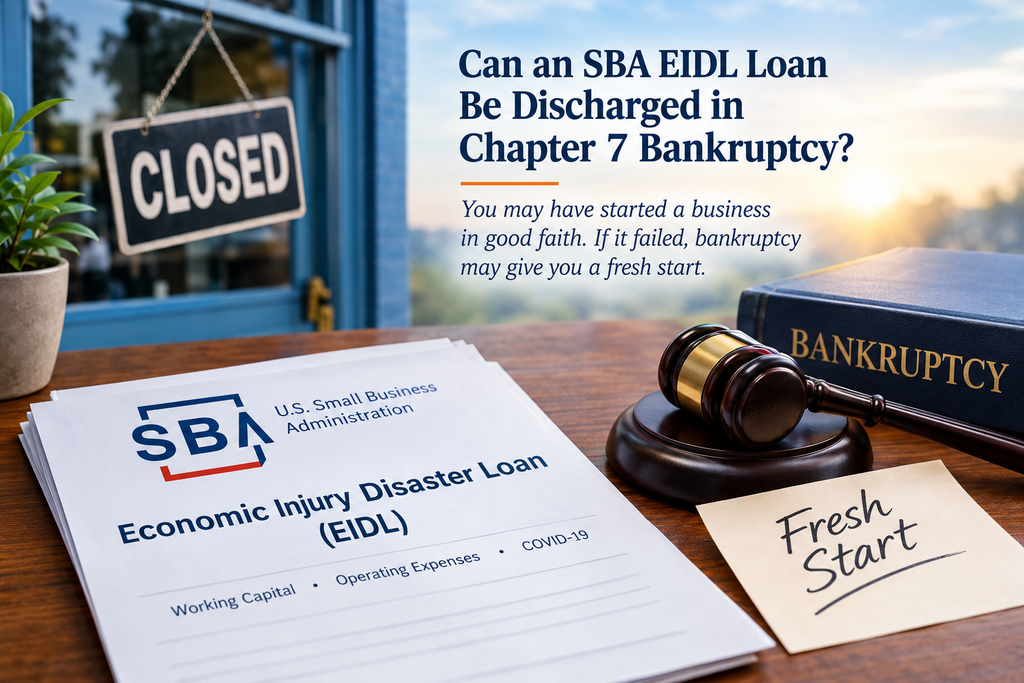
Can an SBA EIDL Loan Be Discharged in Chapter 7 Bankruptcy?

Published
During the COVID-19 pandemic, the federal government made billions of dollars available to small businesses through various programs designed to help businesses survive the economic disruption caused by the pandemic.
One of the most important of these programs was the Economic Injury Disaster Loan, commonly called an EIDL loan, administered by the U.S. Small Business Administration (SBA).
The EIDL program provided businesses with loans to help pay ordinary business expenses and working capital needs during the pandemic. Unlike the Paycheck Protection Program (PPP), EIDL loans were loans that generally had to be repaid.
Now, several years later, I am seeing an increasing number of people who took out EIDL loans during the pandemic and are having difficulty paying them.
Some of these businesses are still operating but are struggling.
Others have closed their doors completely.
And in many cases, the business owner is still dealing with a substantial SBA debt even though the business that borrowed the money is no longer generating enough income to pay it.
Table of Contents
- What Is an EIDL Loan?
- The Business Failed — But the Debt Did Not
- Can an EIDL Loan Be Discharged in Chapter 7?
- I Have Successfully Discharged EIDL Loans for My Clients
- What About EIDL Loans With Collateral?
- What If I Personally Guaranteed the EIDL?
- There Is an Important Exception: Fraud or Misuse of the Loan
- What Happens If the SBA Is Still Trying to Collect?
- Chapter 7 Bankruptcy May Give a Failed Business Owner a Fresh Start
What Is an EIDL Loan?
The COVID-19 Economic Injury Disaster Loan program was established to provide financial assistance to businesses that were suffering economic injury because of the COVID-19 disaster.
The loans could be used for working capital and normal operating expenses. They were generally offered at relatively low interest rates and with long repayment periods.
For many small-business owners, these loans provided desperately needed cash at a time when businesses were shut down or operating at greatly reduced capacity.
A restaurant owner might have used the money to keep paying rent and utilities.
A contractor might have used it to keep his business operating while jobs disappeared.
A retail business might have used it to pay employees and other operating expenses.
A service business might have used it simply to stay open.
At the time, many business owners reasonably believed that their businesses would eventually recover.
Unfortunately, that has not happened for everyone.
The Business Failed — But the Debt Did Not
One of the biggest misconceptions I encounter is the belief that closing a business gets rid of the business’s EIDL loan.
It does not.
Simply shutting down an LLC, corporation, sole proprietorship, or other business does not automatically eliminate the debt.
The SBA continues to have collection rights according to the loan documents, and delinquent COVID EIDL loans can be referred for further federal collection activity.
This can create a very difficult situation.
Imagine someone started a small business in 2020. The business needed money to survive the pandemic, so the owner obtained an EIDL loan.
The business subsequently failed.
The equipment may have been sold.
The business bank account may have been closed.
The business may no longer exist.
But the SBA loan can remain.
If the individual is personally liable for the debt — whether because of the structure of the borrowing, a personal guarantee, or other provisions of the loan documents — the owner can be left with a substantial personal financial obligation after the business itself is gone.
That is where bankruptcy may provide an important solution.
Can an EIDL Loan Be Discharged in Chapter 7?
Generally, yes.
There is nothing in the Bankruptcy Code that creates a blanket exception from discharge simply because a debt is owed to the Small Business Administration.
Chapter 7 bankruptcy is designed to provide an individual with a fresh start by eliminating personal liability for debts that are dischargeable under the Bankruptcy Code.
An EIDL loan is not automatically excluded from Chapter 7 discharge simply because the SBA made the loan.
This is important because some people assume that a debt owed to the federal government cannot be discharged in bankruptcy.
That is not correct.
There are certain government-related debts that Congress has specifically made nondischargeable. The Bankruptcy Code contains numerous exceptions to discharge, including certain taxes, domestic-support obligations, certain student loans, and debts resulting from fraud and other specified conduct.
But an ordinary EIDL loan is not automatically nondischargeable merely because it is an SBA loan.
I Have Successfully Discharged EIDL Loans for My Clients
I have represented many people who took out EIDL loans during the pandemic and subsequently found themselves unable to repay them.
In appropriate Chapter 7 cases, I have successfully obtained bankruptcy discharges that eliminated my clients’ personal liability for these types of SBA loans.
This is an important point for anyone who is carrying an EIDL loan:
Do not assume that you are going to have to pay the loan for the next 20 or 30 years simply because you signed an SBA loan agreement.
If the business has failed and you are personally responsible for the debt, bankruptcy may be an option.
What About EIDL Loans With Collateral?
There is an additional issue that needs to be examined with many EIDL loans: collateral.
The COVID EIDL program generally required collateral for loans above certain thresholds. SBA materials indicate that loans over $25,000 generally involved a security interest in business assets, while personal guarantees were generally required for loans over $200,000. The actual loan and security documents should always be reviewed to determine what applies to a particular borrower.
This distinction is important.
A bankruptcy discharge eliminates personal liability for a dischargeable debt. It does not necessarily eliminate a valid lien against property securing that debt. The federal courts explain that a valid lien can survive bankruptcy even though the debtor’s personal obligation to pay the debt has been discharged.
Consequently, an EIDL loan should not simply be described as either “secured” or “unsecured” without looking at the particular loan documents and the assets involved.
What If I Personally Guaranteed the EIDL?
This is another important issue.
For COVID-19 EIDL loans above $200,000, personal guarantees were generally required under the SBA’s program rules.
If you signed a personal guarantee, the fact that the business was the original borrower does not necessarily protect you from personal collection efforts.
However, a personal guarantee is itself a personal obligation, and bankruptcy can potentially discharge that personal liability if the debt is otherwise dischargeable.
Again, the actual documents need to be reviewed.
There Is an Important Exception: Fraud or Misuse of the Loan
There is one subject that I would never overlook when discussing an EIDL bankruptcy: how the loan was obtained and how the money was used.
The Bankruptcy Code contains exceptions to discharge for certain debts obtained through fraud, false pretenses, or false representations.
That means an EIDL loan should not be treated as automatically dischargeable under every circumstance.
For example, there has already been litigation in which the SBA successfully argued that an individual debtor’s EIDL debt was nondischargeable because of alleged fraudulent representations concerning the loan.
This is why I ask my clients questions about the business, the loan application, the use of the funds, and what happened to the business after the loan was received.
A person whose legitimate business borrowed money during COVID and later failed is very different from a person who obtained an EIDL loan through intentional misrepresentations or knowingly used the funds for prohibited purposes.
Those facts matter.
What Happens If the SBA Is Still Trying to Collect?
If you have an EIDL loan that is delinquent, you should not simply ignore it.
The SBA has collection procedures for delinquent COVID EIDL loans, and some delinquent debts can eventually be referred to the Treasury Department for collection.
If you are already receiving collection notices, have been contacted by the SBA or Treasury, or are concerned about the possibility of a lawsuit or other collection activity, this is a good time to determine whether bankruptcy is appropriate rather than waiting until the situation becomes more serious.
Chapter 7 Bankruptcy May Give a Failed Business Owner a Fresh Start
The purpose of Chapter 7 bankruptcy is to give an honest individual debtor a fresh start by eliminating personal liability for debts that are legally dischargeable.
For a small-business owner who borrowed money through the COVID EIDL program, that can be particularly important.
You may have started your business in good faith.
You may have borrowed the money because your business was struggling during COVID.
You may have done everything you could to make the business succeed.
And you may have ultimately lost the business anyway.
That does not necessarily mean that you must spend the rest of your working life paying an EIDL loan that your failed business can no longer afford.
If you personally owe an SBA EIDL loan and your business has failed or is struggling, it is worth having the debt reviewed by an experienced bankruptcy attorney.
I have helped many clients deal with these loans through Chapter 7 bankruptcy, and in appropriate cases I have successfully obtained discharges of their personal liability for EIDL debt.
The important thing is to look at the entire financial picture — including the EIDL loan, any personal guarantee, collateral, other debts, income, assets, and the circumstances under which the loan was obtained and used — before deciding what to do.
If you are struggling with an EIDL loan, call my office for a free bankruptcy consultation. I will review your situation with you and explain whether Chapter 7 bankruptcy may provide a way to eliminate your personal liability for the debt and give you the fresh start that bankruptcy is intended to provide.