Missed Jury Duty Scam: Don’t Become the Next Victim

Published
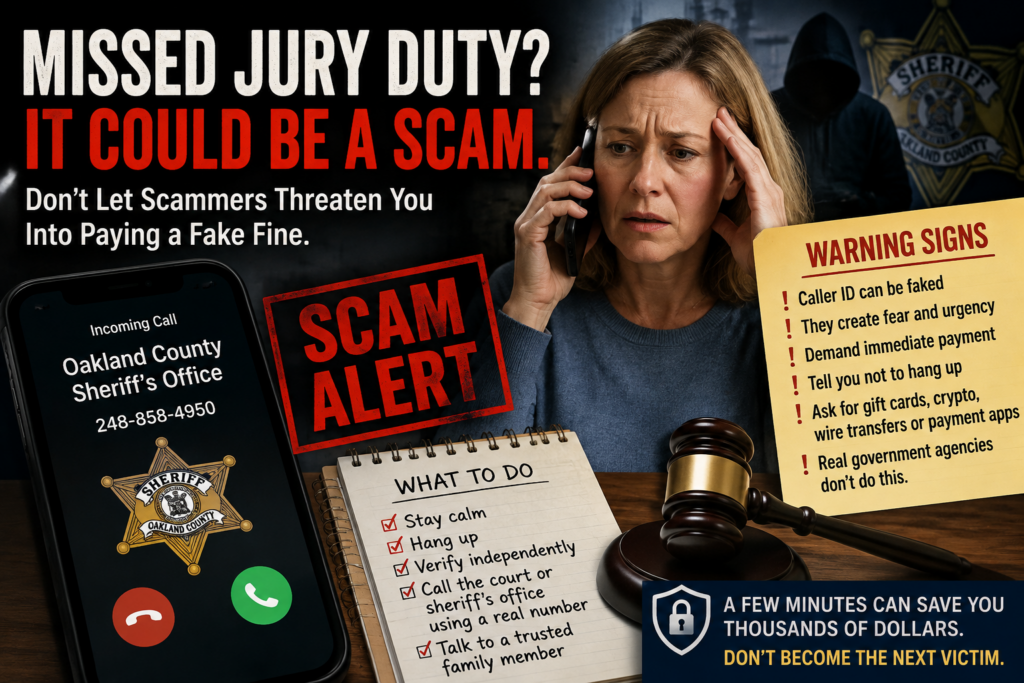
Every week it seems there is a new scam targeting hardworking Americans. Unfortunately, many of these scams have become so sophisticated that even intelligent, cautious people can be fooled.
Recently, a close relative of mine—someone who is well-educated, financially responsible, and certainly not someone who is easily deceived—was almost the victim of one of the fastest-growing scams in the country: the “Missed Jury Duty” scam.
Fortunately, she realized something wasn’t right before she lost any money.
Unfortunately, many others are not as fortunate.
The Phone Call Looked Legitimate
The call appeared to come from our local Oakland County Sheriff’s Office.
The caller ID displayed the Sheriff’s Office telephone number.
The caller identified himself as a Sergeant and spoke professionally and confidently.
He informed my relative that she had failed to appear for jury duty and that a warrant had been issued for her arrest.
Imagine receiving that phone call.
Most law-abiding people have never had any interaction with law enforcement. Hearing that a warrant has supposedly been issued is frightening enough to make anyone panic.
That is exactly what the scammers are counting on.
The Pressure Begins
The caller explained that there was still time to “take care of the matter.”
According to him, she could avoid being arrested by immediately paying a fine and posting a bond.
He stressed that she had to act quickly.
She was instructed not to hang up.
She was told to remain on the phone while making arrangements to pay.
The caller became increasingly urgent, insisting that officers could be dispatched if she failed to cooperate.
Fortunately, as the conversation continued, small details began to sound suspicious. Instead of acting out of fear, she stopped, questioned the situation, and ultimately realized she was speaking with a scammer.
Caller ID Can Be Faked
One of the most dangerous aspects of this scam is that the phone number appearing on your caller ID may actually belong to your local police department or sheriff’s office.
This is called caller ID spoofing.
With today’s technology, scammers can make it appear that they are calling from almost any legitimate telephone number.
Never assume a call is genuine simply because you recognize the number.
How the Scam Works
The scammers rely on several psychological tactics:
- They create fear by claiming you will be arrested.
- They create urgency by insisting immediate payment is required.
- They discourage independent verification by keeping you on the phone.
- They impersonate trusted government officials.
- They often demand unusual forms of payment such as gift cards, cryptocurrency, wire transfers, or electronic payment apps.
These tactics are designed to prevent you from slowing down and thinking logically.
How to Protect Yourself
If you receive a similar phone call:
- Do not panic.
- Do not make any payment during the call.
- Do not provide personal or financial information.
- Hang up.
- Look up the official telephone number for the court or sheriff’s office yourself—not the number shown on your caller ID—and call them directly.
- Discuss the situation with a trusted family member or friend before taking any action.
Government agencies do not resolve alleged jury duty violations by demanding immediate payment over the telephone.
Why Bankruptcy Clients Should Be Especially Careful
Many people considering bankruptcy are already under tremendous financial stress.
Scammers know this.
Someone who is worried about creditors, lawsuits, garnishments, or financial hardship may be especially vulnerable to a threatening phone call claiming an arrest warrant has been issued.
That fear can cause otherwise careful people to make quick decisions they normally never would.
The scam has nothing to do with whether someone has filed bankruptcy or owes money. It is simply another attempt to frighten honest people into sending money to criminals.
Remember: Fear Is Their Greatest Weapon
One common theme runs through nearly every scam I discuss on this blog.
The criminals want you to stop thinking and start reacting.
Whether they claim you missed jury duty, owe back taxes, have a suspended Social Security number, or have an unpaid debt, they all rely on the same strategy: fear and urgency.
The moment someone tells you that you must act immediately, that should be your signal to slow down.
The Bottom Line
The missed jury duty scam is becoming increasingly sophisticated. Scammers can spoof legitimate government telephone numbers, sound convincing, and create a false sense of urgency that causes even intelligent people to question themselves.
My own relative nearly became a victim, and if it can happen to someone like her, it can happen to almost anyone.
If you receive a call claiming you missed jury duty or that a warrant has been issued for your arrest unless you immediately pay a fine, hang up and independently verify the information by contacting the court or law enforcement agency using an official published telephone number.
A few minutes of verification can save you thousands of dollars—and a great deal of unnecessary stress.
A Personal Word from Walter Metzen
During my years of practicing bankruptcy law, I have met thousands of honest, hardworking people who have been targeted by scammers. These criminals do not prey on ignorance—they prey on fear. They count on catching good people off guard and convincing them to act before they have time to think.
If this article helps even one person avoid becoming a victim, then it has served its purpose. Please consider sharing it with your parents, grandparents, neighbors, and friends. Sometimes a simple conversation about these scams is all it takes to prevent someone from losing their hard-earned savings.