What Is a Motion for Relief from the Automatic Stay?

Published
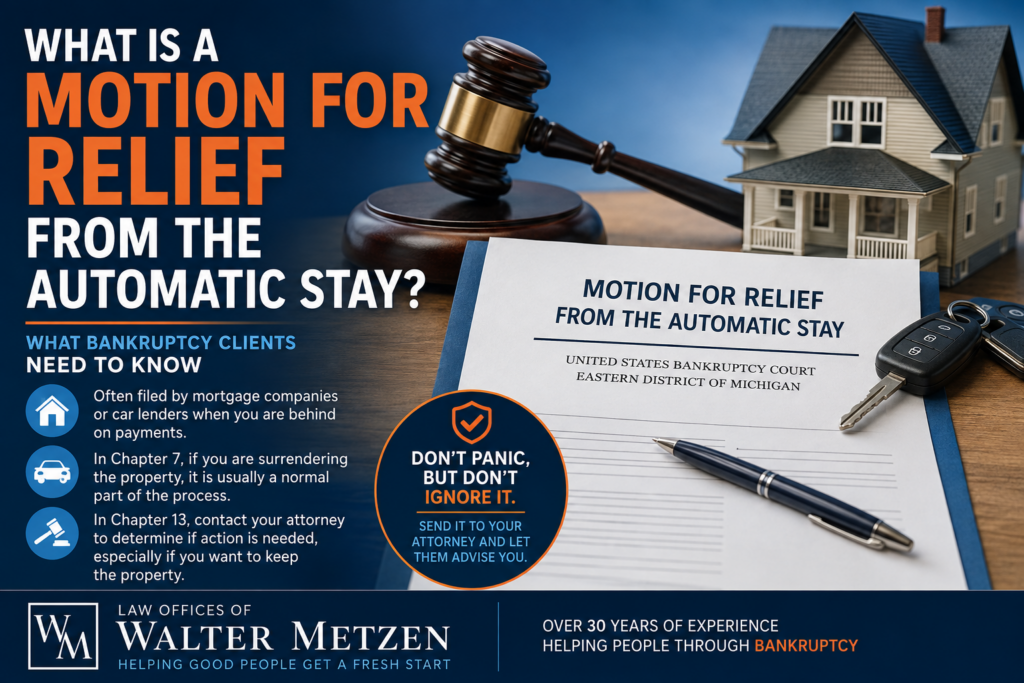
One of the documents that often causes unnecessary concern for my bankruptcy clients is something called a “Motion for Relief from the Automatic Stay.” You may also hear it referred to as a “Motion to Lift the Automatic Stay.”
When a client receives one of these motions, the first reaction is often: “I thought bankruptcy was supposed to stop my creditors. Why is my mortgage company or car lender asking the Bankruptcy Court for permission to do something?”
The answer is that a Motion for Relief from the Automatic Stay is actually a fairly normal part of many bankruptcy cases.
Table of Contents
- What is the Automatic Stay?
- Why would a mortgage company file a Motion for Relief?
- The same thing can happen with a vehicle
- What if I am surrendering the house or car?
- What about Chapter 7?
- Chapter 13 is different
- Does a Motion for Relief mean my bankruptcy is over?
- Why is the creditor required to ask the Bankruptcy Court?
- My advice to bankruptcy clients
What is the Automatic Stay?
When you file bankruptcy, the Bankruptcy Code generally provides an automatic stay that stops most collection activity against you. This includes things such as foreclosure, repossession, lawsuits, garnishments and other collection efforts. The automatic stay is one of the most important protections provided by bankruptcy.
The idea is simple: when you file bankruptcy, your creditors generally have to stop and allow the Bankruptcy Court process to take place.
But the automatic stay does not mean that a creditor is permanently prevented from enforcing its rights against property that secures its debt.
A mortgage company still has a mortgage. A car lender still has a lien on your vehicle. If you are not going to keep the property, or if you are seriously behind on the payments, the creditor may ask the Bankruptcy Court for permission to proceed with its rights against that property.
That request is called a Motion for Relief from the Automatic Stay.
Why would a mortgage company file a Motion for Relief?
Suppose you are filing Chapter 7 bankruptcy and you are several months behind on your mortgage. You have decided that you cannot afford the house and intend to surrender it in the bankruptcy.
The mortgage company may file a Motion for Relief from the Automatic Stay.
The purpose of the motion is essentially to ask the Bankruptcy Court to allow the mortgage company to proceed with foreclosure despite the bankruptcy filing. The Eastern District of Michigan Bankruptcy Court explains that a creditor seeking to continue an action that was stopped by the automatic stay must file a Motion for Relief from the Automatic Stay.
That may sound alarming if you have never been through bankruptcy before.
But if you have already decided to surrender the house, there may be nothing wrong with the mortgage company asking for relief from the stay.
In fact, it is often simply the next step in the process.
The same thing can happen with a vehicle
The same situation can occur with a car.
If you are behind on your car payments and have decided that you are going to surrender the vehicle in Chapter 7, the lender may file a Motion for Relief from the Automatic Stay.
Again, this does not mean that your bankruptcy has failed.
It does not mean that you are losing your discharge.
It does not mean that the creditor is suddenly entitled to collect the entire debt from you personally.
It generally means that the creditor is asking the Bankruptcy Court for permission to take action concerning its collateral—in this case, the automobile.
What if I am surrendering the house or car?
This is where I tell my clients not to panic.
If you are filing Chapter 7 and have told me that you are surrendering your house or vehicle, a Motion for Relief from the Automatic Stay is often nothing that you need to fight.
The bankruptcy case and the secured creditor’s rights in the collateral are two different things.
If you are giving up the property, there is generally no reason for you to spend money and time fighting to keep the creditor from taking possession of property you have already decided you do not want.
This is one of those situations where a document that looks very serious can actually be a routine part of getting the bankruptcy case and the secured creditor’s claim properly resolved.
What about Chapter 7?
In the vast majority of Chapter 7 cases, if a creditor files a Motion for Relief from the Automatic Stay concerning a house or vehicle that the debtor is surrendering, there is often nothing that the debtor needs to do personally.
That does not mean you should simply ignore every motion that arrives in your mailbox.
If you receive a Motion for Relief from the Automatic Stay, send it to your bankruptcy attorney. Your attorney can look at the motion and determine whether anything needs to be done.
There are situations where an objection may be appropriate. For example, the facts may be incorrect or there may be some other legal issue that needs to be addressed.
But if the facts are straightforward and you are surrendering the collateral, the motion may simply be part of the normal Chapter 7 process.
Chapter 13 is different
I want to make an important distinction between Chapter 7 and Chapter 13.
If you are in Chapter 13, you should contact your bankruptcy attorney when you receive a Motion for Relief from the Automatic Stay.
Chapter 13 is designed to allow you to repay certain debts over time through a court-approved repayment plan. If you are trying to keep your home or your car, the situation can be much different from a Chapter 7 case in which you are surrendering the property.
For example, if you are behind on your mortgage but your Chapter 13 plan is designed to allow you to catch up on the mortgage arrearage, the mortgage company’s Motion for Relief may require a response.
Similarly, if you are trying to keep your vehicle and the lender claims that you are behind on post-bankruptcy payments, you need to have your attorney review the situation.
Do not assume that a Chapter 13 Motion for Relief from the Automatic Stay is routine and requires no action.
Call your attorney.
Does a Motion for Relief mean my bankruptcy is over?
No.
This is probably the most important thing to understand.
A Motion for Relief from the Automatic Stay generally concerns the creditor’s ability to take action against a particular property or pursue a particular remedy. It is not a motion to dismiss your bankruptcy case.
The Bankruptcy Code allows a creditor to request that the stay be terminated, modified, annulled or conditioned for certain reasons, including “cause” such as lack of adequate protection.
In other words, the creditor is asking the Bankruptcy Court for permission to proceed with something that the automatic stay would otherwise prevent.
Your bankruptcy case can continue even if the Bankruptcy Court grants relief from the stay concerning a particular piece of property.
Why is the creditor required to ask the Bankruptcy Court?
This is actually an important protection for the bankruptcy debtor.
A creditor cannot simply ignore the automatic stay and decide on its own that it is going to foreclose or repossess property. The creditor generally must come back to the Bankruptcy Court and request relief from the stay.
The Bankruptcy Court then has an opportunity to determine whether the creditor should be allowed to proceed.
The Eastern District of Michigan has specific procedures governing these motions, including notice to the debtor and an opportunity to object.
So, while the title of the document can be intimidating, the process itself is an established part of bankruptcy law.
My advice to bankruptcy clients
After more than 30 years of practicing bankruptcy law and handling thousands of consumer bankruptcy cases, I have seen many clients become worried when they receive a Motion for Relief from the Automatic Stay.
My advice is simple:
Don’t panic, but don’t ignore it.
If you are in a Chapter 7 case and you are surrendering the house or car, there is a very good chance that the motion is simply a normal part of the process and that no action is necessary.
If you are in Chapter 13, particularly if you are trying to keep your house or vehicle, contact your bankruptcy attorney promptly so that your attorney can determine whether an objection or other response is necessary.
The important thing is to understand what the document actually means before assuming the worst.
A Motion for Relief from the Automatic Stay does not necessarily mean that something has gone wrong with your bankruptcy. In many cases, it is simply the legal mechanism that allows a secured creditor to move forward with property that the debtor has decided to surrender.
And that is why I tell my clients: read the document, send it to your attorney, and let your attorney determine whether you need to do anything.