5 Post-Bankruptcy Mistakes to Avoid in Your First Year

Published
One of the things I tell my bankruptcy clients is that obtaining your bankruptcy discharge is not the end of your financial story. It is the beginning of a new chapter.
And, frankly, I have seen people make some very expensive mistakes during the first year after bankruptcy.
The good news is that most of these mistakes are completely avoidable.
After going through the bankruptcy process, you have hopefully eliminated a substantial amount of debt and gotten some breathing room. The last thing you want to do is immediately replace the debt you just eliminated with a new pile of expensive debt.
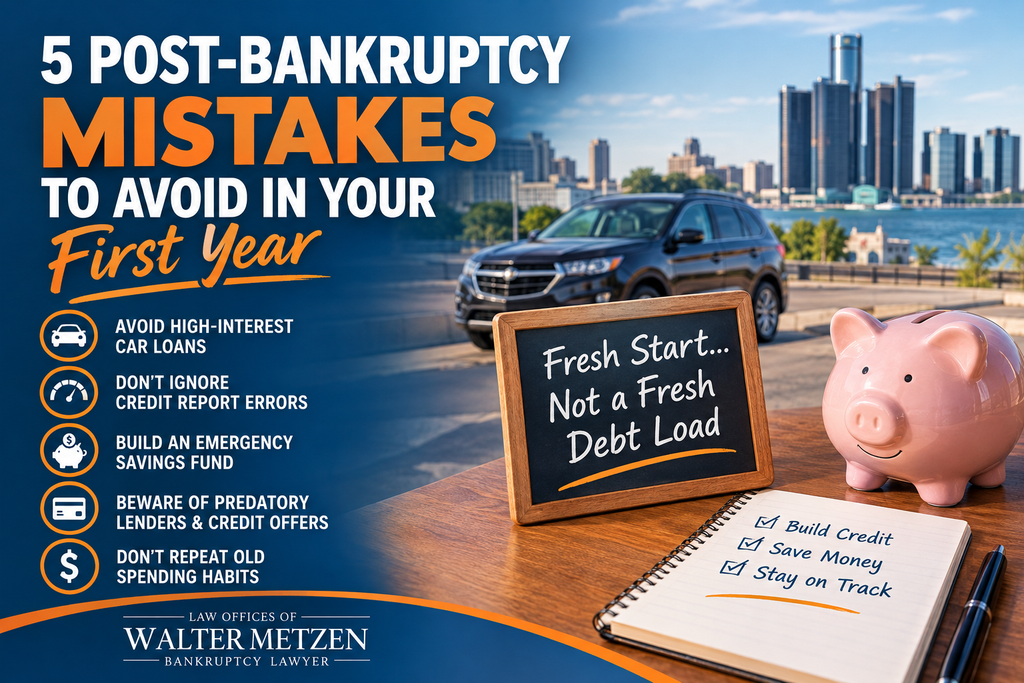
Here are five mistakes I would encourage you to avoid during your first year after bankruptcy.
Table of Contents
- 1. Don’t let a car dealership talk you into more car than you can afford
- 2. Don’t fall for high-interest “credit rebuilding” offers
- 3. Don’t ignore your credit reports
- 4. Don’t forget to build an emergency savings fund
- 5. Don’t go back to your old spending habits
- Your bankruptcy discharge is a fresh start—protect it
1. Don’t let a car dealership talk you into more car than you can afford
This is probably one of the most common problems I see with people who have recently completed a bankruptcy.
I understand why.
If you live in Metro Detroit, you know that we are the Motor City. Public transportation is limited in many parts of Southeast Michigan. If you need a vehicle to get to work, take your kids to school, go grocery shopping, or simply live your life, a reliable automobile is not a luxury—it may be a necessity.
So I am not telling you not to buy a car after bankruptcy.
I am telling you to be careful about what car you buy and how you finance it.
Unfortunately, some lenders specialize in lending to people with damaged credit. After a bankruptcy, you may receive offers for automobile financing that sound pretty good when you’re sitting in the dealership and looking at a shiny vehicle.
The problem may not become apparent until you look at the interest rate, loan term and total amount you will ultimately pay.
A $25,000 used vehicle can become a very expensive vehicle when you finance it at a high interest rate for six or seven years. I’ve seen rates as high as 29.99% here in Michigan.
And there is another problem.
You may be tempted to say:
“I just went through bankruptcy. I deserve something nice.”
I understand the feeling.
But this is where you need to take a deep breath.
You just got out of debt. Don’t immediately put yourself back into debt simply because you can qualify for the loan.
If you need a vehicle, buy a vehicle you can afford—not the most expensive vehicle the lender is willing to finance.
Look at the monthly payment, interest rate, length of the loan and total amount financed. And don’t forget insurance, fuel, maintenance, tires and repairs.
There is nothing wrong with driving a $15,000 or $20,000 vehicle after bankruptcy if it gets you where you need to go.
You don’t have to prove to anyone that you’ve “made it” because you received a bankruptcy discharge.
In fact, one of the smartest things you can do after bankruptcy may be to drive that old car for another year or two while you rebuild your finances.
2. Don’t fall for high-interest “credit rebuilding” offers
Once your bankruptcy is over, you may start receiving credit card offers, personal-loan offers and other solicitations.
Some will be legitimate opportunities to rebuild your credit.
Others will be expensive.
There are lenders and businesses that understand that someone coming out of bankruptcy may desperately want to rebuild his or her credit. That can make a recently discharged debtor an attractive customer for high-interest lenders.
Be careful.
You don’t need to borrow $10,000 at an outrageous interest rate simply because someone is willing to lend you the money.
You also don’t need five new credit cards.
In fact, one or two carefully managed accounts may be more than enough to begin establishing a positive payment history.
The Consumer Financial Protection Bureau recommends paying bills on time, keeping credit-card balances low relative to available credit, limiting applications for new credit and considering products such as secured credit cards when appropriate.
And remember something important:
You do not have to carry a balance on a credit card to build credit.
If you use a credit card, one sensible strategy is to charge only what you can afford to pay off each month and then pay the balance in full.
The goal is to demonstrate that you can responsibly manage credit—not to accumulate another mountain of debt.
3. Don’t ignore your credit reports
I tell my clients that after bankruptcy, you should become somewhat of a credit-report detective.
Look carefully at what is being reported.
After a bankruptcy, you want your discharged debts to be reported accurately. You may encounter accounts that are showing incorrect balances, incorrect account status, duplicate accounts, or other information that doesn’t accurately reflect what happened in your bankruptcy.
You should also make sure that accounts belonging to somebody else haven’t somehow ended up on your credit report.
The CFPB recommends checking your credit reports and disputing errors promptly. The FTC likewise advises consumers to dispute inaccurate information with both the credit reporting company and the business that furnished the information.
And don’t pay some company hundreds of dollars to do something you can often do yourself.
If something on your credit report is accurate but negative, you generally cannot make it disappear simply because you don’t like it.
But if something is wrong, you have the right to dispute it.
Keep copies of your bankruptcy discharge, schedules, orders and other important bankruptcy documents. They may be useful if you need to demonstrate that something is being reported incorrectly.
I would check your credit reports periodically during that first year rather than waiting until you are sitting at a car dealership or applying for a mortgage.
4. Don’t forget to build an emergency savings fund
This one sounds boring.
It is also one of the most important.
Before bankruptcy, many people live from paycheck to paycheck. There simply isn’t enough money left at the end of the month to deal with an unexpected $500 car repair, broken furnace, insurance deductible or medical bill.
Then something happens.
The car breaks down.
The water heater dies.
The furnace needs repair.
And the person who just received a bankruptcy discharge reaches for a credit card.
That’s exactly what we don’t want to happen.
Your first financial goal after bankruptcy should not necessarily be buying a nicer house, a newer car or an expensive vacation.
It should be building some financial breathing room.
Start small.
If you can put $25, $50 or $100 a week into a savings account, do it.
Your first goal might be $500.
Then $1,000.
Eventually, you want to build a reserve large enough that an unexpected expense doesn’t immediately send you back to a credit card or high-interest lender.
An emergency fund may not be very exciting.
But neither is paying 25% interest on a credit card because your furnace stopped working in January.
5. Don’t go back to your old spending habits
This may be the biggest mistake of all.
Bankruptcy can eliminate or substantially restructure your debt, but it does not change your income.
And it doesn’t automatically change your spending habits.
If you were spending more money than you were making before bankruptcy, you need to figure out why.
Was it credit cards?
Eating out?
Online shopping?
Medical expenses?
A vehicle that was simply too expensive?
Helping family members financially?
A house that was beyond your means?
A combination of several things?
There is no shame in figuring out what went wrong.
But you don’t want to repeat it.
One of the best things you can do during the first year after bankruptcy is create a realistic monthly budget and actually look at where your money is going.
And remember that a budget is not a punishment.
A good budget gives you permission to spend money on the things that are important to you without constantly worrying about where the money went.
Your bankruptcy discharge is a fresh start—protect it
I have represented thousands of people who were overwhelmed by debt. One thing I have learned over more than 30 years of practicing bankruptcy law is that getting someone through bankruptcy is only part of the job.
The real goal is to give that person an opportunity to move forward.
If you have just received your Chapter 7 discharge, or completed your Chapter 13 case, don’t be in a hurry to prove that you have recovered financially.
Take your time.
Pay your bills on time.
Keep your credit-card balances under control.
Watch your credit reports.
Build an emergency fund.
And when you need a car, buy a car you can actually afford—even if it isn’t the car you would most like to have sitting in your driveway.
Most importantly, don’t confuse access to credit with the ability to afford debt.
After bankruptcy, you may find that lenders are willing to loan you money again surprisingly quickly.
That doesn’t mean you should take it.
Your bankruptcy gave you something very valuable: a second chance.
Use that second chance to build financial stability rather than immediately rebuilding the debt you just worked so hard to eliminate.
That’s how you make your bankruptcy discharge work for you.