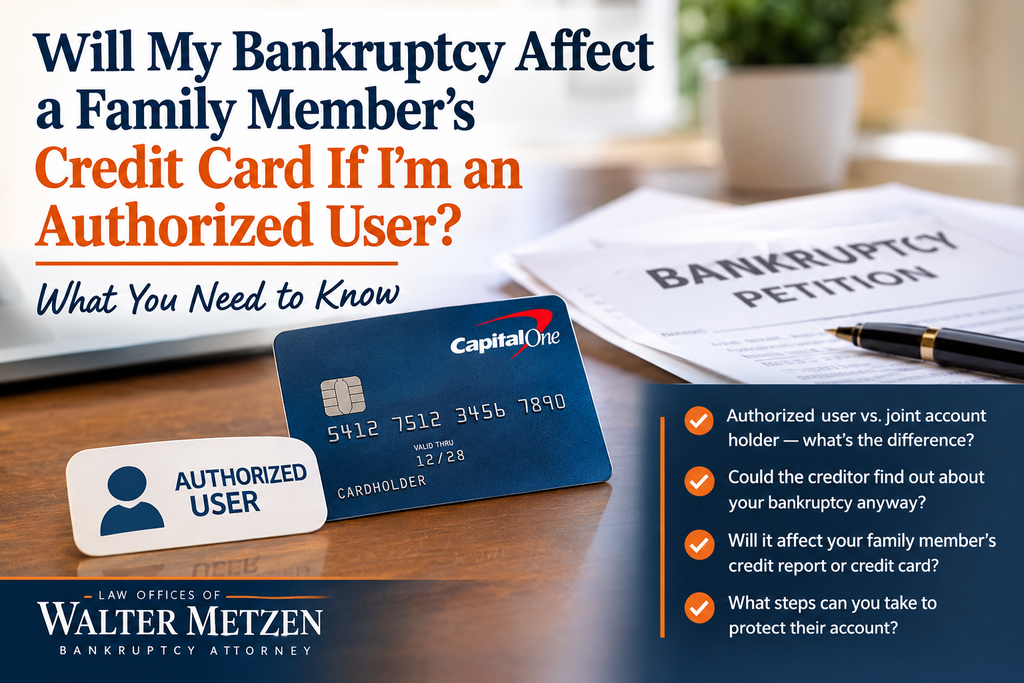
Will My Bankruptcy Affect a Family Member’s Credit Card If I Am an Authorized User?

Published
One question I hear from bankruptcy clients is:
“I am an authorized user on my wife’s, husband’s, parent’s, or child’s credit card. If I file bankruptcy, will my bankruptcy hurt their credit or cause the credit card company to close their account?”
This is an important question, because there is a significant difference between being an authorized user and being a joint account holder or co-borrower.
The first thing I want to determine is exactly what your legal relationship is to the credit card account.
Table of Contents
- Authorized User vs. Joint Account Holder
- The Credit Card Company May Know About Your Bankruptcy Anyway
- Will My Bankruptcy Go on My Wife’s Credit Report?
- Could the Credit Card Company Close or Restrict the Account?
- What If I Have Already Removed Myself From the Account?
- What Happens to Your Family Member’s Credit Score?
- What About Capital One?
- A Word of Caution About Saying “Joint Account”
- Should You Remove Yourself Before Filing Bankruptcy?
- The Bottom Line
Authorized User vs. Joint Account Holder
An authorized user is generally someone who has permission to use another person’s credit card but is not legally responsible for paying the credit card debt.
For example, your wife may have a Capital One credit card in her name. She adds you as an authorized user, and Capital One gives you a card with your name on it. You can use the card, but your wife remains responsible for paying the balance.
Capital One itself explains that an authorized user is not the person legally responsible for the account; the primary cardholder remains responsible for the account and payments.
That is very different from a true joint credit card account, where both people are responsible for the debt.
Why does this distinction matter in bankruptcy?
If you are only an authorized user, and you do not owe the credit card company any money, the credit card debt generally is not your debt simply because your name appears on the card.
Consequently, if your wife has a Capital One credit card and you are merely an authorized user, we generally would not list your wife’s credit card as a debt you owe in your bankruptcy case.
However, there is an important practical issue that bankruptcy clients need to understand.
The Credit Card Company May Know About Your Bankruptcy Anyway
Sometimes a client will tell me:
“If we take my name off my wife’s credit card and don’t list the account in my bankruptcy, Capital One won’t know that I filed bankruptcy.”
I would not rely on that.
Bankruptcy cases are public records. The bankruptcy court itself does not send bankruptcy information directly to the credit reporting agencies, but bankruptcy filings are public records and can be accessed through PACER and other sources.
In addition, credit card companies have their own internal systems and credit-reporting relationships. A creditor may be able to determine that someone associated with an account has filed bankruptcy even though that person is not a borrower on the account.
In other words, removing yourself as an authorized user is a good idea if you do not want the account appearing on your credit report, but it is not a guarantee that the credit card company will never learn that you filed bankruptcy.
That is an important distinction.
Will My Bankruptcy Go on My Wife’s Credit Report?
Generally, no.
Your bankruptcy is your bankruptcy. It does not become your wife’s bankruptcy simply because you are married or because you were previously an authorized user on her credit card.
There is no single “married couple” credit report. Each person’s credit report is separate. Capital One similarly explains that marriage does not combine spouses’ credit histories or credit scores.
If your wife is the sole borrower on the credit card, your bankruptcy should not simply appear as a bankruptcy filing on her credit report.
However, there is another issue:
What will the credit card company do with the account?
That is where things can become more complicated.
Could the Credit Card Company Close or Restrict the Account?
Potentially, yes.
A credit card company is not necessarily required to continue providing credit simply because the primary account holder has always paid the bill on time.
A creditor may have contractual or business reasons for closing, suspending, or changing an account. Capital One’s credit card agreements, for example, state that the company may close or suspend an account in circumstances permitted by the agreement and applicable law.
Therefore, if you are an authorized user on your wife’s account and you file bankruptcy, there is a possibility that the creditor could take some action concerning the account if it learns about your bankruptcy.
That does not mean it will happen.
It simply means that I cannot promise a client that the account is completely insulated from the bankruptcy.
What If I Have Already Removed Myself From the Account?
This is actually a sensible step if you are an authorized user and your goal is to separate your credit history from the family member’s credit card.
Suppose your wife has a Capital One account and you were an authorized user. You have now asked Capital One to remove you from the account.
There are really two separate questions:
1. Can the account be removed from your credit report?
Possibly.
If Capital One continues reporting the account as an authorized-user account on your credit reports after you have been removed, you can check your reports and, if necessary, dispute inaccurate information with the credit reporting agencies and/or contact Capital One.
Capital One acknowledges that authorized-user account information can appear on an authorized user’s credit report when the issuer reports it.
2. Does removing me guarantee that my wife’s account will be unaffected by my bankruptcy?
No.
Removing you as an authorized user separates you from the account going forward, but it does not create a guarantee that the creditor will never learn about your bankruptcy.
The creditor may have already associated your name and identifying information with the account.
What Happens to Your Family Member’s Credit Score?
There are several possibilities.
If you are merely an authorized user and the primary cardholder continues making all payments on time, your bankruptcy does not automatically become a negative item on the primary cardholder’s credit report.
However, if the credit card company closes the account because of the bankruptcy or for some other reason, the closing of the account could have an indirect effect on the primary cardholder’s credit score.
For example, closing a credit card can affect the amount of available credit and therefore the person’s credit utilization ratio.
The effect depends upon the person’s entire credit profile.
This is one reason I tell clients that there is a difference between:
“My bankruptcy will appear on my wife’s credit report.”
and
“Something the credit card company does because of my bankruptcy could indirectly affect my wife’s credit score.”
Those are two very different things.
What About Capital One?
Capital One is a good example of why we have to look carefully at the account.
Capital One currently distinguishes between primary users, authorized users, account managers and joint account holders. An authorized user is not financially responsible for the account simply because he or she has a card.
Capital One also reports that authorized-user information may be reported to the credit bureaus, which is why an authorized user’s account can appear on that person’s credit report.
So if you are an authorized user on your wife’s Capital One account, the first thing I would want to know is:
Are you truly only an authorized user, or are you actually a joint account holder?
That distinction can change the bankruptcy analysis considerably.
A Word of Caution About Saying “Joint Account”
Clients sometimes tell me:
“It’s a joint account. I’m the additional user.”
Those two things are not necessarily the same.
A person can have a card with his or her name on it without being legally responsible for the underlying debt.
If you are simply an authorized user, you generally are not responsible for paying the debt.
If you are a joint borrower, however, you may actually be legally responsible for the debt.
That is why I don’t want a bankruptcy client simply looking at the credit card and deciding that because his or her name appears on the card, the debt belongs in the bankruptcy.
We need to determine what your actual legal responsibility is.
Should You Remove Yourself Before Filing Bankruptcy?
If you are merely an authorized user on a family member’s credit card, and you want to minimize the possibility that your bankruptcy will create problems for that person’s account, removing yourself as an authorized user before filing may be a reasonable precaution.
But I would not tell a client that doing so guarantees that the creditor will never know about the bankruptcy.
It doesn’t.
The important thing is to make sure that your bankruptcy schedules accurately identify your debts and your legal obligations. An account belonging solely to your wife is not automatically your debt simply because you have been an authorized user.
At the same time, I want my clients to understand that bankruptcy is not invisible to the financial world.
The Bottom Line
If you are an authorized user on a family member’s credit card, filing bankruptcy generally does not mean that the family member has filed bankruptcy.
However:
- An authorized user is different from a joint account holder.
- An authorized user generally is not personally responsible for the credit card debt.
- The account may nevertheless appear on the authorized user’s credit report if the creditor reports authorized-user information.
- Removing yourself as an authorized user may help separate your credit report from the account.
- Removing yourself does not guarantee that the creditor will never learn that you filed bankruptcy.
- Your bankruptcy should not simply appear as a bankruptcy on your spouse’s credit report because you are married.
- Nevertheless, the credit card company could potentially take action concerning the account after learning of your bankruptcy.
- If the creditor closes the account, that could indirectly affect the primary cardholder’s credit score.
- Most importantly, we need to determine whether you are actually an authorized user or whether you are legally responsible for the account.
If you are considering bankruptcy and you are an authorized user on a spouse’s, parent’s, child’s or other family member’s credit card, tell me about the account before we file. I would much rather identify the issue before filing than discover a problem afterward.
As with many issues in bankruptcy, the answer depends upon exactly how the account is titled and who is legally obligated to pay the debt.