I Received a United States Trustee Statement of Presumption of Abuse. What Does That Mean?

Published
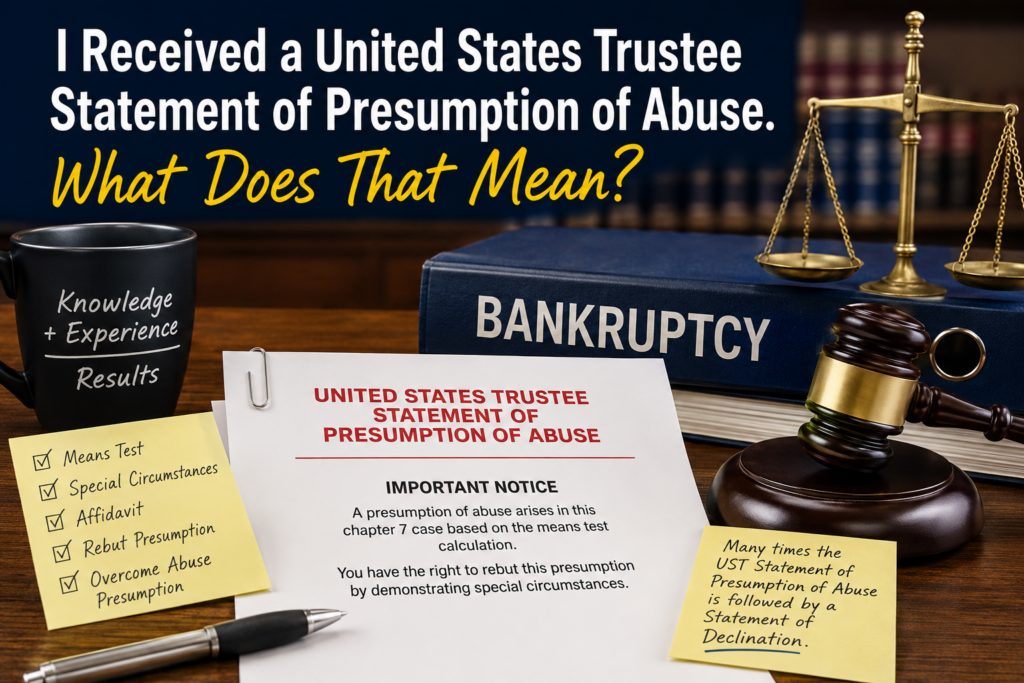
One of the documents that can cause a Chapter 7 bankruptcy client a great deal of anxiety is a United States Trustee’s Statement of Presumption of Abuse.
I have had many clients call me after receiving one of these documents and say, “I thought you told me I could file Chapter 7. Does this mean I can’t?”
Not necessarily. In fact, in many cases, receiving a Statement of Presumption of Abuse is not the end of the Chapter 7 case. It is simply the beginning of the process of addressing an issue raised by the means test.
The United States Trustee’s Office is required to review Chapter 7 cases and determine whether the Bankruptcy Code creates a presumption that the case is an abuse of Chapter 7. The means test is one of the primary tools used to make that determination.
Table of Contents
- What Is the Means Test?
- Why Does the Means Test Sometimes Not Tell the Whole Story?
- Why Would I Recommend Chapter 7 If the Means Test Shows a Presumption of Abuse?
- What Is an Affidavit of Special Circumstances?
- What Happens After the United States Trustee Files a Statement of Presumption of Abuse?
- What Is a United States Trustee Statement of Declination?
- Does the United States Trustee Have to File a Motion to Dismiss?
- How Do You Overcome a Presumption of Abuse?
- The Six-Month Lookback Can Be Misleading
- A Presumption Is Not a Finding of Abuse
- What Should I Do If I Receive One?
What Is the Means Test?
The means test was created as part of the Bankruptcy Abuse Prevention and Consumer Protection Act. Its purpose is to determine whether a debtor who has primarily consumer debts has sufficient income, after applying the deductions permitted by the Bankruptcy Code, to repay a meaningful amount of unsecured debt.
The first part of the calculation looks at the debtor’s current monthly income, which is generally based upon income received during the six calendar months before the bankruptcy filing. If the debtor’s income is below the applicable median income for a household of the same size in the state, the debtor generally does not have to complete the second part of the means test.
If the debtor’s income is above the applicable median, the Chapter 7 means test calculation is performed. The calculation applies certain deductions for allowable expenses, secured debt payments, priority claims and other items specified by the Bankruptcy Code. If the resulting calculation exceeds the statutory threshold, a presumption of abuse may arise.
This is an important point:
A presumption of abuse does not mean that the debtor has done anything wrong.
It does not mean the debtor has committed bankruptcy fraud. It does not mean the debtor lied on the bankruptcy petition. It does not mean the debtor cannot receive a Chapter 7 discharge.
It means that, based upon the statutory calculation, the Bankruptcy Code initially presumes that the debtor may have enough income to repay creditors and therefore may not be entitled to Chapter 7 relief without further explanation.
Why Does the Means Test Sometimes Not Tell the Whole Story?
This is where the six-month income period used in the means test can create a problem.
When I meet with a client, I am looking at the client’s actual financial situation and what is happening in the client’s life now.
The means test, however, is based in substantial part upon historical income received during the six-month period preceding the bankruptcy filing.
Those two things are not always the same.
For example, a debtor may have received substantial overtime during the previous six months. Perhaps the debtor was working significant amounts of overtime because a co-worker was out on medical leave. Perhaps the debtor received a temporary bonus. Perhaps the debtor was working two jobs temporarily.
Then, shortly before the bankruptcy is filed, the overtime disappears.
The debtor’s current income may be substantially lower than the income used in the means-test calculation.
I see situations like this regularly.
The same problem can occur when a debtor has experienced a substantial increase in expenses that was not present during the six-month period used to calculate current monthly income.
Perhaps there has been a significant change in the family’s circumstances. Perhaps a necessary expense has developed. Perhaps the debtor has incurred an expense that is not adequately reflected in the standardized means-test calculation.
This is one of the reasons I do not simply look at the number produced by the computer when determining whether someone should file Chapter 7.
I look at the entire financial picture.
Why Would I Recommend Chapter 7 If the Means Test Shows a Presumption of Abuse?
Clients sometimes ask me this after receiving a Statement of Presumption of Abuse:
“If the means test showed a problem, why did you recommend Chapter 7 in the first place?”
The answer is that the means test is not necessarily the final word.
There are circumstances in which I know, before filing the case, that the six-month historical income calculation does not accurately reflect the debtor’s present financial circumstances.
If the debtor’s circumstances have materially changed, I may still recommend Chapter 7 because I believe the debtor has a legitimate basis for rebutting the presumption of abuse.
The Bankruptcy Code specifically permits a debtor to rebut the presumption by demonstrating special circumstances that justify additional expenses or an adjustment to current monthly income for which there is no reasonable alternative. The debtor must identify and document those circumstances and explain why the additional expenses or adjustment is necessary and reasonable. The information must also be provided under oath.
What Is an Affidavit of Special Circumstances?
When appropriate, I will prepare and file an Affidavit of Special Circumstances on behalf of the debtor.
The affidavit explains what has changed and why the means-test calculation does not accurately represent the debtor’s present financial situation.
For example, if a debtor’s income during the six months before filing was artificially high because of temporary overtime, but that overtime has ended, I can document the change.
If the debtor has experienced a substantial necessary expense that was not present during the six-month lookback period, that circumstance can be documented and explained.
The important thing is that this cannot simply be an argument that the debtor “needs” Chapter 7.
The Bankruptcy Code requires a showing of special circumstances. The debtor must provide documentation and a detailed explanation demonstrating that the additional expense or adjustment is necessary and reasonable.
That is why I spend considerable time with my clients gathering the documentation necessary to explain what has happened.
What Happens After the United States Trustee Files a Statement of Presumption of Abuse?
When the United States Trustee files a Statement of Presumption of Abuse, it can look alarming on the bankruptcy docket.
But it is not the same thing as the United States Trustee filing a motion to dismiss your bankruptcy case.
The Statement indicates that, based upon the information available to the United States Trustee, the statutory presumption of abuse has arisen.
The case can then be reviewed further.
This is where the debtor’s attorney has an opportunity to address the circumstances that produced the presumption.
In an appropriate case, I will file the necessary affidavit and supporting documentation explaining the debtor’s special circumstances.
What Is a United States Trustee Statement of Declination?
One of the documents that I have seen filed after a Statement of Presumption of Abuse is a United States Trustee’s Statement of Declination.
A Statement of Declination is significant because it means that, after reviewing the case, the United States Trustee has determined that no action is required with respect to the presumed abuse. Bankruptcy court guidance specifically describes the Statement of Declination as the filing used when the United States Trustee previously indicated that a case was considered abusive but subsequently decides that no action is required.
In practical terms, this can be very good news for the Chapter 7 debtor.
The sequence can look something like this:
- The Chapter 7 case is filed.
- The means test produces a presumption of abuse.
- The United States Trustee files a Statement of Presumption of Abuse.
- The debtor’s attorney explains the special circumstances and provides documentation.
- The United States Trustee reviews the additional information.
- The United States Trustee determines that no motion to dismiss or convert is necessary.
- The United States Trustee files a Statement of Declination.
The fact that a Statement of Presumption of Abuse was filed does not necessarily mean that the case will be dismissed.
Does the United States Trustee Have to File a Motion to Dismiss?
No.
A Statement of Presumption of Abuse and a motion to dismiss are two different things.
The United States Trustee may ultimately decide that the circumstances do not justify pursuing dismissal. If that happens, the United States Trustee may file a Statement of Declination.
The United States Trustee’s review is an important part of the Chapter 7 process. The United States Trustee Program is responsible for monitoring Chapter 7 cases and supervising the administration of the bankruptcy system.
If, however, the United States Trustee believes that the case constitutes abuse and the issue is not resolved, the debtor may have to defend the Chapter 7 filing in court.
How Do You Overcome a Presumption of Abuse?
The first thing I tell a client is do not panic.
The second thing I do is determine exactly why the presumption arose.
I review the income used in the six-month calculation. I compare that historical income with the debtor’s current income. I examine the debtor’s current expenses and determine whether there are circumstances that were not adequately reflected in the original means-test calculation.
Then I determine whether those circumstances qualify as the type of special circumstances contemplated by Section 707(b)(2)(B).
The Bankruptcy Code requires the debtor to itemize the additional expense or income adjustment, provide documentation, explain why the circumstances are necessary and reasonable, and attest under oath to the accuracy of the information.
In other words, you don’t overcome a presumption of abuse simply by saying, “My situation has changed.”
You overcome it by proving what changed.
The Six-Month Lookback Can Be Misleading
This is one of the most important things I want prospective bankruptcy clients to understand.
Suppose you had an unusually good six months immediately before filing bankruptcy.
That does not necessarily mean you have the ability to continue earning that amount of money.
Your income could have fallen dramatically.
You may have lost overtime. You may have changed jobs. Your spouse’s income may have changed. A temporary source of income may have disappeared. Your financial circumstances may have changed substantially.
The means test does not necessarily know that when the case is initially filed.
That’s where experienced bankruptcy representation becomes important.
The bankruptcy forms tell us what the historical numbers are. My job is to understand the story behind those numbers.
A Presumption Is Not a Finding of Abuse
This distinction is extremely important.
The United States Trustee’s Statement of Presumption of Abuse does not say:
“You have committed abuse.”
It says, in substance, that the statutory calculation creates a presumption that abuse exists.
The Bankruptcy Code itself provides a mechanism for rebutting that presumption through a showing of special circumstances.
And even when the means-test presumption does not arise or has been rebutted, the Bankruptcy Code provides that a Chapter 7 case may still be reviewed under other standards, including bad faith and the totality of the debtor’s financial circumstances.
That is why a Chapter 7 case should never be evaluated solely by looking at one number on one bankruptcy form.
What Should I Do If I Receive One?
If you receive a United States Trustee Statement of Presumption of Abuse, do not assume that your Chapter 7 bankruptcy is over.
Instead, contact your bankruptcy attorney immediately.
The attorney should determine:
- Why the means test created the presumption;
- Whether your income has changed since the six-month period used for the calculation;
- Whether your expenses have materially changed;
- Whether special circumstances exist;
- What documentation is available to establish those circumstances;
- Whether an Affidavit of Special Circumstances should be filed; and
- Whether the United States Trustee ultimately intends to pursue dismissal or conversion.
In my practice, I have represented many clients whose financial circumstances at the time of filing were substantially different from the financial circumstances reflected by the six-month income calculation.
That is precisely why I sometimes recommend Chapter 7 even when I know the means test is likely to generate a presumption of abuse.
I am not ignoring the means test. I am looking beyond it.
If the debtor has legitimate special circumstances, those circumstances can be presented to the United States Trustee with the documentation necessary to explain why Chapter 7 is appropriate.
And many times, after that review, the United States Trustee files a Statement of Declination, allowing the Chapter 7 case to proceed.
The Bottom Line
Receiving a United States Trustee Statement of Presumption of Abuse can be unsettling. But it does not automatically mean that you are going to lose your Chapter 7 bankruptcy.
The means test is a statutory calculation based in significant part upon historical income. Your actual financial circumstances may be very different today.
When there are legitimate special circumstances, the Bankruptcy Code provides a mechanism for rebutting the presumption.
A Statement of Presumption of Abuse is a problem that needs to be addressed—not necessarily a reason that your Chapter 7 bankruptcy cannot succeed.
As with every bankruptcy case, the facts matter. The important question is not simply what number the means test produced. The important question is why it produced that number and whether that number accurately reflects your actual financial circumstances today.
This article is intended for general informational purposes and is not legal advice. Bankruptcy law is highly fact-specific, and you should consult a qualified bankruptcy attorney regarding your particular circumstances.