What Is Abuse of Chapter 7 Bankruptcy?

Published
One of the questions I frequently receive from people considering bankruptcy is:
“Can the bankruptcy court tell me that I am abusing Chapter 7 because I make too much money?”
The answer is: sometimes. But it is not nearly as simple as saying that someone makes too much money and therefore cannot file Chapter 7.
The Bankruptcy Abuse Prevention and Consumer Protection Act of 2005—usually referred to as BAPCPA—made significant changes to Chapter 7 bankruptcy. One of the most important changes was the creation of the means test, which is designed to identify certain Chapter 7 cases that may be presumed to be an abuse of the bankruptcy system.
But there is an important qualification that is sometimes overlooked:
The Chapter 7 abuse provisions of 11 U.S.C. § 707(b) apply to individuals whose debts are primarily consumer debts.
That distinction can be extremely important, particularly for people who have significant business, tax, investment, or other nonconsumer debt.
Table of Contents
- Chapter 7 and Chapter 13 Are Different
- What Is the Chapter 7 Means Test?
- The United States Trustee’s Role
- What About Nonconsumer Debt?
- Social Security Income Is Different
- What About VA Benefits?
- What Happens If the U.S. Trustee Thinks Chapter 7 Is an Abuse?
- Defense No. 1: The Debts Are Primarily Nonconsumer Debts
- Defense No. 2: The Means Test Was Calculated Incorrectly
- Defense No. 3: Special Circumstances
- Defense No. 4: The Totality of the Circumstances
- What If Chapter 13 Is Possible?
- Do Not Assume That Making Good Money Means You Cannot File Chapter 7
- Chapter 7 Abuse Is Not the Same Thing as Bankruptcy Fraud
- My Advice to People Facing a § 707(b) Motion
- The Bottom Line
Chapter 7 and Chapter 13 Are Different
Before discussing abuse, it is important to understand the fundamental difference between Chapter 7 and Chapter 13.
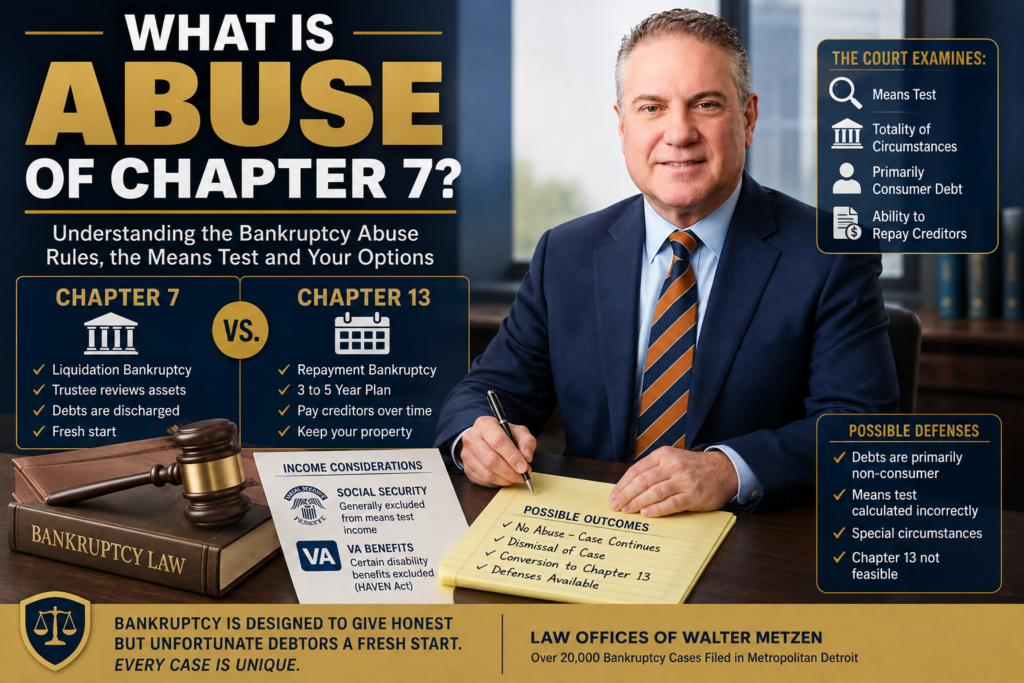
Chapter 7 is primarily a liquidation bankruptcy.
A Chapter 7 trustee examines the debtor’s assets and determines whether there is any nonexempt property that can be liquidated for the benefit of creditors. In a typical consumer Chapter 7 case, the debtor receives a discharge of qualifying debts without having to make payments to creditors through a repayment plan.
Chapter 13 is a repayment bankruptcy.
Instead of liquidating nonexempt assets, an individual with regular income proposes a repayment plan, generally lasting three to five years. Depending upon the circumstances, the debtor may pay a portion—or sometimes all—of the unsecured debt through the plan.
The means test is largely a mechanism for determining whether certain individuals who want to file Chapter 7 have sufficient ability to repay creditors and therefore should instead be required to proceed under Chapter 13.
That is where the concept of abuse comes into play.
What Is the Chapter 7 Means Test?
The means test is found in 11 U.S.C. § 707(b)(2).
For individuals with primarily consumer debts, the first step is to determine the debtor’s current monthly income.
Current monthly income is generally based upon the debtor’s average income during the six calendar months before the bankruptcy filing, subject to the exclusions contained in the Bankruptcy Code.
If the debtor’s income is below the applicable median income for the household size, the debtor generally does not have to complete the second portion of the Chapter 7 means test.
If the debtor’s income is above the applicable median, the debtor may have to complete the more detailed means-test calculation.
The calculation uses a combination of statutory and IRS-based expense standards, along with certain actual expenses permitted by the Bankruptcy Code.
The purpose is to determine whether the debtor has sufficient income available to pay creditors.
If the calculation produces a sufficiently high amount of projected disposable income, a presumption of abuse may arise. The Bankruptcy Code establishes specific statutory thresholds for making this determination, and those amounts are periodically adjusted for inflation.
But a presumption of abuse is not the same thing as an automatic dismissal.
There are additional legal issues that have to be considered.
The United States Trustee’s Role
This is where the United States Trustee becomes particularly important.
The United States Trustee Program is part of the United States Department of Justice. One of its responsibilities is to protect the integrity of the bankruptcy system.
The U.S. Trustee Program reviews individual Chapter 7 cases for possible abuse, including cases in which the means test may create a presumption of abuse and cases where abuse may be alleged under the broader “totality of the circumstances” or bad-faith provisions of § 707(b)(3).
In my practice, I tell clients that they should assume that the Chapter 7 case will be examined carefully.
That does not mean that the United States Trustee is looking for a reason to deny every Chapter 7.
It means that the bankruptcy system has a process for identifying cases where Chapter 7 may not be appropriate.
The Chapter 7 trustee also reviews the schedules and financial information and may identify issues that need to be brought to the attention of the United States Trustee. The U.S. Trustee then decides whether to take action under § 707(b).
What About Nonconsumer Debt?
This is one of the most important points I want to make in this article.
The means test under § 707(b) is directed at individuals whose debts are primarily consumer debts.
Consumer debt is generally debt incurred primarily for a personal, family, or household purpose.
Business debt is generally nonconsumer debt.
Suppose, for example, that someone owns a business and personally guarantees $500,000 of business loans and business credit cards.
That person’s financial situation may look very different from someone who has $500,000 of credit card debt accumulated for personal living expenses.
The characterization of the debt matters.
If a debtor’s debts are not primarily consumer debts, the § 707(b) abuse provisions—including the statutory means-test presumption—do not apply in the same way.
This is why I always want to know what the debts are and why they were incurred, not merely how much money the debtor makes.
Courts have recognized that § 707(b) applies only when the debtor’s debts are primarily consumer debts.
So, for someone with substantial business debt, simply looking at the person’s income and saying, “You make too much money for Chapter 7,” can be an incomplete analysis.
There may be a very significant question as to whether § 707(b) applies at all.
Social Security Income Is Different
Another issue that frequently arises involves Social Security benefits.
Social Security benefits are excluded from the Bankruptcy Code’s definition of current monthly income for purposes of the means test.
This is extremely important for retirees and disabled individuals who receive Social Security.
For example, suppose a married couple receives $5,000 per month in Social Security benefits and another $4,000 per month from employment.
You cannot simply take the entire $9,000 and assume that the entire amount is treated as current monthly income for purposes of the Chapter 7 means test.
The Social Security benefits receive special treatment under the Bankruptcy Code.
That does not mean Social Security can simply be omitted from the bankruptcy schedules.
It must still be properly disclosed.
There is an important difference between disclosing income and having that income included in the particular calculation being performed.
What About VA Benefits?
Veterans’ benefits also require careful analysis.
Congress enacted the HAVEN Act, which excludes certain disability and death-related benefits paid to veterans and survivors from the Bankruptcy Code’s definition of current monthly income. These exclusions can include certain benefits administered by the Department of Veterans Affairs and the Department of Defense.
This can be extremely important for veterans considering Chapter 7.
For example, a veteran might receive substantial VA disability compensation each month. That does not necessarily mean that the entire amount will be included in the Chapter 7 means-test calculation.
The exact nature of the benefit matters.
I would caution veterans against simply assuming that all VA payments are excluded or that all VA payments are included. The particular benefit needs to be identified and analyzed under the Bankruptcy Code.
There is also a special means-test exception for certain disabled veterans who incurred the debts they are seeking to discharge while on active duty. Section 707(b)(2)(D) provides an important protection for qualifying disabled veterans.
This is an area where having an attorney who understands both bankruptcy law and the treatment of veterans’ benefits can make a significant difference.
What Happens If the U.S. Trustee Thinks Chapter 7 Is an Abuse?
If the United States Trustee believes that a Chapter 7 case is abusive, the U.S. Trustee may file a motion to dismiss under § 707(b).
That is a serious matter.
But receiving a motion to dismiss does not mean that the case is over.
The debtor’s attorney should carefully examine the legal and factual basis for the motion.
There are several possible defenses.
Defense No. 1: The Debts Are Primarily Nonconsumer Debts
This can be one of the most important defenses.
If the debtor’s debts are primarily business or other nonconsumer debts, § 707(b) may not apply.
This requires more than simply labeling a debt “business debt.”
The underlying purpose of the debt must be examined, and the amounts of consumer and nonconsumer debt must be carefully calculated.
But where the debtor truly has primarily nonconsumer debt, this can take the entire § 707(b) means-test analysis off the table.
Defense No. 2: The Means Test Was Calculated Incorrectly
The means test is complicated.
There are numerous provisions governing what income is included, what income is excluded and what expenses can be deducted.
A Chapter 7 debtor should not simply accept the United States Trustee’s calculation without examining it.
An incorrect income figure, an improperly calculated household size, an improperly excluded expense, an incorrect secured-debt deduction or failure to account for a statutory exclusion can materially change the result.
The first question should always be:
“Is the U.S. Trustee’s calculation actually correct?”
Defense No. 3: Special Circumstances
The Bankruptcy Code allows a debtor to rebut a presumption of abuse by demonstrating special circumstances that justify additional expenses or adjustments to current monthly income.
This is important because the means test is, by its nature, a mathematical formula.
Real life is not always mathematical.
A debtor may have extraordinary expenses that are not adequately reflected in the standard means-test calculation.
Examples might include unusual medical expenses, special care requirements, or other circumstances recognized under the Bankruptcy Code.
These circumstances must be documented and properly presented.
Simply saying, “My expenses are high,” is generally not enough.
Defense No. 4: The Totality of the Circumstances
Even when the mathematical means test does not result in a presumption of abuse—or when a presumption has been rebutted—the United States Trustee may attempt to establish abuse under § 707(b)(3).
That provision allows the court to consider the totality of the circumstances of the debtor’s financial situation.
Courts have recognized that the analysis is not simply a mechanical calculation of whether someone has the theoretical ability to repay a certain amount of debt. The circumstances surrounding the debtor’s financial condition must be examined.
This can include questions such as:
- What caused the financial problems?
- Is the debtor’s income stable?
- Are the debtor’s expenses reasonable?
- Is there actually sufficient income available to fund a meaningful Chapter 13 plan?
- Has the debtor suffered a significant financial setback?
- Are there unusual or necessary expenses?
- What percentage would unsecured creditors realistically receive?
- Is the debtor acting in good faith?
The goal is to determine whether allowing the debtor to remain in Chapter 7 would truly constitute an abuse.
What If Chapter 13 Is Possible?
Sometimes the most practical answer is not to fight the U.S. Trustee’s motion all the way through litigation.
Sometimes Chapter 13 is the better solution.
If the debtor has regular income and can afford to make a Chapter 13 payment, conversion may allow the debtor to retain property while paying creditors through a court-approved plan.
But there is an important word in that sentence:
Feasible.
A Chapter 13 plan has to be feasible.
It is not enough to say that the debtor could theoretically make a payment. The debtor must actually have sufficient income to make the required plan payments while maintaining reasonable living expenses and paying other obligations that must be paid outside the plan.
A court may be reluctant to dismiss a Chapter 7 case for abuse where the evidence shows that the debtor does not actually have enough disposable income to fund a feasible Chapter 13 plan. Courts have denied § 707(b) motions where the debtor lacked sufficient income to fund a Chapter 13 plan and the other circumstances did not demonstrate abuse.
Do Not Assume That Making Good Money Means You Cannot File Chapter 7
This is probably the biggest misconception I see.
There is no simple income number that says, “You make too much money to file Chapter 7.”
The analysis is much more complicated.
We have to look at:
- The debtor’s household income;
- The six-month lookback period;
- The applicable median income;
- Whether the debts are primarily consumer or nonconsumer;
- The means-test calculation, when applicable;
- Social Security and other excluded income;
- Qualifying veterans’ benefits;
- The debtor’s actual expenses;
- Any special circumstances;
- The totality of the debtor’s financial circumstances; and
- Whether a feasible Chapter 13 plan could actually be funded.
That is a lot different from simply looking at someone’s annual salary.
Chapter 7 Abuse Is Not the Same Thing as Bankruptcy Fraud
I also want to make an important distinction.
When we talk about “abuse of Chapter 7,” we are not necessarily talking about bankruptcy fraud.
A debtor can be completely honest, accurately disclose every asset and debt, cooperate with the trustee, and still have a Chapter 7 case challenged as an abuse.
The issue may simply be whether Chapter 7 is the appropriate chapter for that debtor under the circumstances.
That is very different from hiding assets, lying on bankruptcy schedules, failing to disclose income or otherwise committing bankruptcy fraud.
My Advice to People Facing a § 707(b) Motion
If you receive a motion from the United States Trustee alleging abuse of Chapter 7, do not ignore it.
It is not something that should be handled by simply calling the U.S. Trustee’s office and promising that you will pay your debts.
Your attorney should review the motion carefully and determine exactly what the U.S. Trustee is alleging.
In my experience, the most important questions are:
Does § 707(b) apply?
Is the means-test calculation correct?
Are all applicable exclusions and deductions being properly considered?
Are there special circumstances?
What does the totality of the circumstances show?
And finally:
If Chapter 7 is not available, is a feasible Chapter 13 actually possible?
Those questions can make the difference between losing a Chapter 7 case and successfully defending it—or determining that Chapter 13 is the better alternative.
The Bottom Line
The purpose of bankruptcy is to give honest but unfortunate debtors a fresh start. At the same time, Congress has established rules intended to prevent people who have the ability to repay a meaningful portion of their debts from improperly using Chapter 7 to avoid doing so.
That is the basic idea behind the Chapter 7 abuse provisions.
But the analysis is not simply “you make too much money, so you cannot file Chapter 7.”
The means test applies principally to individual debtors with primarily consumer debts. Social Security benefits are excluded from current monthly income, and certain veterans’ disability and related benefits receive special treatment under the HAVEN Act. Debtors with primarily nonconsumer debts may be outside the scope of § 707(b)’s abuse provisions altogether.
And even when a presumption of abuse arises, there may be defenses based upon the accuracy of the calculation, special circumstances, the totality of the circumstances, or the fact that a Chapter 13 plan would not actually be feasible.
That is why I believe every Chapter 7 case needs to be evaluated individually.
The question is not simply how much money you make.
The question is whether, under the Bankruptcy Code and the circumstances of your particular case, Chapter 7 is an appropriate form of relief.