Creditor Has a Judgment? You Can Still File Bankruptcy

Published
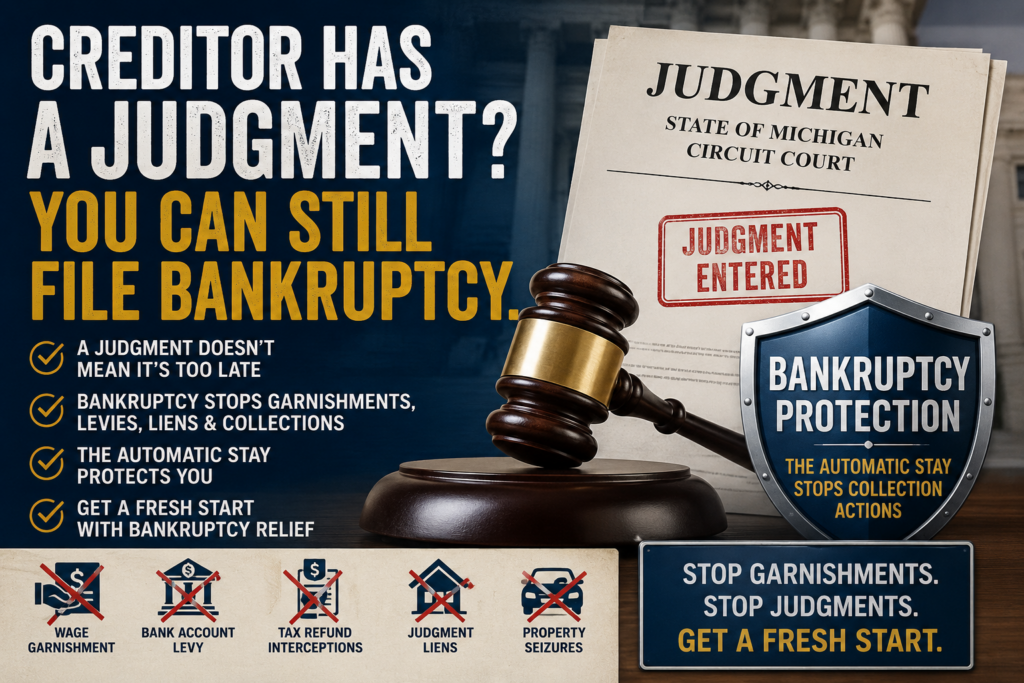
One of the biggest misconceptions I hear from people considering bankruptcy is this:
“It’s too late. The creditor already has a judgment against me.”
That is simply not true.
I have had many potential clients tell me that they would have filed bankruptcy sooner, but they believed that once a creditor went to court and obtained a judgment, bankruptcy was no longer an option. Others tell me, “They are already garnishing my wages, so I guess there is nothing bankruptcy can do now.”
Again, that is not correct.
A judgment does not prevent you from filing bankruptcy. In many cases, a bankruptcy filing is exactly what you need to stop the creditor from enforcing that judgment.
Table of Contents
- A State Court Judgment Does Not Make a Debt Bankruptcy-Proof
- “But They Are Already Garnishing My Wages”
- What Can a Judgment Creditor Do?
- What About a Judgment Lien on Your House?
- What Happens to the Judgment After Bankruptcy?
- Bankruptcy Can Stop the Collection Process
- Don’t Assume the Judgment Means You Have Lost Your Chance
A State Court Judgment Does Not Make a Debt Bankruptcy-Proof
When a creditor sues you in Michigan state court and obtains a judgment, that judgment gives the creditor powerful collection remedies under Michigan law.
But a bankruptcy case is filed in the United States Bankruptcy Court, a federal court operating under federal bankruptcy law.
The fact that a creditor has already obtained a judgment in a Michigan court does not mean that the creditor has somehow obtained immunity from the federal Bankruptcy Code.
The Bankruptcy Code specifically provides that the filing of a bankruptcy petition automatically stays, among other things, the enforcement of a pre-bankruptcy judgment and acts to collect a pre-bankruptcy debt. 11 U.S.C. § 362(a).
In other words, the creditor can win the state court case and obtain a judgment, and you can still subsequently file bankruptcy.
The judgment is not the end of the story.
“But They Are Already Garnishing My Wages”
This is another situation I see frequently.
A creditor obtains a judgment. The creditor then obtains a wage garnishment. Every payday, money is taken out of the debtor’s paycheck.
The debtor may think:
“There is no point in filing bankruptcy now. They already have the judgment and the garnishment.”
Actually, the opposite may be true.
When a bankruptcy petition is filed, the automatic stay generally goes into effect immediately. The Eastern District of Michigan Bankruptcy Court explains that most proceedings to collect debts must stop once bankruptcy is filed.
The Bankruptcy Code specifically prohibits the continuation of collection actions and the enforcement of judgments obtained before the bankruptcy case. It also prohibits acts to collect a pre-bankruptcy claim.
So, depending upon the circumstances, filing bankruptcy can stop the wage garnishment.
What Can a Judgment Creditor Do?
A judgment can give a creditor substantial collection power. If you do nothing, a judgment creditor may attempt to use various collection remedies available under Michigan law.
For example, a judgment creditor may attempt to:
- Garnish your wages.
- Levy against money in your bank account.
- Intercept or levy against a Michigan income tax refund.
- Record or enforce a judgment lien against your real estate.
- Take other steps to enforce the judgment.
- In appropriate circumstances, pursue the seizure and sale of personal property, potentially including a vehicle.
The longer you wait, the more complicated the situation can become.
But the fact that the creditor has begun these collection efforts does not mean you have missed your opportunity to file bankruptcy.
The automatic stay is one of the most powerful protections bankruptcy provides. The federal statute stays enforcement of pre-bankruptcy judgments, collection activity, and certain actions against property.
What About a Judgment Lien on Your House?
This is an area where people need to be particularly careful.
There is an important distinction between stopping the enforcement of a judgment and a lien that has already attached to property.
Filing bankruptcy may stop a creditor from continuing to enforce a judgment, but that does not automatically mean that every lien created before bankruptcy simply disappears.
Depending upon the circumstances, a bankruptcy debtor may have additional remedies concerning a judgment lien. For example, certain judicial liens may be avoidable under § 522(f) of the Bankruptcy Code if the statutory requirements are satisfied. Michigan has a unique remedy whereupon a judicial lien can be extinguished upon the bankruptcy court granting a discharge.
That is something that needs to be examined carefully when preparing the bankruptcy case.
I always tell clients that we need to know not only who has a judgment, but also what the creditor has done with that judgment.
Has there been a wage garnishment?
Has a bank account been levied?
Has a tax refund been intercepted?
Has a judgment lien been recorded?
Has property actually been seized?
Those details can make a difference in determining what bankruptcy can accomplish.
What Happens to the Judgment After Bankruptcy?
This is where bankruptcy can provide an enormous amount of relief.
If the underlying debt is dischargeable and the debtor receives a bankruptcy discharge, the creditor generally cannot continue trying to collect that discharged debt as a personal obligation.
The fact that the creditor obtained a judgment before bankruptcy does not, by itself, make the underlying debt nondischargeable.
Of course, not every judgment debt is dischargeable.
There are certain types of debts that Congress has specifically excluded from discharge, including various categories of tax debts, domestic support obligations, certain student loan obligations, and debts involving particular types of fraud or misconduct. There are also situations where a creditor may ask the Bankruptcy Court to determine that a particular debt is nondischargeable.
So the important question is not simply:
“Do you have a judgment?”
The more important questions are:
What is the judgment for? Is the underlying debt dischargeable? Has a lien been created? And what collection activity has the creditor already taken?
Bankruptcy Can Stop the Collection Process
I have had clients come into my office after they have ignored a judgment for months or even years.
By the time they see me, they may have received garnishment notices, had money taken from their bank account, lost a tax refund, or received threatening letters from the judgment creditor.
They often tell me:
“I should have done this before they got the judgment.”
Maybe it would have been easier.
But that does not mean it is too late.
The Bankruptcy Code is specifically designed to give financially distressed debtors a way to stop collection activity and obtain relief from qualifying debts. The automatic stay provides the immediate breathing room necessary for the bankruptcy case to proceed.
And importantly, the stay applies to the enforcement of a judgment obtained before the bankruptcy case.
Don’t Assume the Judgment Means You Have Lost Your Chance
If a creditor has sued you and obtained a judgment, don’t assume that bankruptcy is no longer available to you.
If your wages are being garnished, don’t assume that you have to continue losing part of every paycheck.
If a creditor is threatening to levy your bank account, don’t assume that you have no options.
If a creditor has obtained a judgment and is pursuing your Michigan tax refund, don’t assume that the refund is automatically lost.
And if a creditor has recorded a judgment lien against your home, don’t assume that the judgment has made bankruptcy impossible.
The judgment is not necessarily the end of the road.
In fact, when someone comes into my office with a judgment creditor aggressively pursuing collection, one of the first things I want to determine is whether bankruptcy can stop the collection activity and whether the underlying debt can ultimately be discharged.
The Bottom Line
It is not too late to file bankruptcy simply because a creditor has obtained a judgment.
A Michigan state court judgment does not prevent you from filing a case in the United States Bankruptcy Court. Once a bankruptcy case is properly filed, the automatic stay generally stops the creditor from continuing to enforce the judgment or pursue collection of the pre-bankruptcy debt.
The creditor may have won the lawsuit.
That does not necessarily mean they get to keep collecting forever.
If you have a judgment against you, particularly if your wages are being garnished, your bank account is being threatened, your tax refund is being intercepted, or a lien has been placed against your property, don’t assume that it is too late to do something about it.
It may be exactly the time to talk to a bankruptcy attorney about your options.