Supreme Court Protects Debtors Who Convert from Chapter 13 to Chapter 7: The Impact of Harris v. Viegelahn on Consumer Bankruptcy Cases

Published
One of the most important protections available to consumer debtors is the ability to seek a fresh start through bankruptcy. The Bankruptcy Code provides different paths depending upon a debtor’s circumstances. Chapter 7 allows an honest but unfortunate debtor to discharge qualifying debt and move forward, while Chapter 13 allows a debtor with regular income to reorganize debts and protect assets such as a home or vehicle.
But what happens when a Chapter 13 case does not work out and the debtor needs to convert to Chapter 7?
That question was answered by the United States Supreme Court in Harris v. Viegelahn, a case that has significant implications for consumer bankruptcy cases throughout the country, including here in Michigan.
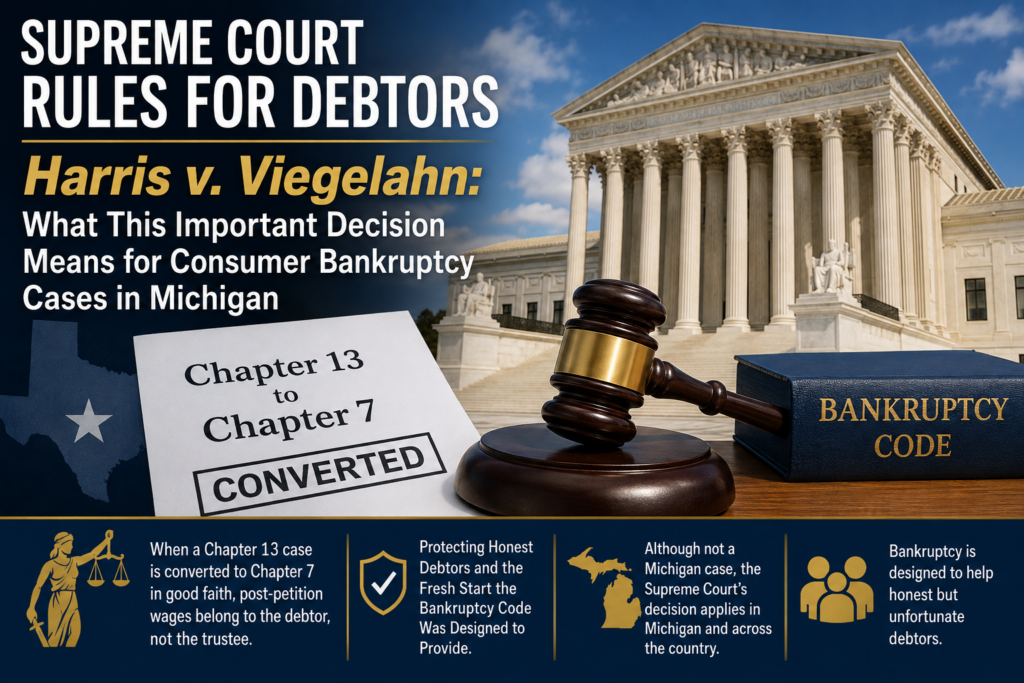
A quick note for Michigan bankruptcy practitioners and consumers: although this case is often discussed in Michigan bankruptcy circles, Harris v. Viegelahn was not a Michigan case. It arose from Texas and was decided after review of a Fifth Circuit decision. However, the legal principles announced by the Supreme Court apply equally to bankruptcy cases filed in the Eastern District of Michigan and throughout the United States.
The Facts Behind Harris v. Viegelahn
The debtor in Harris originally filed a Chapter 13 bankruptcy case. His plan required that money be withheld from his wages and paid to the Chapter 13 trustee, who would then distribute those funds to creditors according to the confirmed plan.
Unfortunately, the debtor fell behind on his mortgage payments, and his home was eventually foreclosed. After that occurred, the Chapter 13 trustee continued to receive wage payments but accumulated funds that had not yet been distributed to creditors.
The debtor later converted his case from Chapter 13 to Chapter 7. After the conversion, the trustee distributed more than $5,500 of the debtor’s post-petition wages to creditors.
The issue before the Supreme Court was simple but extremely important:
When a debtor converts a Chapter 13 case to Chapter 7, who gets the post-petition wages that are still sitting with the Chapter 13 trustee?
The trustee argued the money should go to creditors. The debtor argued that once the case converted to Chapter 7, those wages belonged to him.
The Supreme Court agreed with the debtor.
The Supreme Court’s Decision
In a unanimous decision, the Supreme Court held that when a debtor converts a Chapter 13 case to Chapter 7 in good faith, any post-petition wages that have not yet been distributed by the Chapter 13 trustee must be returned to the debtor.
The Court focused on the structure of the Bankruptcy Code. Under Section 348(f), when a Chapter 13 case is converted to Chapter 7, the Chapter 7 estate generally consists of property the debtor owned at the time the original bankruptcy petition was filed. Post-petition wages earned during the Chapter 13 case are generally not included in the converted Chapter 7 estate unless the conversion was made in bad faith.
The Court also noted that a Chapter 13 trustee’s authority ends upon conversion. Once the case becomes a Chapter 7 case, the Chapter 13 trustee no longer has the authority to continue administering payments under the Chapter 13 plan.
Why Harris v. Viegelahn Matters to Michigan Bankruptcy Debtors
In my consumer bankruptcy practice, I regularly see debtors who begin a Chapter 13 case with the best intentions. They want to repay creditors, save their home, catch up on arrears, or simply avoid liquidation.
But life happens.
A job loss, medical problem, divorce, unexpected expense, or reduction in income can make a Chapter 13 payment impossible. The Bankruptcy Code recognizes this reality by allowing debtors to convert their case when appropriate.
Harris v. Viegelahn reinforces an important principle:
A debtor should not be punished for making the honest decision to seek a different form of bankruptcy relief.
The purpose of bankruptcy is not to trap people in a repayment plan that no longer works. Bankruptcy is designed to give honest but unfortunate debtors a meaningful fresh start.
The Importance of Good Faith
There is an important limitation to the Harris decision: the conversion from Chapter 13 to Chapter 7 must be done in good faith.
Bankruptcy courts have long recognized that the Bankruptcy Code is intended to protect honest debtors, not those who attempt to manipulate the system. A debtor cannot hide assets, misrepresent finances, or file bankruptcy with the intent to abuse the process.
Honesty remains the foundation of every bankruptcy case.
That means complete and accurate schedules, truthful testimony at the meeting of creditors, and full disclosure of assets and income are essential.
A debtor who honestly seeks relief from overwhelming debt is exactly the person bankruptcy laws were designed to help.
The Bottom Line
Harris v. Viegelahn is a powerful reminder that consumer bankruptcy laws are designed with fairness in mind. The Supreme Court recognized that when a Chapter 13 case fails and a debtor must convert to Chapter 7, the debtor should not lose wages that the Bankruptcy Code says belong to them.
For Michigan consumers considering bankruptcy, the lesson is clear:
Bankruptcy is not about failure. It is about using the protections Congress created to provide a fresh financial start. But that fresh start depends on one thing above all else — honesty.
The Bankruptcy Code protects honest but unfortunate debtors. Debtors who fully disclose their financial circumstances and work within the system are entitled to those protections.