What Is the K-Shaped Economy? Why Some Americans Are Thriving While Others Are Falling Behind

Published
For decades, Americans believed that if the economy was doing well, most people would benefit. When the stock market rose, unemployment fell, and businesses expanded, the average family generally shared in that prosperity.
Today, that is no longer true.
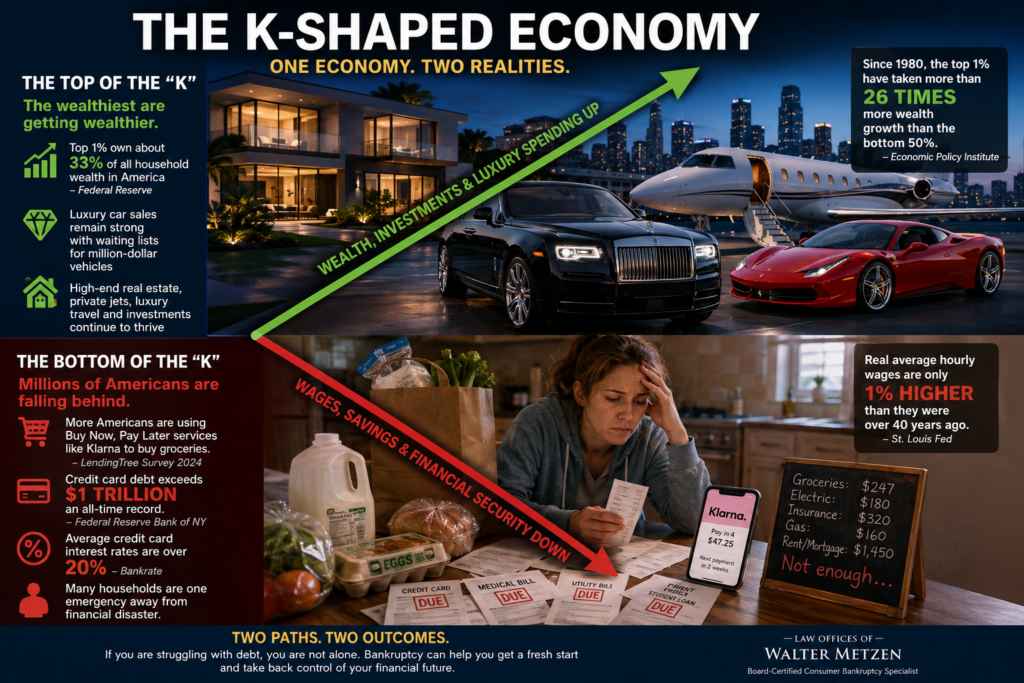
Instead, economists increasingly describe our economy as “K-shaped.” The name comes from the letter K. Imagine one line going upward while another falls downward. That is exactly what has happened in America over the last several years.
One group is becoming wealthier than ever.
The other is struggling just to pay for everyday necessities.
As a bankruptcy attorney who has represented thousands of Michigan families over the past three decades, I see the downward side of that “K” every day. The clients who walk into my office are hardworking people who are often employed, yet they simply cannot keep up with rising costs, mounting debt, and interest rates that make financial recovery nearly impossible.
The Top of the “K”
The wealthiest Americans have experienced extraordinary gains.
According to the Federal Reserve, the top 1% of households now own roughly one-third of all household wealth in the United States, while the bottom half of Americans own only a tiny fraction of the nation’s wealth. Wealth concentration has steadily increased over the past several decades.
Luxury spending tells the story.
Automakers such as Ferrari, Lamborghini, Bentley, Rolls-Royce, and Bugatti continue to report strong demand despite economic uncertainty. Waiting lists for exotic vehicles often stretch many months or even years. Million-dollar collector cars continue to sell at record-setting auctions.
High-end travel, luxury watches, private aviation, and multimillion-dollar homes have all remained remarkably resilient despite higher interest rates.
For affluent households whose wealth is tied to investments, real estate, or privately owned businesses, the economy has often continued moving upward.
The Bottom of the “K”
Now consider what is happening to millions of ordinary Americans.
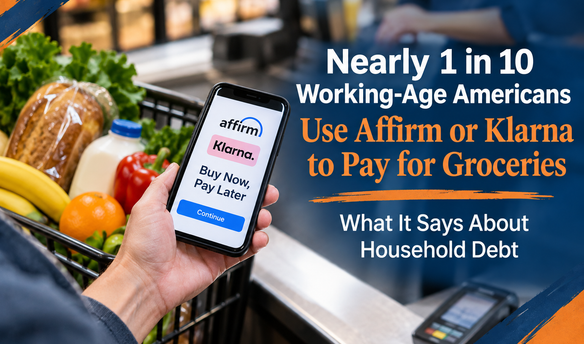
Increasingly, families are using Buy Now, Pay Later services—including Klarna, Afterpay, Affirm, and Zip—not to finance televisions or vacations, but to purchase groceries.
That should concern all of us.
Several recent consumer surveys found that a growing percentage of Americans have used installment payment services for food purchases because they lacked enough cash to cover basic necessities. Even more concerning, many users report making late payments or taking on multiple installment plans simultaneously.
Think about that for a moment.
Americans are financing milk, bread, eggs, and diapers.
When families must borrow money to purchase groceries, it is usually a sign that something much larger is wrong.
Credit Card Debt Continues to Break Records
Americans now carry well over $1 trillion in credit card debt, an all-time record according to the Federal Reserve Bank of New York. At the same time, average credit card interest rates frequently exceed 20%, making it increasingly difficult for families to ever pay down their balances.
Every month I meet clients who are making:
- $700 monthly minimum credit card payments
- $900 car payments
- Mortgage payments that have increased because of taxes and insurance
- Student loans that have resumed
- Rising utility and grocery bills
Despite working full-time, many simply run out of money before the month ends.
Retirement Isn’t What It Used to Be
Years ago, many Americans entered retirement with:
- A paid-off home
- Little or no credit card debt
- A modest pension
- Social Security sufficient to supplement savings
Today, that picture has dramatically changed.
I regularly meet retirees who still owe hundreds of thousands of dollars on their mortgages, have significant auto loans, carry substantial credit card balances, and are helping adult children or grandchildren financially.
Many cannot afford to retire at all.
Others return to work simply to make minimum payments on debt.
Inflation Doesn’t Hurt Everyone Equally
One of the defining characteristics of a K-shaped economy is that inflation affects people differently.
If your investments rise faster than inflation, you may barely notice higher grocery prices.
If every paycheck already goes toward necessities, however, even modest price increases can become overwhelming.
A gallon of milk, automobile insurance, property taxes, prescription medications, and utility bills all compete for the same limited paycheck.
When one expense rises, something else often gets charged to a credit card.
Eventually, the math no longer works.
Bankruptcy Is Often a Financial Reset—Not a Failure
Many people believe bankruptcy is only for someone who has been irresponsible.
Nothing could be further from the truth.
Today’s financial pressures are affecting teachers, nurses, factory workers, retirees, small business owners, and professionals alike.
Job loss, illness, divorce, inflation, rising insurance premiums, and high interest rates can overwhelm even families that have managed their finances responsibly for years.
Bankruptcy exists because Congress recognized that honest people sometimes need a fresh financial start.
It can eliminate overwhelming unsecured debt, stop collection activity, prevent wage garnishments, and allow families to rebuild instead of simply surviving.
The Bottom Line
The K-shaped economy reminds us that headline economic numbers do not tell the whole story. Record stock market highs and luxury spending can exist at the very same time that millions of Americans are financing groceries, juggling credit cards, and wondering how they will make next month’s mortgage payment.
If you find yourself living on credit cards, using installment loans for everyday expenses, or making only minimum payments while your balances continue to grow, you are not alone. Those are often warning signs that your financial situation has become unsustainable—not because you failed, but because the economy has left many hardworking families on the wrong side of the “K.”
The sooner you explore your options, the more choices you typically have. Bankruptcy is not about giving up. It is about taking back control of your financial future and giving yourself the opportunity for the fresh start that the law was designed to provide.