Buying a Car Immediately After Filing Chapter 7 Bankruptcy

Published
One of the biggest misconceptions I hear from people considering bankruptcy is that after filing Chapter 7 bankruptcy, you will not be able to get credit or finance a car.
That simply is not true.
In fact, many of my clients tell me that almost immediately after their Chapter 7 case is filed, they begin receiving offers from automobile dealerships throughout Metro Detroit encouraging them to come in and purchase a vehicle.
And there is a reason for this.
Table of Contents
- You May Be Able to Finance a Car Immediately After Filing Bankruptcy
- You Do Not Need Court Permission to Buy a Car After Filing Chapter 7
- Just Because You Can Finance It Doesn’t Mean You Should
- Pay Attention to the Interest Rate
- Pay Attention to the Length of the Loan
- Don’t Focus Only on the Monthly Payment
- Bankruptcy Is Your Fresh Start—Don’t Waste It
- The Myth That You Can’t Get Credit After Bankruptcy
- My Advice to Anyone Buying a Car After Chapter 7
You May Be Able to Finance a Car Immediately After Filing Bankruptcy
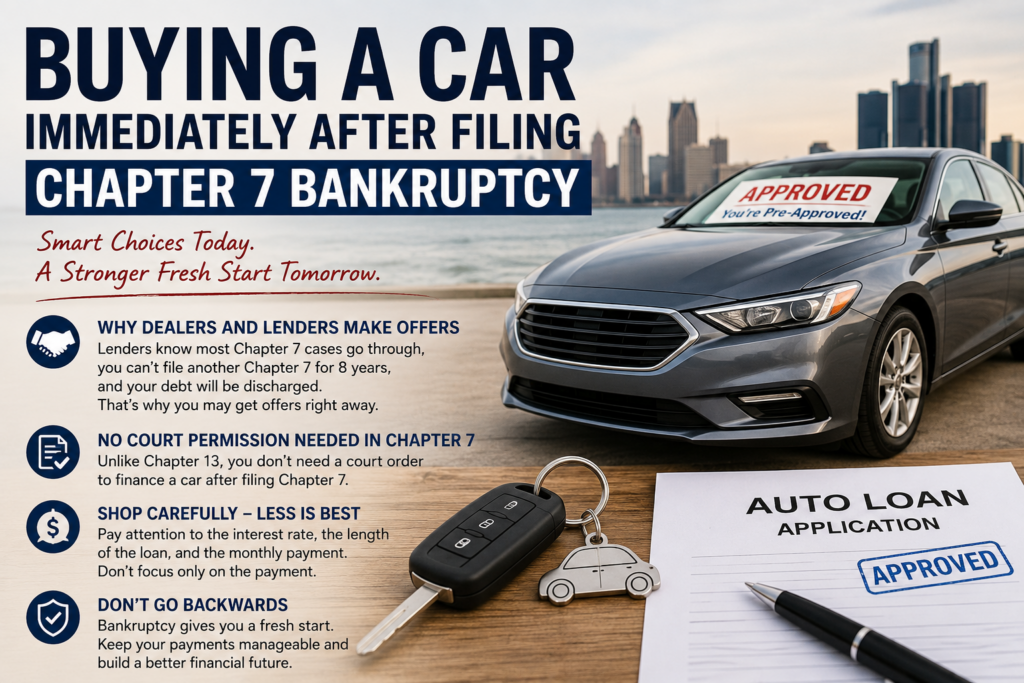
Automobile lenders understand something that many consumers do not: a Chapter 7 bankruptcy can actually put a person in a much better financial position.
When a Chapter 7 case is filed, the debtor is seeking to eliminate—or “discharge”—most of his or her unsecured debt. Credit card balances, medical bills, personal loans and other qualifying debts may ultimately be eliminated.
The lender also knows that, assuming the debtor receives a Chapter 7 discharge, the debtor generally cannot receive another Chapter 7 discharge for eight years from the date the prior Chapter 7 case was filed.
In other words, from the lender’s perspective, there may be considerably less debt competing for the debtor’s monthly income after bankruptcy than there was before bankruptcy.
This is particularly true when the debtor has hired an experienced bankruptcy attorney and the case is properly prepared. The lender may look at the situation and conclude that the bankruptcy is likely to proceed successfully and that the debtor will soon emerge with a substantially cleaner financial balance sheet.
That is why it is not unusual for my clients to tell me that they are receiving automobile financing offers shortly after filing their Chapter 7 case.
The ability to get a car loan after bankruptcy is not the problem. The problem can be getting too much car.
You Do Not Need Court Permission to Buy a Car After Filing Chapter 7
Another common misconception is that someone who has filed bankruptcy cannot purchase a vehicle without first getting permission from the Bankruptcy Court.
That is generally not the case in Chapter 7.
A Chapter 7 debtor ordinarily does not need a court order simply because he or she wants to finance a vehicle after filing the case.
This is different from Chapter 13 bankruptcy. In a Chapter 13 case, debtors are generally required to obtain court approval before incurring certain new debt during the case. In the Eastern District of Michigan, for example, the local rules address the incurring of new debt, including the commonly encountered $2,000 threshold.
Chapter 7 is different.
Once the Chapter 7 case is filed, there is no general requirement that the debtor obtain a Bankruptcy Court order before financing an automobile.
That does not mean, however, that you should rush out and buy one.
Just Because You Can Finance It Doesn’t Mean You Should
This is where I give my clients some very simple advice:
Less is best when you are emerging from bankruptcy.
The purpose of bankruptcy is to give you a fresh financial start. You don’t want to walk out of the courthouse with your unsecured debts discharged and immediately replace them with a massive automobile payment.
I have seen people make this mistake.
They file bankruptcy because they cannot keep up with their credit cards, personal loans and other monthly obligations. Their bankruptcy eliminates thousands—or sometimes tens of thousands—of dollars of debt.
Then they go to a dealership.
The salesperson tells them they have been approved.
Suddenly, the person who could not afford their old financial obligations is driving away in a $40,000, $50,000 or $60,000 vehicle with a six- or seven-year loan.
That defeats much of the purpose of filing bankruptcy in the first place.
Pay Attention to the Interest Rate
If you need to finance a vehicle after bankruptcy, look carefully at the interest rate.
Don’t simply ask, “What is my monthly payment?”
A salesperson can make almost any automobile payment sound affordable by extending the financing over a longer period of time.
A vehicle that seems affordable at $600 per month may actually cost you dramatically more because of the interest you are paying over the life of the loan.
Shop around.
Get multiple offers.
Ask the lender to tell you the annual percentage rate (APR), not just the monthly payment.
And remember that a bankruptcy filing does not mean you have to accept the first financing offer that comes through the door.
Pay Attention to the Length of the Loan
The second thing I tell my clients to watch is the length of the financing agreement.
Six- seven and even eight-year automobile loans have become commonplace. But just because a lender will finance a vehicle for eight years doesn’t mean that you should finance it for eight years.
The longer the loan, the longer you remain obligated to make payments.
You can also find yourself in a situation where you owe considerably more on the vehicle than it is worth.
If you have just completed a Chapter 7 bankruptcy, the last thing you want is to create another significant financial obligation that you cannot afford.
Don’t Focus Only on the Monthly Payment
Perhaps the biggest mistake people make when purchasing a vehicle is focusing exclusively on the monthly payment.
“I can afford $650 a month.”
But can you afford the car?
Those are two different questions.
A dealership can lower the monthly payment by extending the financing. That does not make the vehicle less expensive.
When shopping for a car after bankruptcy, look at the entire transaction:
- The purchase price of the vehicle
- The interest rate
- The amount financed
- The length of the loan
- The total amount you will pay
- Your insurance costs
- Your down payment
- Your monthly payment
- Whether you are trading in a vehicle with negative equity
All of these numbers matter.
Bankruptcy Is Your Fresh Start—Don’t Waste It
I tell my clients that bankruptcy should be viewed as an opportunity to reset your finances.
If your Chapter 7 case eliminates $50,000 of credit-card debt, don’t immediately replace that $50,000 of debt with a collection of new monthly obligations.
You don’t necessarily need a brand-new vehicle.
You may not need the most expensive vehicle the dealership is willing to finance.
You may be much better off buying a reliable used vehicle with a reasonable payment—or, if possible, paying cash.
Less is best.
Your goal should be to come out of bankruptcy with as little debt as possible.
The Myth That You Can’t Get Credit After Bankruptcy
There is a persistent misconception that filing bankruptcy means you will never be able to obtain credit again.
That is simply not true.
People finance cars after bankruptcy. They obtain credit cards. They eventually qualify for mortgages. They rebuild their credit.
In fact, one of the reasons I encourage my clients to think carefully about what they do after bankruptcy is because rebuilding credit is possible.
But rebuilding credit does not mean taking every loan a lender offers you.
You don’t rebuild your financial life by proving that you can borrow a lot of money.
You rebuild it by demonstrating that you can live within your means, make your payments on time and avoid accumulating the kind of debt that caused you to seek bankruptcy protection in the first place.
My Advice to Anyone Buying a Car After Chapter 7
If you have just filed Chapter 7 and need a vehicle, don’t be embarrassed by your bankruptcy.
Shop for financing.
Compare lenders.
Compare interest rates.
Negotiate the price of the vehicle.
Keep the loan as short as you can reasonably afford.
And most importantly, don’t allow a lender to determine how much car you can afford simply because they are willing to finance it.
The fact that someone will lend you $50,000 does not mean you should borrow $50,000.
Your bankruptcy gave you a fresh start.
Use it.
If you need a vehicle, buy a vehicle you can comfortably afford. Keep your payment manageable. Keep your other expenses under control. And remember the lesson that brought you to bankruptcy in the first place.
The goal isn’t to get more credit. The goal is to build a better financial life.
About Walter Metzen
I am Walter Metzen, a Board-Certified Consumer Bankruptcy Specialist and the founder of the Law Offices of Walter Metzen. I have filed more than 25,000 consumer bankruptcy cases in Metro Detroit. If you are considering Chapter 7 bankruptcy, one of the most important things you can do is understand not only how bankruptcy will affect your debts, but also how the decisions you make after filing can affect your fresh start.