Are Bail Bonds Dischargeable in Bankruptcy in Michigan?

Published
If you have ever had to post a bail bond for yourself, a family member, or a friend, you probably did not expect that the bail bond could eventually become a significant debt.
But what happens if the person who posted or guaranteed the bond cannot pay it?
Can a bail bond debt be discharged in bankruptcy?
The answer is: sometimes.
This is an area of bankruptcy law where the precise nature of the debt matters. A debt owed to a private bail bondsman under a contractual agreement is different from a bail bond forfeiture judgment owed directly to the government. The distinction can be extremely important when determining whether the debt can be eliminated in Chapter 7 or Chapter 13 bankruptcy.
Table of Contents
- How Bail Bonds Work
- The Bankruptcy Code Starts With a Presumption of Discharge
- A Debt Owed to a Bail Bondsman Is Different
- But There Is a Big Exception
- What About Michigan?
- What If the Debt Is Owed Directly to the Bail Bondsman?
- What About Chapter 13?
- The Most Important Question: Who Are You Actually Owing?
- Don’t Assume That a Bail Bond Debt Cannot Be Bankrupted
- The Bottom Line for Michigan Debtors
How Bail Bonds Work
When someone is arrested in Michigan, a court may set a bond as a condition of release.
A defendant may post the bond directly or obtain a surety bond through a licensed bail bond agency. In the latter situation, the bail bondsman agrees to guarantee the defendant’s appearance in court.
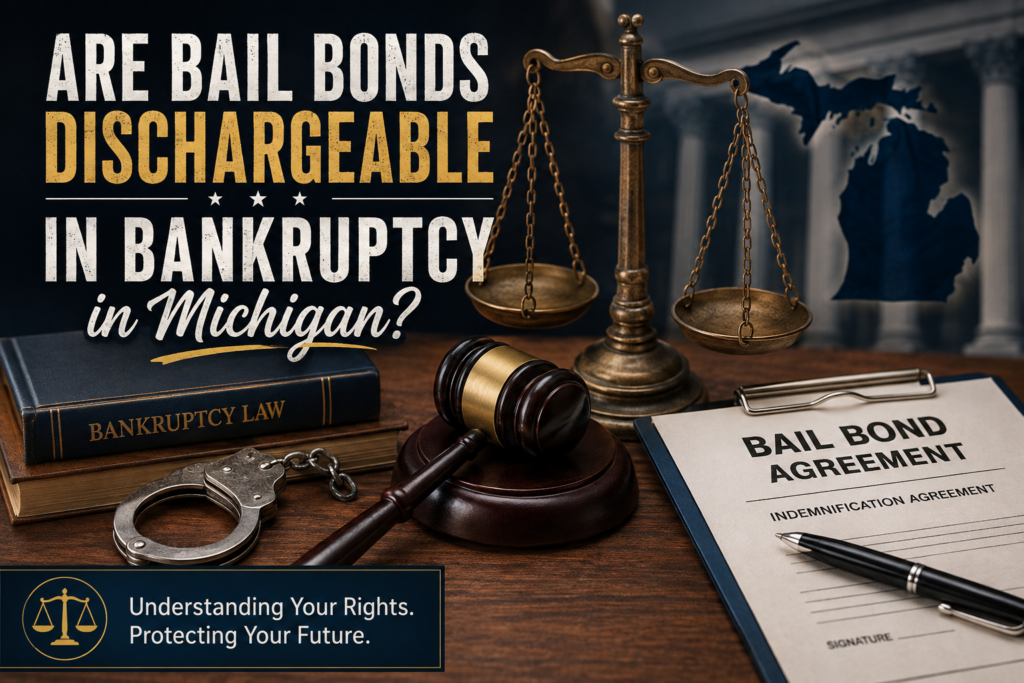
The person obtaining the bond may be required to pay a premium and may also be required to sign an indemnification agreement agreeing to reimburse the bondsman if the bond is forfeited.
For example, suppose a defendant is released on a $50,000 surety bond. A family member may sign an agreement with the bondsman guaranteeing that if the defendant fails to appear and the bond is forfeited, the family member will reimburse the bondsman.
If the defendant appears as required, there may never be a significant debt beyond the original premium.
But if the defendant disappears and the bond is forfeited, the situation can become very different.
Michigan law provides procedures for forfeiting bail bonds when a defendant fails to comply with the conditions of release. Michigan’s court system explains that when a defendant fails to appear, the court may issue a warrant and proceed with forfeiture of the bond. Michigan law also provides specific notice requirements to the surety following a defendant’s failure to appear.
That forfeiture can result in a substantial financial obligation.
The Bankruptcy Code Starts With a Presumption of Discharge
One of the fundamental principles of bankruptcy is that an individual debtor is entitled to a discharge of most prepetition debts.
But there are important exceptions.
Section 523 of the Bankruptcy Code identifies numerous categories of debts that are not discharged in bankruptcy. These include certain taxes, debts arising from fraud, certain governmental fines and penalties, and other obligations specifically identified by Congress.
The question with a bail bond is whether the obligation falls within one of these exceptions.
One of the most important provisions to examine is 11 U.S.C. § 523(a)(7).
That section makes nondischargeable a debt that is a:
- fine;
- penalty; or
- forfeiture
payable to and for the benefit of a governmental unit, so long as it is not compensation for an actual pecuniary loss.
This language is extremely important when analyzing a forfeited bail bond.
A Debt Owed to a Bail Bondsman Is Different
Suppose John signs an agreement with ABC Bail Bonds.
John agrees that if ABC Bail Bonds suffers a loss because the defendant fails to appear, John will reimburse ABC Bail Bonds for that loss.
The defendant fails to appear.
The bond is forfeited.
ABC Bail Bonds then obtains a judgment against John for $25,000 under the indemnification agreement.
There is a strong argument that this is a contractual debt owed to a private creditor, rather than a governmental fine, penalty, or forfeiture.
That distinction has been recognized by several courts.
For example, in In re Collins, the Fourth Circuit considered bail bond obligations owed to the Commonwealth of Virginia. The debtor had been a professional bail bondsman, and the Commonwealth had obtained judgments against him for unpaid forfeited bail bonds.
The Fourth Circuit held that the obligations were dischargeable in bankruptcy.
The court emphasized the contractual nature of the obligation and concluded that the bail bondsman’s liability did not constitute the type of nondischargeable penalty contemplated by § 523(a)(7).
The Fifth Circuit reached a similar conclusion in In re Hickman, holding that bail bond forfeiture obligations arising from a commercial bail bond business were not the type of penal forfeiture made nondischargeable by § 523(a)(7).
These cases provide important support for the proposition that a contractual obligation arising from a commercial bail bond may be dischargeable.
But There Is a Big Exception
There is another line of cases that reaches a different result when the debt is actually a forfeiture payable to the government.
Consider United States v. Zamora, 238 B.R. 842 (D. Ariz. 1999).
In Zamora, the debtor had agreed to act as a surety on a federal bail bond. The criminal defendant failed to appear, and the government obtained a $25,000 judgment based upon the forfeited bond.
The debtor subsequently filed Chapter 7.
The government argued that the obligation was nondischargeable under § 523(a)(7).
The district court agreed.
The court reasoned that the obligation was expressly a forfeiture, was payable to and for the benefit of the government, and was not compensation for an actual pecuniary loss. It therefore concluded that the debt fell within § 523(a)(7).
This case demonstrates why simply saying “bail bonds are dischargeable” can be misleading.
The identity of the creditor and the legal nature of the obligation matter.
What About Michigan?
Michigan has its own statutory procedures governing bail bond forfeitures.
For example, Michigan law provides that when a defendant fails to appear and the applicable requirements are satisfied, the court can declare the bond forfeited and pursue recovery on the bond.
Michigan courts have also emphasized that the statutory procedures surrounding bond forfeiture are important. In In re Forfeiture of Bail Bond (People v. Gaston), the Michigan Supreme Court held that the statutory seven-day notice requirement to the surety is mandatory and that failure to comply with the requirement can prevent the forfeiture from proceeding.
This means that before even reaching the bankruptcy question, an attorney should examine the underlying bond forfeiture to determine whether it was properly entered under Michigan law.
But there is an additional issue.
The Sixth Circuit has not squarely resolved the precise question of whether every Michigan bail bond forfeiture obligation is nondischargeable under § 523(a)(7).
That means a Michigan bankruptcy attorney should not simply assume that a bail bond debt is either automatically dischargeable or automatically nondischargeable.
The underlying documents and the nature of the claim must be examined.
What If the Debt Is Owed Directly to the Bail Bondsman?
This may be the more favorable situation for a debtor.
If the bail bondsman has a contractual claim against the debtor based upon an indemnification agreement, the creditor may argue that the debt represents reimbursement for the bondsman’s contractual loss.
The debtor, on the other hand, may argue that the debt is simply a private contractual obligation and does not satisfy § 523(a)(7)’s requirement that the debt be payable to and for the benefit of a governmental unit.
That argument has substantial support in the federal cases addressing commercial bail bond obligations.
However, other exceptions to discharge could potentially apply depending upon the facts.
For example, if the debt was obtained through fraud or false pretenses, § 523(a)(2) could become relevant. If the debtor’s conduct resulted in a willful and malicious injury, § 523(a)(6) might also become an issue.
In other words, the label placed on the debt is not necessarily the end of the analysis.
What About Chapter 13?
Chapter 13 requires a separate analysis.
The discharge available at the end of a Chapter 13 case is somewhat broader than the Chapter 7 discharge, although there are still numerous exceptions.
Section 1328 specifically identifies debts that survive a Chapter 13 discharge, including certain criminal fines and restitution obligations.
Therefore, if someone has a substantial bail-related obligation, it is important to determine exactly what the debt represents before deciding whether Chapter 7 or Chapter 13 is appropriate.
A Chapter 13 plan may also provide a practical method of dealing with a disputed or potentially nondischargeable obligation, depending upon the circumstances of the case.
The Most Important Question: Who Are You Actually Owing?
When someone tells me, “I owe money on a bail bond,” that isn’t enough information to determine whether the debt is dischargeable.
I would want to know:
Who is the creditor?
Is it:
- a private bail bond company?
- a surety company?
- the State of Michigan?
- a county or municipality?
- a court?
- another person who paid the bond?
I would also want to see:
- the original bail bond;
- the indemnification agreement;
- any collateral agreement;
- the court’s order forfeiting the bond;
- any judgment entered following the forfeiture; and
- the current balance being claimed.
These documents can make the difference between a debt that is potentially dischargeable and one that may survive bankruptcy.
Don’t Assume That a Bail Bond Debt Cannot Be Bankrupted
I have encountered many people who believe that anything connected to a criminal case automatically survives bankruptcy.
That is not correct.
Bankruptcy law does not simply ask whether a debt is connected to a criminal proceeding. It asks what the debt actually is and whether Congress has made that particular type of debt nondischargeable.
The Supreme Court and the Bankruptcy Code have established that dischargeability depends upon the statutory exception that applies to the particular obligation. The federal courts have reached differing conclusions concerning bail bond forfeitures, particularly depending upon whether the obligation is viewed as a private contractual obligation or a governmental forfeiture.
That is why the details matter.
The Bottom Line for Michigan Debtors
Can a bail bond debt be discharged in bankruptcy in Michigan?
Possibly.
A contractual debt owed to a private bail bondsman may be dischargeable, and several federal appellate courts have held that commercial bail bond obligations are dischargeable.
On the other hand, a forfeiture payable directly to a governmental unit may fall within § 523(a)(7) and therefore may be nondischargeable. The case law on this issue is not uniform.
For a Michigan debtor, the safest approach is not to assume that the debt is dischargeable or nondischargeable merely because it arose from a bail bond.
The actual bond, the forfeiture order, the creditor, and the legal basis for the debt should all be reviewed before making that determination.
And, as with every bankruptcy case, the debt should be disclosed in the bankruptcy schedules. A debtor should never omit a debt simply because there is a question about whether it will ultimately be discharged.
Bankruptcy is a powerful remedy for the honest but unfortunate debtor. But obtaining that fresh start begins with complete and accurate disclosure of your financial obligations.
This article is for general informational purposes and is not intended to constitute legal advice. The dischargeability of a particular bail bond obligation depends upon the facts, the documents, the identity of the creditor, and applicable federal and Michigan law.