W-2 vs. Income Tax Return: Why Your Bankruptcy Attorney Needs Your Actual Tax Returns

Published
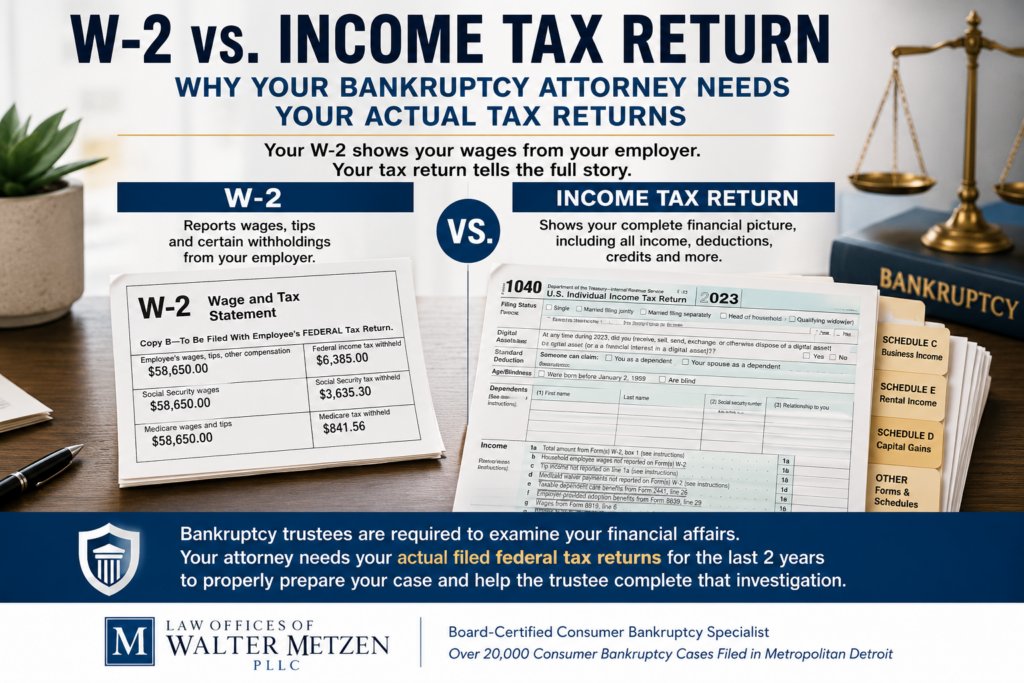
When you are preparing to file bankruptcy, one of the things you will be asked to provide is your federal income tax return for the last two years. Many clients respond by sending their W-2s and asking, “Isn’t that my tax return?”
The answer is no.
A W-2 and an income tax return are two very different documents. Both contain important financial information, but they serve very different purposes. If you are filing bankruptcy, your attorney needs the actual filed federal income tax returns, not simply your W-2s.
What Is a W-2?
A W-2 is a document provided by your employer after the end of the calendar year. It reports the wages, salaries, tips and certain other compensation that your employer paid you during the year.
Your W-2 also shows certain amounts withheld from your paycheck, such as federal income taxes, Social Security and Medicare taxes.
For example, if you worked for three different employers during the year, you may receive three separate W-2 forms.
Your W-2 tells us about your employment income. It does not tell us your complete financial story.
What Is an Income Tax Return?
Your federal income tax return is the document you actually file with the Internal Revenue Service, generally using Form 1040 and whatever schedules, statements and forms are attached to it.
Your tax return provides a much broader picture of your financial affairs.
Depending upon your circumstances, it may contain information concerning:
- Wages and employment income;
- Self-employment or business income;
- Interest and dividend income;
- Capital gains and losses;
- Rental income;
- Retirement income;
- Unemployment compensation;
- Social Security income;
- Alimony or other sources of income;
- Business expenses;
- Rental expenses;
- Itemized deductions;
- Dependents;
- Tax credits;
- Losses carried forward from prior years; and
- Other financial information reported to the IRS.
In other words, your W-2 is one piece of the tax return; it is not the tax return.
Why Does the Bankruptcy Trustee Need Your Tax Returns?
When you file a bankruptcy case, the bankruptcy trustee has an obligation to examine your financial affairs.
The trustee is not simply looking at how much you earn from your current job. The trustee is attempting to understand your overall financial situation and determine whether there are assets, income, transfers or other financial matters that need to be investigated.
Your federal income tax returns are an important part of that investigation.
The tax return can allow the trustee to compare the information contained in your bankruptcy petition with information that was previously reported to the IRS.
For example, the trustee may be interested in determining whether:
- Your reported income is consistent with the information in your bankruptcy schedules;
- You operated a business or received self-employment income;
- You received rental income;
- You reported the sale of property;
- You received substantial interest or dividend income;
- You claimed certain deductions or losses;
- There were significant changes in your financial circumstances; or
- There are financial transactions that require further explanation.
The trustee is essentially trying to answer a basic question: Does the bankruptcy petition accurately disclose the debtor’s financial affairs?
Your tax returns help the trustee answer that question.
Why I Need Your Actual Tax Returns
As your bankruptcy attorney, I also need your actual filed tax returns.
A bankruptcy petition is a detailed financial document. I cannot properly prepare that petition by simply asking you how much money you made last year or by looking at your W-2.
The tax returns provide information that can help me identify income, businesses, property, deductions, losses and other financial matters that may need to be disclosed in your bankruptcy case.
This is particularly important when someone is self-employed, owns rental property, has investments, has operated a business, or has had significant changes in income.
Sometimes a client will tell me, “I don’t have any businesses,” only to discover that a Schedule C was attached to a prior tax return. Or a client may not remember receiving rental income, capital gains, or other income that appears on the tax return.
It is much better for me to discover that information while preparing your bankruptcy petition than for the bankruptcy trustee to discover it after the case has been filed.
The Trustee May Have Your Tax Return Too
It is also important to understand that the bankruptcy trustee is conducting an independent investigation.
The trustee may request your tax returns as part of the administration of your bankruptcy case. The fact that you have already provided a copy to your attorney does not mean that the trustee’s review is unnecessary.
The trustee wants to make sure that the information provided in the bankruptcy case is accurate and complete.
That is one reason why I ask clients for their tax returns before filing the bankruptcy petition.
I want to know what is in those returns before your case is filed.
What If I Don’t Have My Tax Returns?
If you do not have copies of your prior federal income tax returns, don’t panic.
You may be able to obtain transcripts or copies of previously filed returns from the IRS. However, there is an important distinction between an IRS tax transcript and the actual tax return that you filed.
A transcript may contain much of the information reported to the IRS, but it is not necessarily a complete copy of the return, including all schedules and attachments.
If I am preparing your bankruptcy case, I want to know exactly what documents you have and what information they contain so that we can determine what is appropriate for your particular case.
Don’t Send Me Just Your W-2s
One of the most common misunderstandings I see is a client sending several W-2s and saying, “Here are my tax returns.”
Those are not your tax returns.
Your W-2s are important, and I will need them in appropriate circumstances. But they are only one part of the information used to prepare your bankruptcy case.
If I ask you for your last two years of federal income tax returns, I am asking for the actual returns that you filed with the IRS, including the schedules and attachments—not simply the W-2s you received from your employer.
The Bottom Line
Bankruptcy requires complete and accurate financial disclosure.
Your bankruptcy attorney needs to know your financial history before filing your case, and the bankruptcy trustee needs to be able to investigate your financial affairs after the case is filed.
Your W-2 tells us what an employer reported paying you.
Your federal income tax return tells us much more about your overall financial affairs.
That distinction matters.
When I ask a bankruptcy client for the last two years of federal income tax returns, there is a reason for the request. I need those returns to properly prepare your bankruptcy petition, and the trustee needs them to conduct an appropriate investigation into your financial affairs.
Providing complete information at the beginning of your case helps prevent surprises later and gives your attorney the information necessary to properly represent you.
If you are considering bankruptcy, don’t wait until after your case is filed to start gathering your tax returns. Get them together before your initial bankruptcy preparation appointment. It can save time, prevent unnecessary questions and help make sure your bankruptcy petition accurately reflects your financial situation.
This article is intended for general informational purposes and is not legal advice. Every bankruptcy case is different, and you should consult with a qualified bankruptcy attorney regarding your particular circumstances.