I Filed Bankruptcy and Am Surrendering My Car, but the Lender Refuses to Pick It Up. What Can I Do?

Published
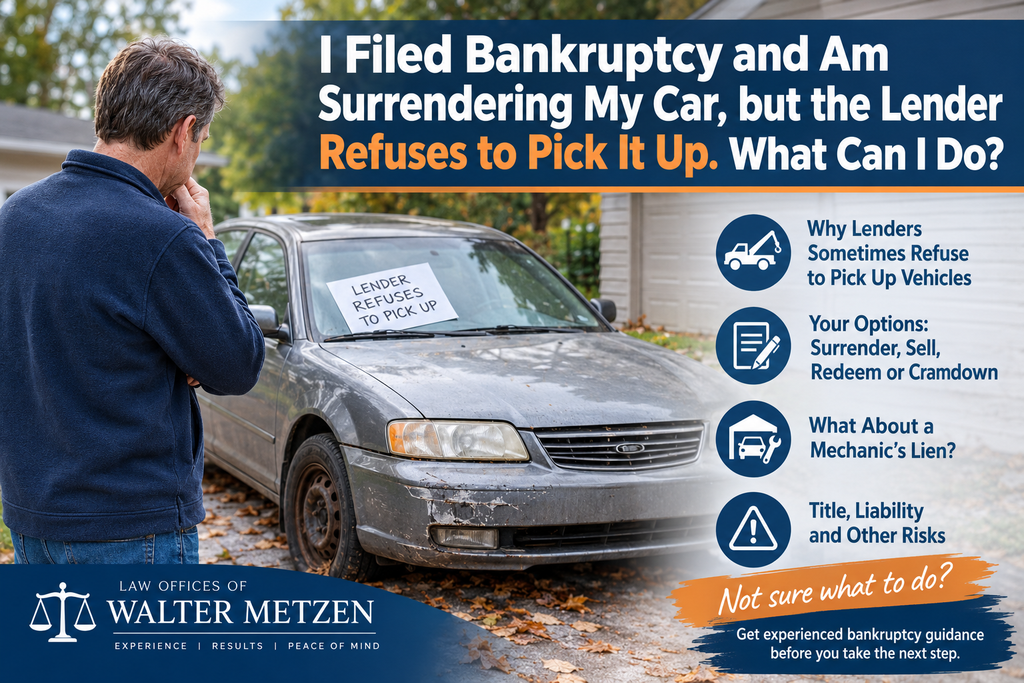
One of the options available to someone filing Chapter 7 bankruptcy is to surrender a vehicle to the lender. Usually, this is a fairly straightforward process. The debtor stops making payments, the bankruptcy case is filed, and the lender eventually repossesses the vehicle.
But what happens when the lender refuses to pick up the car?
Over my 35-year career practicing bankruptcy law, I have encountered situations where a client has surrendered a vehicle in bankruptcy, only to discover that the finance company has no interest in taking it back. Sometimes the vehicle is sitting in the client’s driveway or garage. Other times, it is an inoperable vehicle sitting in an apartment complex parking lot or at a mechanic’s shop where storage charges may be accumulating.
The bankruptcy may have eliminated the client’s personal liability on the car loan, but the unwanted vehicle remains a problem.
Let’s look at why this happens and what you may be able to do about it.
Table of Contents
- What Does It Mean to Surrender a Vehicle in Bankruptcy?
- Why Would a Finance Company Refuse to Pick Up Its Vehicle?
- Does the Bankruptcy Discharge Mean I No Longer Have to Worry About the Car?
- Option 1: Ask the Lender to Accept a Voluntary Surrender
- Option 2: Can I Sell the Vehicle to a Junkyard or Salvage Yard?
- Option 3: What If the Vehicle Is Sitting at a Mechanic’s Shop?
- Option 4: Can I Leave the Vehicle Where It Is?
- Option 5: Could I Redeem the Vehicle in Chapter 7 or Keep It Through Chapter 13?
- An Important Warning: You May Still Be the Registered Owner
- What I Would Recommend If You Are in This Situation
- Final Thoughts
What Does It Mean to Surrender a Vehicle in Bankruptcy?
When you file Chapter 7 bankruptcy, you generally have several options concerning a vehicle that is subject to a loan. You may be able to keep the vehicle and continue making payments, redeem it by paying its current value in a lump sum, or surrender it to the lender.
Surrendering a vehicle means giving up your claim to keep it and allowing the secured creditor to exercise its rights against the collateral. It does not mean that you personally arrange and pay for a repossession, nor does it necessarily mean that the lender must immediately come and remove the vehicle from your property.
In most cases, the process works as expected.
A debtor who can no longer afford the car payment files bankruptcy and indicates an intention to surrender the vehicle. The lender eventually repossesses it, typically after several missed payments and often around three months of nonpayment, although the timing varies considerably by lender, state law, and the circumstances of the case.
When a bankruptcy case is pending, the automatic stay generally prevents the lender from repossessing the vehicle without bankruptcy court permission. The lender will commonly obtain relief from the automatic stay or wait until the stay no longer prevents repossession. There are exceptions, including situations in which the stay terminates or does not apply under the Bankruptcy Code.
Once the lender is legally permitted to repossess the vehicle, it usually takes possession, sells the vehicle at auction, and applies the proceeds toward the loan balance and permitted expenses.
If the auction proceeds are insufficient to pay the entire debt, the remaining deficiency is generally an unsecured debt that can be discharged in the bankruptcy, subject to the usual exceptions to discharge.
That is how the process is supposed to work in the ordinary case.
Why Would a Finance Company Refuse to Pick Up Its Vehicle?
Occasionally, a finance company decides that repossessing a vehicle simply is not worth the expense.
This is particularly common when a vehicle is older, has high mileage, has significant body damage, or has a serious mechanical problem. A vehicle with a blown engine, transmission failure, extensive collision damage, or other expensive repairs may have very little resale value.
The lender has to consider the economics of repossession.
There may be costs for:
- Hiring a repossession company.
- Towing the vehicle, particularly if it is not drivable.
- Cleaning or preparing the vehicle for sale.
- Storing the vehicle before auction.
- Paying auction fees and other disposition expenses.
- Handling the paperwork and administrative work associated with the sale.
If the lender believes that the vehicle will generate very little money at auction, the expected proceeds may not justify those expenses.
In that situation, the lender may effectively abandon its collateral. It may simply stop responding to requests to retrieve the vehicle.
I have had clients who desperately wanted an unwanted vehicle removed from their property, only to find that the creditor was unwilling to spend the money necessary to take it away.
Unfortunately, you cannot ordinarily force the lender to repossess the vehicle simply because you elected to surrender it in bankruptcy.
The bankruptcy process addresses your obligations and the creditor’s rights. It does not automatically provide a mechanism to make the lender come and collect its collateral on your schedule.
Does the Bankruptcy Discharge Mean I No Longer Have to Worry About the Car?
Not necessarily.
A Chapter 7 discharge generally eliminates your personal liability for a dischargeable car loan. It does not automatically transfer ownership of the vehicle to the lender, clear the title, or remove your name from the vehicle’s registration records.
The lender may retain its lien even though it can no longer collect the discharged debt from you personally.
That distinction is important. You may no longer owe the loan as a personal obligation, but you may still be the vehicle’s registered owner, and the vehicle may still be titled in your name.
This can create practical and potentially legal problems.
For example, a vehicle left in an apartment complex parking lot may violate the complex’s parking rules. Management may demand that the vehicle be removed, threaten towing under the lease or applicable law, or take other permitted action.
A homeowner may simply want a wrecked vehicle removed from the driveway. A mechanic may refuse to release space in the shop’s lot while storage charges accumulate. And the lender may continue to refuse to take possession because it believes the vehicle is worth less than the cost of retrieving it.
You can end up with a vehicle that you no longer want, a loan you can no longer be required to pay personally, and a title that is still in your name.
That is where additional options may be worth exploring.
Option 1: Ask the Lender to Accept a Voluntary Surrender
The first thing I recommend is contacting the lender’s bankruptcy department or repossession department in writing.
Explain that you filed bankruptcy, elected to surrender the vehicle, and want it removed. Provide the vehicle’s location, condition, mileage, and whether it is drivable. If the lender has already told you it will not retrieve the vehicle, ask whether it will provide a written statement confirming that decision.
Keep copies of all correspondence.
You should also make sure that your bankruptcy attorney knows what is happening. If the case is still pending, the automatic stay and any orders entered by the bankruptcy court may affect what the lender can do and what steps you can safely take.
However, there is an important limitation: the lender may have no financial incentive to cooperate. Repeatedly asking the lender to pick up a vehicle worth very little may not change its decision.
Option 2: Can I Sell the Vehicle to a Junkyard or Salvage Yard?
Sometimes, the most practical solution is to sell the vehicle to a junkyard, scrap yard, or salvage vehicle dealer.
Even a vehicle that does not run may have value for its scrap metal, engine, transmission, catalytic converter, or other usable parts. Depending on its condition, the salvage yard may be willing to pay you something for it.
The difficulty is the lien.
If you have a clear title and no lien, disposing of the vehicle is usually much easier. You can generally transfer ownership to the salvage buyer using the required title documents.
But what if the lender still has a lien on the vehicle and refuses to release it?
In Michigan, the existence of a bankruptcy discharge does not, by itself, eliminate the lien or give you the right to transfer the vehicle free and clear of the lender’s security interest. Michigan generally requires appropriate title documentation and a lien termination statement for an ordinary transfer where a lien remains recorded. See the Michigan Secretary of State’s vehicle title guidance.
Some salvage buyers may be able to take a vehicle through an alternative process, depending on the circumstances. For example, a properly licensed business may be able to use applicable abandoned-vehicle procedures, or a buyer may obtain the necessary cooperation from the lienholder. A qualifying garage keeper may also be able to sell a vehicle through a statutory lien process.
But be careful about anyone who tells you that a salvage yard can automatically obtain a new title simply because the vehicle is junk and the lender will not pick it up. There is no universal procedure that lets a salvage yard disregard an existing lien. The applicable process depends on the vehicle’s title status, the lien, the buyer’s legal authority, and the circumstances of the transaction.
Before transferring or scrapping the vehicle, make sure the proposed process is legally valid and that ownership can actually be transferred. Do not sign a blank title, hand over the vehicle without documentation, or assume that the lender’s refusal to repossess means you are free to dispose of its collateral.
Option 3: What If the Vehicle Is Sitting at a Mechanic’s Shop?
This is a situation I have seen create considerable frustration for debtors.
A client may have an older vehicle that broke down before bankruptcy. The vehicle is sitting at a repair shop, and the mechanic may be charging storage fees. The debtor files bankruptcy, surrenders the vehicle, and expects the lender to pick it up.
The lender refuses.
Meanwhile, the mechanic wants the vehicle removed and may be adding storage charges to the bill.
Michigan law provides a potential solution in certain circumstances: a qualifying repair facility may be entitled to a garage keeper’s lien. Under the applicable statutory process, a repair facility that meets the requirements may be able to retain the vehicle and pursue a sale to recover qualifying charges. The Michigan Secretary of State explains the requirements, notices, deadlines, and sale procedure in its garage keeper lien guidance.
This can sometimes solve the practical problem because the vehicle may ultimately be sold through the statutory process, with the buyer applying for title using the required documentation.
However, a garage keeper’s lien is not automatic merely because a vehicle is sitting on a mechanic’s property. The repair facility must satisfy the applicable requirements. Whether it can claim storage charges, whether the owner authorized the relevant work or storage, and how its lien interacts with an earlier security interest all matter.
For a vehicle that is already involved in a bankruptcy case, the repair facility and debtor must also consider the automatic stay and other bankruptcy restrictions before taking action.
If the vehicle is at a mechanic’s shop, I would have the bankruptcy attorney contact the shop and determine whether the statutory garage keeper process is available. It may provide a lawful path to getting the vehicle off the premises without requiring the debtor to pay a discharged loan balance.
Option 4: Can I Leave the Vehicle Where It Is?
Sometimes, debtors ask whether they can simply leave the vehicle where it is because the lender has refused to take it.
That is rarely a good long-term plan.
An apartment complex may have rules against inoperable or unregistered vehicles. A landlord may have rights under the lease and applicable law to require removal. A vehicle left on private property may eventually be towed, and a vehicle left on public property may be subject to local ordinances and abandoned-vehicle procedures.
If the vehicle is sitting at a mechanic’s shop, storage charges or other lawful claims may continue to accrue. You should not assume that the bankruptcy discharge eliminates every obligation arising from the vehicle’s continued presence on someone else’s property.
Instead, try to establish a written plan for removal. If the vehicle is at an apartment complex, communicate with management before the situation escalates. If it is at a repair facility, determine the charges and whether the shop is willing to pursue a lawful lien and sale process.
The important point is that surrendering the vehicle in bankruptcy does not make the practical problem disappear.
Option 5: Could I Redeem the Vehicle in Chapter 7 or Keep It Through Chapter 13?
If the vehicle has some value, but the loan balance is substantially greater than that value, it may be worth discussing other bankruptcy options with your attorney.
Chapter 7: Redemption
Under Section 722 of the Bankruptcy Code, an individual debtor may be able to redeem qualifying personal-use property from a lien by paying the creditor the amount of its allowed secured claim, generally the vehicle’s current replacement value, in a lump sum. Redemption is subject to specific statutory requirements, including that the property is intended primarily for personal, family, or household use.
For example, suppose your car is worth $2,000 but you owe $12,000 on the loan. If you qualify for redemption, you may be able to keep the vehicle by paying the secured creditor the applicable value rather than the entire loan balance.
Of course, you still need to come up with the redemption money, and the vehicle must be worth keeping. If it has a blown engine or serious mechanical problems, redemption may not make economic sense.
For a vehicle that is worth very little, redemption may be an option worth investigating, but it is not necessarily a solution if your primary goal is simply to get rid of the car.
Chapter 13: Cramdown
Chapter 13 may offer another approach in an appropriate case.
Depending on the circumstances, a Chapter 13 plan may allow a debtor to pay the allowed secured value of a vehicle through the plan, with the remaining qualifying debt treated as unsecured. This is commonly called a cramdown.
However, important restrictions apply. In particular, the Bankruptcy Code’s 910-day rule generally prevents a debtor from using this treatment for a qualifying purchase-money vehicle loan incurred within 910 days before the bankruptcy filing. Other limitations can apply as well.
Chapter 13 is not necessarily the right answer for someone who simply wants an unwanted vehicle removed. But if you are considering keeping a vehicle with substantial negative equity, it may be worth exploring with your bankruptcy attorney.
An Important Warning: You May Still Be the Registered Owner
There is another issue that deserves special attention.
Even after you file bankruptcy and surrender a vehicle, you may remain the vehicle’s registered owner. If the lender does not repossess it and does not transfer title, the vehicle may continue to be associated with you in the state’s records.
This is more than a paperwork inconvenience.
Under Michigan law, a vehicle owner can be held liable for injuries caused by negligent operation of the vehicle when the statutory requirements are met, including the requirement that it be driven with the owner’s express or implied consent or knowledge. There are exceptions and fact-specific issues, so ownership does not mean automatic liability for every accident. See Michigan Compiled Laws § 257.401.
Consider what could happen if an unwanted vehicle is left unlocked in an accessible parking lot, someone takes it without your permission, and an accident occurs. Whether you could be held liable would depend on the facts and applicable law, but the situation creates an unnecessary risk.
For that reason, I would not recommend simply abandoning the vehicle and assuming that the bankruptcy discharge has removed all responsibility associated with it.
You should take reasonable steps to secure the vehicle, document your efforts to have it removed, and pursue a lawful way to dispose of it or transfer ownership. You should also speak with your insurance agent about your coverage and obligations while the vehicle remains titled or registered in your name.
A completed and legally valid transfer of ownership is important. Merely telling the lender that you surrender the vehicle does not accomplish that transfer.
What I Would Recommend If You Are in This Situation
If you filed bankruptcy in Michigan, surrendered your vehicle, and the lender refuses to pick it up, I would approach the problem in this order:
- Contact the lender in writing. Request pickup and ask whether it will authorize a voluntary transfer or release the lien so the vehicle can be disposed of.
- Document the vehicle’s condition. Take photographs, obtain a repair estimate if appropriate, and keep copies of your communications with the lender.
- Determine whether a salvage yard will accept it. Ask specifically whether it can legally take the vehicle with the existing lien and what title documentation it requires.
- If the vehicle is at a repair facility, explore the garage keeper’s lien process. This may provide a lawful way to resolve the vehicle and storage problem.
- Address any demands from your landlord or property manager promptly. Do not assume that the bankruptcy filing prevents towing or other lawful action concerning a vehicle left on the property.
- Consult your bankruptcy attorney before disposing of the vehicle. This is especially important if your case is still pending, the automatic stay remains in effect, or the vehicle may be property of the bankruptcy estate.
The best solution depends on the vehicle’s value, condition, title status, lienholder, and location.
Final Thoughts
Surrendering a vehicle in bankruptcy is ordinarily a relatively simple process. The lender repossesses the vehicle, sells it, and the bankruptcy discharge generally eliminates the debtor’s personal liability for any qualifying deficiency balance.
But occasionally, a finance company decides that an old, damaged, or inoperable vehicle is not worth retrieving. When that happens, the debtor can be left with a vehicle that nobody wants, a lien that has not been released, and a landlord or mechanic demanding that the vehicle be removed.
The most important thing to understand is that surrendering a vehicle in bankruptcy does not automatically transfer title to the lender or force the lender to pick it up.
Depending on the circumstances, a salvage sale, a properly conducted garage keeper’s lien process, or another lawful title-transfer procedure may provide a solution. Your bankruptcy attorney can help determine which approach is appropriate without creating additional legal problems.
If you are considering bankruptcy and have a vehicle you cannot afford, or you have already filed bankruptcy and are struggling to get rid of a surrendered vehicle, I encourage you to discuss the situation with an experienced bankruptcy attorney before taking action.
In my practice, I have found that these unusual vehicle problems often require a practical solution beyond simply checking the surrender box on the bankruptcy petition.
This article provides general information about bankruptcy and Michigan vehicle-title procedures. The appropriate solution depends on the facts of the individual case and applicable law.