Why Does the Bankruptcy Trustee Want to See 60 Days of Pay Stubs?

Published
One of the documents I routinely request from clients before filing a Chapter 7 or Chapter 13 bankruptcy is their last 60 days of pay stubs. Many clients wonder why this is necessary. After all, if they have already provided their tax returns, bank statements, and other financial information, why does the bankruptcy trustee also need to see two months of pay stubs?
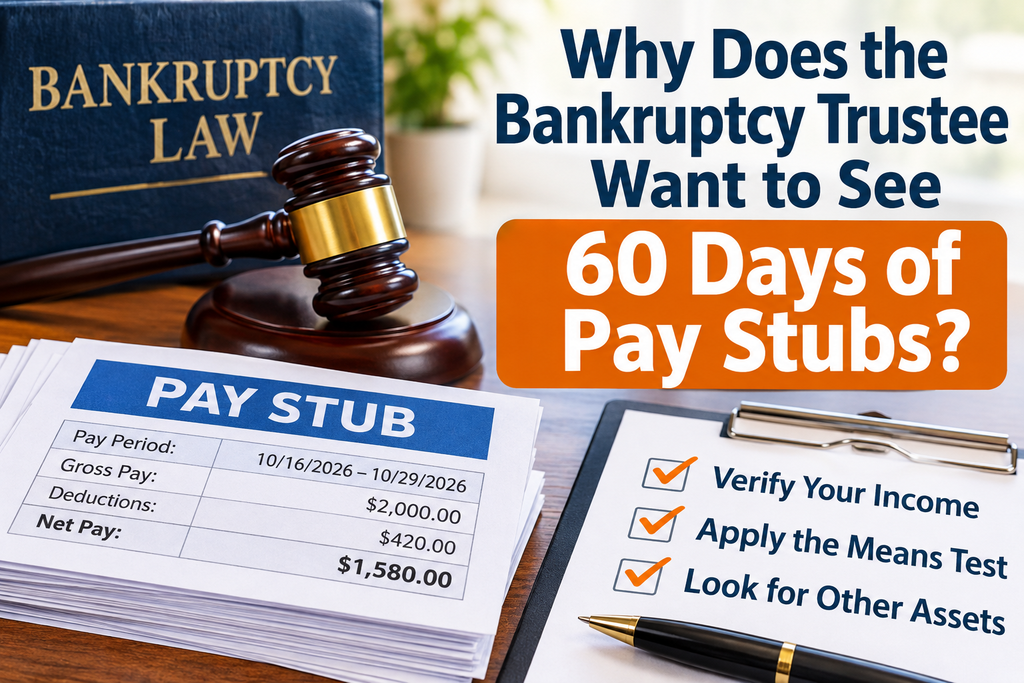
The answer is that there are several important reasons. First, it is a requirement of the Bankruptcy Code. Second, the trustee needs to verify the debtor’s income to determine whether the debtor qualifies for Chapter 7 bankruptcy and whether the income and expenses reported in the bankruptcy schedules are accurate. Finally, pay stubs can provide the trustee with valuable clues about other assets and financial accounts that may need to be disclosed.
Let’s take a closer look at why those 60 days of pay stubs are so important.
Table of Contents
- 1. It Is a Requirement of the Bankruptcy Code
- 2. The Trustee Needs to Verify Your Income
- 3. The Pay Stubs Are Important for the Means Test
- 4. Pay Stubs Can Reveal Other Assets the Trustee Wants to Know About
- 5. What If You Have Overtime, Bonuses, or Irregular Income?
- 6. What If You Are Self-Employed or Do Not Receive Pay Stubs?
- 7. What Happens If You Do Not Provide the Pay Stubs?
- Conclusion: The Trustee Is Looking at More Than Your Take-Home Pay
1. It Is a Requirement of the Bankruptcy Code
The requirement to provide pay stubs is not something that bankruptcy attorneys or trustees simply made up.
Under Section 521(a)(1)(B)(iv) of the Bankruptcy Code, a debtor is required to provide copies of payment advices or other evidence of payment received from an employer during the 60 days before the bankruptcy filing, unless the court orders otherwise.
In addition, Bankruptcy Rule 4002(b)(2) requires debtors to provide evidence of their current income, including payment advices, to the trustee at least seven days before the meeting of creditors.
In other words, providing the last 60 days of pay stubs is a normal and expected part of the bankruptcy process.
This requirement applies even if the debtor has worked for the same employer for many years, even if the debtor’s income has not changed, and even if the debtor has already provided other financial documents.
2. The Trustee Needs to Verify Your Income
One of the trustee’s primary responsibilities is to examine the debtor’s financial circumstances. The pay stubs provide an independent way to verify the income reported in the bankruptcy paperwork.
When we file a bankruptcy case, we prepare two important schedules dealing with income and expenses:
Schedule I – Your Income
Schedule I identifies the debtor’s current income, including wages, Social Security, pensions, retirement income, and other sources of regular income. If the debtor is married, the income of a non-filing spouse may also need to be disclosed, even if the spouse is not filing bankruptcy.
Schedule J – Your Expenses
Schedule J identifies the debtor’s regular monthly household expenses, including mortgage or rent payments, utilities, food, transportation, insurance, medical expenses, and other necessary living expenses.
Together, Schedules I and J provide the trustee and creditors with a picture of the debtor’s monthly financial situation.
The trustee will compare the income shown on the pay stubs with the income reported on Schedule I. If the numbers do not match, the trustee may ask questions.
For example, the trustee may want to know whether the debtor has received a recent raise, overtime, bonuses, commissions, or other additional compensation. The trustee may also inquire about deductions that appear on the pay stubs but were not identified in the bankruptcy schedules.
The goal is to make sure that the bankruptcy paperwork accurately reflects the debtor’s financial circumstances.
3. The Pay Stubs Are Important for the Means Test
For many Chapter 7 debtors, one of the most important reasons the trustee reviews pay stubs is to examine the Chapter 7 means test.
The means test was established under the Bankruptcy Abuse Prevention and Consumer Protection Act of 2005. Its purpose is to determine whether a debtor’s income is sufficiently high to create a presumption of abuse if the debtor files Chapter 7 bankruptcy.
The means test generally looks at the debtor’s average income during the six full calendar months before the month in which the bankruptcy case is filed.
This is an important distinction: The 60 days of pay stubs required by the Bankruptcy Code are not the same thing as the six-month income period used for the means test.
For example, if a debtor files bankruptcy on November 25, 2026, the means test generally looks at income received from May 1 through October 31, 2026.
The trustee may therefore request additional pay stubs beyond the last 60 days when necessary to verify the six-month income calculation.
The means test considers more than just the debtor’s take-home pay. It generally starts with gross income before payroll deductions and includes qualifying income from various sources, subject to statutory exclusions.
The trustee will look for items such as:
- Regular wages and salary.
- Overtime.
- Bonuses and commissions.
- Second-job income.
- Certain retirement and pension income.
- Other sources of income that must be included under the means test.
There are special rules for Social Security benefits, which are excluded from the means test calculation, although they still must be disclosed in the appropriate bankruptcy schedules.
The trustee may also compare the means test calculation with the income reported on Schedule I.
It is important to understand that passing the means test does not automatically mean that every Chapter 7 case is approved without further examination. The trustee can still investigate whether the bankruptcy filing involves abuse or whether there are other issues concerning the debtor’s financial circumstances.
4. Pay Stubs Can Reveal Other Assets the Trustee Wants to Know About
This is something many debtors do not anticipate.
A pay stub is not just evidence of how much money someone earns. It can also provide the trustee with clues about other assets, financial accounts, and benefits that the debtor may have.
Experienced bankruptcy trustees know what to look for.
For example, a trustee reviewing pay stubs may see deductions for:
401(k) Contributions
If the debtor is making contributions to a 401(k), the trustee may ask for information about the retirement account, including its current balance and recent statements.
Retirement accounts often receive special protection under bankruptcy law, but the trustee still needs to know that they exist. The fact that an account may be exempt does not mean it can be omitted from the bankruptcy paperwork.
Pension Contributions
Some employers deduct money from employee paychecks for pension plans or other retirement benefits. These deductions may alert the trustee to the existence of a pension or retirement account.
The trustee may want to determine whether the debtor has a vested pension benefit or other retirement assets that need to be disclosed.
Life Insurance
Pay stubs sometimes show deductions for employer-sponsored life insurance or supplemental life insurance coverage.
The trustee may ask whether the debtor has a life insurance policy, whether it has any cash surrender value, and whether the debtor owns the policy or is simply covered under an employer-provided group plan.
This distinction can be important because certain life insurance policies have cash value that may constitute an asset of the bankruptcy estate.
Direct Deposits to Financial Institutions
A pay stub may show that an employee has elected to divide a paycheck among several financial institutions or accounts.
For example, a debtor may have $2,000 deposited into one bank account, $200 deposited into a credit union account, and another $100 deposited into an online savings account.
The trustee may ask about each of these accounts and request bank statements.
It is not unusual for a debtor to forget about an account that has not been actively used for some time. However, all financial accounts and assets must be properly disclosed, even if the balances are relatively small.
Health Savings Accounts and Other Benefits
Pay stubs may also identify deductions for health savings accounts (HSAs), flexible spending arrangements, stock purchase plans, employee stock options, and other employer-sponsored benefits.
Some of these arrangements may involve assets or financial interests that need to be examined and disclosed.
The important point is that trustees do not simply look at the bottom line of a pay stub. They examine the individual deductions and deposits because those entries can lead to questions about other financial interests.
5. What If You Have Overtime, Bonuses, or Irregular Income?
This is another reason why the trustee wants to see actual pay stubs rather than simply accepting a debtor’s estimate of monthly income.
Many employees do not earn exactly the same amount every pay period.
Some work overtime. Others receive commissions, quarterly bonuses, production incentives, or seasonal income. Some employees may receive substantial overtime during certain months but very little during others.
A debtor who earns $1,500 every two weeks in regular wages may have a paycheck of $2,200 during a pay period when overtime is included.
The trustee will want to understand these variations.
For the means test, income generally must be calculated using the applicable six-month lookback period. A debtor cannot simply use the most recent paycheck or multiply one paycheck by two to determine average monthly income.
Likewise, if a debtor recently lost a job, experienced a reduction in hours, or received a significant pay increase, those circumstances may need to be explained.
The timing of the bankruptcy filing can make a substantial difference in the means test calculation.
This is one reason why I carefully review income information before filing a bankruptcy case.
6. What If You Are Self-Employed or Do Not Receive Pay Stubs?
Not everyone receives a traditional paycheck.
Self-employed individuals, independent contractors, business owners, and people who receive income through other arrangements may not have conventional pay stubs.
That does not eliminate the requirement to document income.
Depending on the circumstances, the trustee may request other evidence, including:
- Profit and loss statements.
- Business bank statements.
- Personal bank statements.
- 1099 forms.
- Invoices and payment records.
- Other documentation showing income received.
The objective is the same: the trustee must be able to verify the debtor’s income and financial circumstances.
7. What Happens If You Do Not Provide the Pay Stubs?
Failing to provide the required income documentation can create unnecessary problems in a bankruptcy case.
The trustee may request additional documents, continue the meeting of creditors, or raise concerns about whether the debtor has complied with the Bankruptcy Code.
In some circumstances, failure to provide required documents can result in dismissal of the bankruptcy case.
It is therefore important to provide your bankruptcy attorney with complete and accurate income documentation before the case is filed.
Do not assume that a pay stub is unimportant because it shows only a small deduction or because the account involved has a relatively small balance.
Something that appears insignificant to the debtor may be important to the trustee.
Conclusion: The Trustee Is Looking at More Than Your Take-Home Pay
The requirement to provide 60 days of pay stubs is a normal part of filing bankruptcy. The Bankruptcy Code requires it, and the trustee uses the information to verify income, review the debtor’s financial circumstances, and determine whether the means test and bankruptcy schedules are accurate.
But there is another important reason: pay stubs can reveal financial accounts, retirement contributions, insurance policies, and other assets that the trustee needs to know about.
In my practice, I want to identify these issues before the bankruptcy case is filed, rather than have them come up unexpectedly at the meeting of creditors.
I have practiced bankruptcy law exclusively for more than 35 years and have represented more than 25,000 people in bankruptcy matters. I have appeared before the bankruptcy trustees in the Eastern District of Michigan for decades, and I understand the types of questions they ask and the documents they expect to see.
If you are considering filing Chapter 7 or Chapter 13 bankruptcy, it is important to have an experienced bankruptcy attorney review your income and financial records before filing.
If you have questions about filing bankruptcy in Michigan, call my office at 313-962-4656. I will be happy to discuss your situation and explain what documents you will need to get started.