Can Filing Bankruptcy Get Your Driver’s License Reinstated If It Was Suspended Because of a Creditor Judgment?

Published
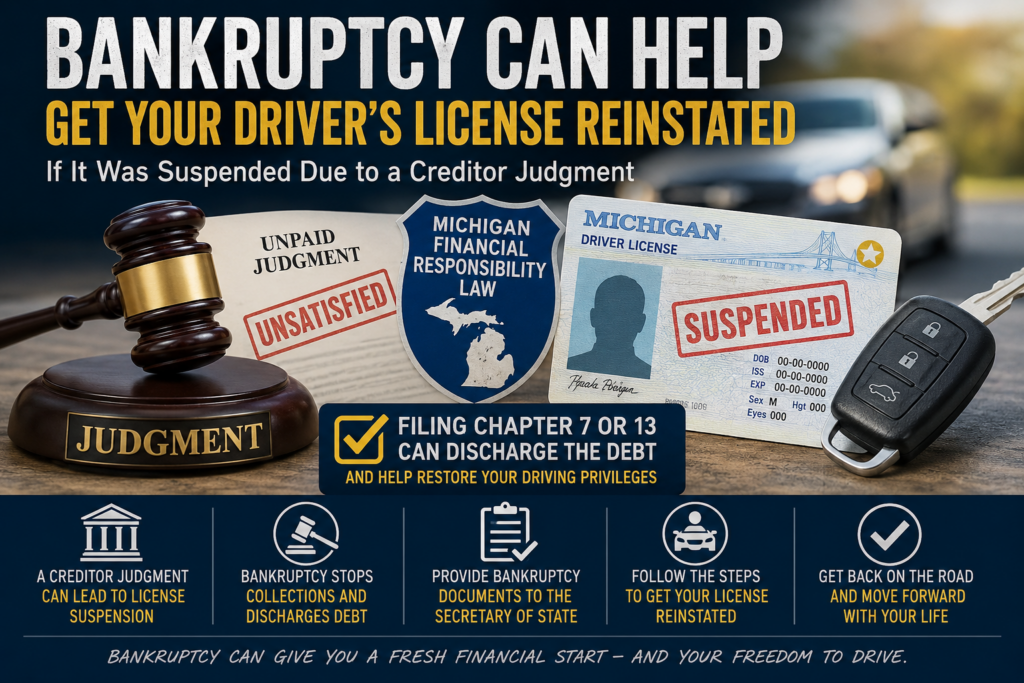
One of the more unusual problems I see in my bankruptcy practice is a client who comes into my office with a suspended driver’s license because of an unpaid judgment.
Many people are surprised to learn that in Michigan, an unpaid judgment arising out of an automobile accident can result in the suspension of their driver’s license. For someone who needs a car to get to work, take children to school, or simply carry on everyday life, losing a driver’s license can be devastating.
The good news is that bankruptcy can provide a solution in many of these situations.
Table of Contents
- How Does a Creditor Get Your Driver’s License Suspended?
- The Uninsured Automobile Accident Is a Common Scenario
- Can Bankruptcy Help?
- What About the Automatic Stay When Bankruptcy Is Filed?
- Chapter 7 Can Provide Relief
- Chapter 13 Can Also Be an Option
- What Do I Need to Do After Filing Bankruptcy?
- What If the Judgment Creditor Says Bankruptcy Doesn’t Get Your License Back?
- What If the Accident Involved Drunk Driving?
- Bankruptcy Is Not a Way to Erase the Accident
- Don’t Drive Until Your License Is Actually Reinstated
- Bankruptcy Can Give You Back More Than Your Financial Future
How Does a Creditor Get Your Driver’s License Suspended?
Michigan has what is commonly referred to as a financial responsibility law. Under the Michigan Vehicle Code, an unpaid judgment arising from the use or operation of a motor vehicle can result in the suspension of a person’s driver’s license.
Michigan Compiled Laws § 257.511 provides a procedure by which an unsatisfied judgment can be certified to the Secretary of State. Under MCL § 257.513, the license generally remains suspended until the judgment is satisfied, an installment repayment arrangement is established, and the required financial responsibility is maintained.
This is an important distinction: the creditor does not simply call the Secretary of State and have your license suspended because you owe money. There is a statutory procedure involving an unsatisfied judgment.
The Michigan Secretary of State explains that a financial-responsibility judgment commonly occurs when someone is driving without insurance, is involved in an accident, and is found liable for damages. The injured party can obtain a judgment against the uninsured driver, which can then lead to the suspension of the driver’s license.
The Uninsured Automobile Accident Is a Common Scenario
I see this situation most often when someone has been involved in an automobile accident while uninsured.
For example, suppose you are driving your automobile and unfortunately cause an accident. You do not have automobile insurance at the time of the accident. The other driver’s insurance company pays for the damage to its insured’s vehicle and then pursues you to recover what the insurance company paid.
This is called a subrogation claim.
The insurance company may eventually file a lawsuit against you. If a judgment is entered and you cannot pay it, the judgment can become an “unsatisfied judgment” for purposes of Michigan’s financial responsibility law. The resulting suspension can remain on your driving record until the requirements of the statute are satisfied.
This can create a terrible situation.
The person cannot afford to pay the judgment. The person loses the ability to drive. Without a driver’s license, it may become more difficult to get to work and earn the money necessary to pay the judgment.
That is one reason bankruptcy can be so important in this situation.
Can Bankruptcy Help?
Yes, in many circumstances.
A judgment arising from an ordinary automobile accident is generally a debt that can be discharged in bankruptcy, assuming none of the exceptions to discharge apply.
The United States Supreme Court addressed a very similar issue in Perez v. Campbell, 402 U.S. 637 (1971). In that case, the Supreme Court held that a state could not continue to deny a driver’s license based upon a judgment that had been discharged in bankruptcy. The Court concluded that a state law requiring continued payment of a discharged judgment conflicted with federal bankruptcy law.
This is a very important case for someone facing a driver’s license suspension because of an automobile judgment.
The bankruptcy does not merely eliminate the creditor’s ability to collect the money from you. A discharged judgment cannot continue to be used as a basis for denying a driver’s license in a manner that conflicts with federal bankruptcy law.
What About the Automatic Stay When Bankruptcy Is Filed?
There is another important aspect to this situation.
When a bankruptcy petition is filed, the automatic stay generally goes into effect immediately. Among other things, 11 U.S.C. § 362(a) stays the enforcement of a pre-bankruptcy judgment and acts to collect a pre-bankruptcy debt.
There is, however, an important qualification.
The Bankruptcy Code specifically provides an exception to the automatic stay for certain driver’s-license suspensions imposed under state law for domestic-support obligations. That exception is found in 11 U.S.C. § 362(b)(2)(D). That provision should not be confused with a Michigan financial-responsibility suspension arising from an automobile judgment.
Consequently, an attorney handling one of these cases should look carefully at why the license was suspended and what legal authority is supporting the suspension.
That is important because not every driver’s-license suspension is treated the same way in bankruptcy.
Chapter 7 Can Provide Relief
If the automobile judgment is a dischargeable debt, a Chapter 7 bankruptcy can eliminate the debtor’s personal liability for the judgment.
The important point is that the judgment needs to be properly included in the bankruptcy schedules. I tell my clients that we do not want to simply list “insurance company” or “collection agency” without determining exactly who owns the judgment and who is legally entitled to collect it.
We want to identify the judgment creditor correctly and provide the proper notice of the bankruptcy.
After the bankruptcy is filed, the debtor or the debtor’s attorney can provide the appropriate bankruptcy documentation to the Michigan Secretary of State and request that the financial-responsibility suspension be reviewed and removed.
The Secretary of State’s records are important here. The State’s own materials explain that an unsatisfied judgment can appear on the Michigan driving record with corresponding suspension and restriction information.
Chapter 13 Can Also Be an Option
Chapter 13 can be useful when a person does not qualify for Chapter 7 or needs the other protections provided by Chapter 13.
A Chapter 13 filing can also address a dischargeable judgment debt through the Chapter 13 plan. At the conclusion of a successful Chapter 13 case, qualifying debts are discharged.
There can also be situations in which a person wants to use the bankruptcy filing to deal with the judgment while maintaining a structured repayment arrangement rather than immediately pursuing a Chapter 7 discharge.
The appropriate chapter depends upon the debtor’s income, assets, debts and particular circumstances.
What Do I Need to Do After Filing Bankruptcy?
This is where I think it is particularly important for a debtor to understand that filing the bankruptcy is not necessarily the end of the process.
The Secretary of State has a driving record. The bankruptcy court has a bankruptcy case. The creditor has a judgment. These are three separate systems, and the information sometimes has to be properly connected.
In a typical case, I would take the following steps.
1. Make sure the judgment creditor is properly scheduled
The judgment creditor needs to be included in the bankruptcy case with the correct name and address.
If an insurance company obtained the judgment and later assigned or sold the judgment to another company, that needs to be investigated carefully.
2. Provide bankruptcy notice
The creditor should receive notice of the bankruptcy filing.
The debtor’s attorney can also provide documentation concerning the bankruptcy filing and automatic stay to the appropriate parties.
3. Obtain the bankruptcy filing information
The debtor should maintain copies of the bankruptcy petition, Notice of Bankruptcy, schedules showing the judgment, and other documentation demonstrating that the judgment is included in the bankruptcy.
These documents can be important when dealing with the Secretary of State.
4. Contact the Michigan Secretary of State regarding the suspension
The debtor should check the Michigan driving record and determine exactly what is causing the suspension.
This is extremely important.
Sometimes a person believes that the suspension is from the automobile judgment when there are actually multiple suspensions or other issues on the driving record.
The Michigan Secretary of State recommends checking the status of the license before pursuing reinstatement and notes that other sanctions or holds can prevent restoration even after one particular problem has been resolved.
5. Provide the bankruptcy documentation requested by the Secretary of State
The debtor should provide the Secretary of State with documentation showing the bankruptcy filing and that the judgment is included in the bankruptcy case.
The precise procedure can depend upon how the suspension was entered and what documentation the Secretary of State requires.
I would not simply assume that the computer system will automatically recognize the bankruptcy and restore the license.
Follow up.
That is particularly important when the person needs the license to work.
6. Obtain the discharge
In a Chapter 7 case, the discharge normally comes after the required bankruptcy process has been completed.
In a Chapter 13 case, the discharge comes after successful completion of the Chapter 13 plan and the other requirements for a Chapter 13 discharge.
The discharge is extremely important because it establishes that the debtor has been legally discharged from the qualifying debt.
7. Have the judgment addressed on the state-court record when necessary
Michigan has a specific statute addressing cancellation of judgments after bankruptcy.
MCL § 600.2914 provides a procedure under which, after a bankruptcy discharge, an interested person may apply to have a dischargeable judgment canceled and discharged of record upon proof of the bankruptcy discharge. The statute specifically refers to judgments subject to MCL § 257.513.
This is an additional tool that may be useful when dealing with an old judgment that continues to appear in the state-court records.
8. Pay any applicable Secretary of State reinstatement fee
Bankruptcy does not necessarily eliminate every fee associated with restoring a driver’s license.
The Michigan Secretary of State states that reinstatement fees may still be required and that other sanctions, violations or holds may have to be resolved before driving privileges can be restored.
So, even if the judgment itself has been discharged, there may still be a Secretary of State fee or another unrelated problem that needs to be addressed.
What If the Judgment Creditor Says Bankruptcy Doesn’t Get Your License Back?
This is where the Perez v. Campbell case becomes particularly important.
A creditor cannot simply say, “You filed bankruptcy, but you still owe us the money, so we are going to keep your license suspended.”
If the underlying judgment is dischargeable and has been discharged, federal bankruptcy law limits the creditor’s ability to continue using the discharged debt as a collection device.
The United States Supreme Court made clear in Perez that a state cannot use its motor-vehicle licensing laws to frustrate the effect of a federal bankruptcy discharge.
That does not mean that every license suspension disappears automatically when someone files bankruptcy. The exact reason for the suspension matters, and there can be other requirements imposed by the Secretary of State.
But it does mean that bankruptcy can be a very powerful tool for someone whose license has been suspended because of an unpaid, dischargeable automobile judgment.
What If the Accident Involved Drunk Driving?
This is an important exception.
Not every automobile accident judgment is dischargeable.
Under 11 U.S.C. § 523(a)(9), certain debts for death or personal injury caused by the debtor’s unlawful operation of a motor vehicle while intoxicated are excepted from discharge.
Therefore, someone whose judgment arose from an accident involving drunk or intoxicated driving needs to have the circumstances carefully reviewed before assuming that bankruptcy will eliminate the judgment.
The same is true for other circumstances that could make a particular debt nondischargeable.
Bankruptcy Is Not a Way to Erase the Accident
I also think it is important to explain what bankruptcy does and does not do.
If you caused an automobile accident and were uninsured, bankruptcy does not make the accident disappear.
It does not change what happened.
It does not erase the other person’s damages.
What bankruptcy can do is provide a legal mechanism for dealing with the financial liability arising from the accident when that liability is dischargeable under federal bankruptcy law.
That distinction is important.
Don’t Drive Until Your License Is Actually Reinstated
One final warning: do not assume that filing bankruptcy means you are automatically authorized to drive.
A person should confirm that the suspension has actually been removed or that the person’s driving privileges have otherwise been legally restored before getting behind the wheel.
The Michigan Secretary of State specifically advises that reinstatement depends upon whether other sanctions or holds remain on the driving record.
Driving while suspended can create an entirely new legal problem.
Bankruptcy Can Give You Back More Than Your Financial Future
When people think about bankruptcy, they usually think about credit cards, medical bills, collection accounts and stopping garnishments.
They don’t always realize that bankruptcy can sometimes solve problems that are not traditionally thought of as “bankruptcy problems.”
A suspended driver’s license resulting from an unpaid automobile judgment is a good example.
I have had clients come into my office who cannot afford to pay a judgment resulting from an uninsured automobile accident. They have lost their license, and the loss of the license makes it harder to work and support their families.
When the judgment is a dischargeable debt, bankruptcy may provide a way out.
The key is to look at the entire situation — the judgment, the reason for the driver’s-license suspension, the identity of the judgment creditor, the bankruptcy dischargeability of the debt, and the requirements of the Michigan Secretary of State.
If you are a Michigan resident whose driver’s license has been suspended because of an unpaid judgment arising from an automobile accident, bankruptcy may be able to help you deal with both the debt and the driver’s-license problem.
As with any bankruptcy case, however, the specific facts matter. A suspended license can have multiple causes, and a judgment arising from an automobile accident should be reviewed carefully before deciding whether Chapter 7 or Chapter 13 is appropriate.