Do I Have to Have a Reason to File for Bankruptcy?

Published
One of the questions I sometimes hear from people who are considering bankruptcy is, “Do I have to have a reason to file for bankruptcy?”
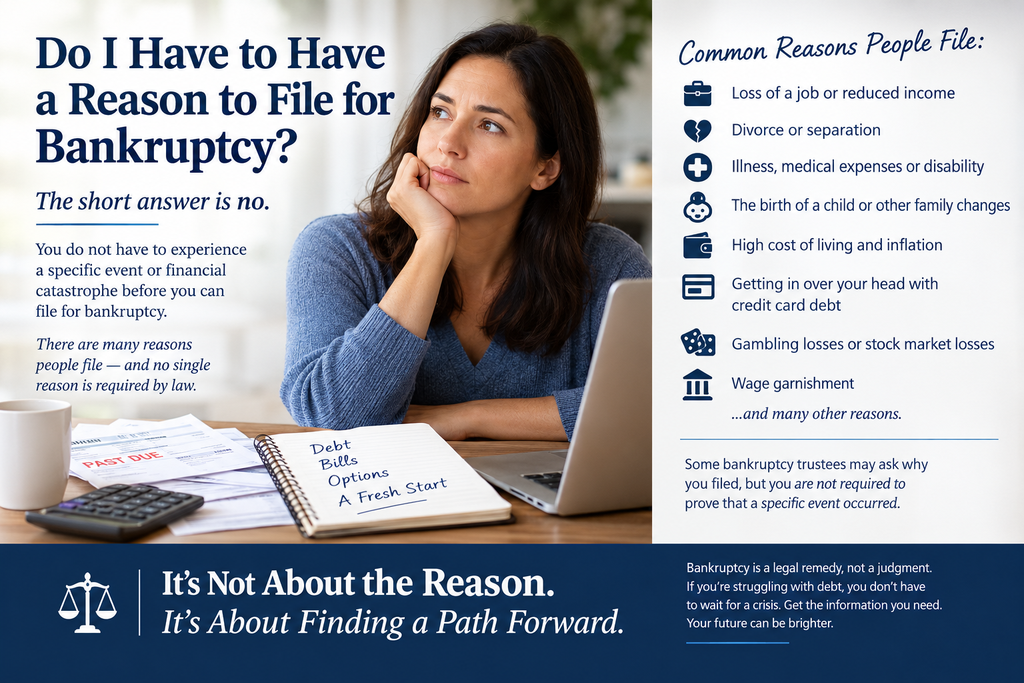
The answer is no. You do not have to experience a particular event or financial catastrophe before you can file for bankruptcy.
Over my 35-year career, having represented more than 25,000 people in bankruptcy cases, I have seen just about every reason imaginable for someone to file. Some people have lost their jobs, gone through a divorce, suffered a serious illness, or experienced an accident or disability. Others have struggled with the high cost of living, the birth of a child, gambling losses, or losing money in the stock market.
And then there are people who simply got in over their heads with credit card debt. They kept using their credit cards, perhaps believing they would eventually catch up, but the balances grew to the point where they could no longer afford to pay them off.
I have helped people in all of these situations. The circumstances are different, but the important point is that bankruptcy law does not require you to prove that some specific event caused your financial problems.
Table of Contents
What Are Some Common Reasons People File for Bankruptcy?
There is no single reason why people file for bankruptcy. In my experience, financial difficulties develop in many different ways, and sometimes several circumstances combine to create a situation that becomes impossible to manage.
Here are some of the reasons I have seen over the years.
1. Loss of a Job or Reduction in Income
Losing a job can turn an otherwise manageable financial situation into a serious problem. Even someone who has always paid their bills on time may quickly fall behind when their paycheck disappears.
Sometimes a person finds another job, but it pays substantially less than the job they lost. Other times, they may be unemployed for months while their mortgage, car payments, credit cards, and other bills continue to come due.
Even after finding a new job, catching up on months of accumulated debt can be difficult or impossible.
2. Divorce or Separation
Divorce and separation are other common reasons people find themselves considering bankruptcy.
When a household splits into two, the cost of living often increases dramatically. Instead of sharing one mortgage or rent payment, utility bills, groceries, and other expenses, each person must now maintain a separate household.
There may also be attorney fees, support obligations, and debts accumulated during the marriage.
I have represented many people whose financial problems arose, at least in part, because their marriage ended. They may have been financially comfortable as a couple but find themselves struggling to make ends meet on a single income.
3. Illness, Medical Expenses, or Disability
A serious illness or accident can affect a person’s finances in several ways at once.
Medical bills may accumulate, insurance may not cover every expense, and the person may be unable to work for an extended period. Even with health insurance or disability benefits, the loss of regular income can make it difficult to keep up with ordinary household expenses.
Sometimes the financial consequences continue long after the medical problem itself has been addressed.
A person should not have to spend the rest of their life struggling with overwhelming debt simply because an unexpected medical problem disrupted their finances.
4. The Birth of a Child or Other Family Changes
Having a child is normally a happy occasion, but it can also bring significant new expenses.
There may be additional costs for childcare, diapers, clothing, medical care, food, and housing. One parent may take time off work or reduce their hours to care for the child. In some households, the loss of a second income can be especially difficult.
Other family circumstances, including caring for an aging parent or helping a family member through a difficult period, can also place substantial demands on a household budget.
These are ordinary life events. Nevertheless, they can have a significant financial impact.
5. The High Cost of Living and Inflation
Sometimes there is no dramatic event that causes a person to fall behind financially.
Instead, expenses gradually increase until the household budget no longer works.
The cost of groceries, housing, utilities, insurance, vehicle repairs, and other necessities can consume an increasingly large portion of a person’s income. High fuel prices can be particularly difficult for people who must drive to work, especially in the Detroit metropolitan area, where many people depend on their vehicles to get around.
Even people who are employed full-time may find that their paychecks simply do not stretch as far as they once did.
When the cost of necessities increases, people sometimes rely on credit cards to cover the difference. At first, they may believe they can pay the balances off when things improve. But interest charges and minimum payments can cause the debt to grow faster than they can pay it down.
Eventually, a person may find that much of their income goes toward making payments on old debt, leaving too little money for current living expenses.
You do not have to experience a financial disaster to qualify for bankruptcy. Sometimes the problem is simply that your income is no longer sufficient to cover your expenses and your existing debts.
6. Getting In Over Your Head With Credit Card Debt
This is one of the situations I have encountered many times during my career.
A person may start out with a manageable amount of credit card debt. They use their cards for purchases, unexpected expenses, car repairs, or ordinary household bills. They make their monthly payments and believe they will eventually pay off the balances.
But then something changes. Perhaps their expenses increase, their income falls, or they begin relying on credit cards more frequently to make ends meet.
Before long, they are carrying balances on several cards. The minimum payments become substantial, and much of each payment goes toward interest rather than reducing the principal.
If they miss a payment, additional charges may follow. Late fees, higher interest rates, and other applicable fees can make the situation worse. When a cardholder exceeds a credit limit, additional consequences may also arise under the terms of the account.
I have seen people make payments month after month without making any meaningful progress toward paying off their debts. They are trying to do the right thing, but the combination of high interest rates, fees, and accumulated balances makes it nearly impossible to get ahead.
Eventually, they may realize that if they continue making minimum payments, it could take many years to pay off the debt, assuming they stop charging new purchases altogether.
This is an important point: you do not have to lose your job, become seriously ill, or go through a divorce to have a legitimate reason to consider bankruptcy.
Sometimes people simply get in over their heads. Their debt becomes too large relative to their income, and they cannot see a realistic way to pay it off.
That is one of the reasons bankruptcy exists.
7. Gambling Losses or Losing Money in the Stock Market
I have also seen people experience financial problems because of gambling losses or unsuccessful investments.
Gambling can become particularly damaging when someone tries to recover previous losses by continuing to gamble. A person may start using savings, then credit cards, and eventually other sources of borrowed money in an effort to win back what was lost.
Similarly, someone who loses a substantial amount of money in the stock market may find that they still have bills, credit card balances, or other debts to pay even though their investments have declined in value.
Investment losses can be especially difficult when borrowed money was involved or when the person had been counting on those investments to support their retirement.
Neither gambling losses nor investment losses automatically disqualifies someone from filing for bankruptcy. However, the circumstances matter. Bankruptcy law contains provisions addressing fraud, certain transfers, and other conduct that can affect the treatment or discharge of particular debts. The timing and nature of the transactions may need to be examined.
The larger point remains the same: there is no general requirement that a person must have experienced a particular kind of hardship before seeking bankruptcy relief.
8. Wage Garnishment Can Be the Final Straw
Another situation I have encountered many times is a person who has been struggling with debt for months or even years but finally decides to file bankruptcy when their wages are garnished.
Before the garnishment begins, the person may already be having difficulty paying their bills. They may be juggling credit card payments, making partial payments to creditors, or falling behind on utilities and other household expenses.
Then a creditor obtains a judgment and begins garnishing their paycheck.
Suddenly, the person has even less money available to pay the mortgage or rent, buy groceries, pay for gas, and support their family. What was already a difficult financial situation can become unmanageable almost overnight.
In many cases, the garnishment is not the original cause of the person’s financial problems. It is simply the event that pushes them over the edge and convinces them that they need to do something.
A bankruptcy filing may provide relief through the automatic stay, which generally stops most collection activity, including many wage garnishments, once the case is filed. There are exceptions, and the treatment of a particular garnishment depends on the circumstances.
For some people, filing bankruptcy is the first realistic opportunity they have had to stop falling further behind and begin rebuilding their financial lives.
Will the Bankruptcy Trustee Ask Why I Am Filing?
This is an important distinction.
Although you do not have to experience a specific event to qualify for bankruptcy, some Chapter 7 and Chapter 13 trustees do ask debtors why they filed.
At the meeting of creditors, commonly called the 341 meeting, a trustee may ask what led to the bankruptcy filing. The trustee might want to know whether you lost your job, experienced a divorce, incurred substantial medical expenses, accumulated credit card debt, or experienced some other financial difficulty.
The trustee may also ask whether there was a particular event that caused your financial circumstances to deteriorate.
Why ask the question if the law does not require a specific event?
The trustee may be trying to understand your financial history, how your debts accumulated, whether your circumstances changed, and whether there are issues that require further examination. Your answers may help the trustee understand the information contained in your bankruptcy petition and supporting documents.
But there is a difference between being asked why you filed and being legally required to establish a particular reason for filing.
For example, a debtor might truthfully explain that they had accumulated substantial credit card debt over several years, could no longer afford the minimum payments, and eventually fell behind. There may have been no single triggering event.
Another debtor might explain that they had a good job and were making their payments until a wage garnishment reduced their take-home pay to the point that they could no longer meet their basic living expenses.
Both situations can be entirely understandable, even though neither necessarily involves a single dramatic event.
You should always answer the trustee’s questions truthfully. You should also make sure that your bankruptcy paperwork accurately discloses your financial circumstances. But you do not need to manufacture a special reason or identify a particular event if there was none.
Do I Have to Prove That Something Beyond My Control Happened?
No. Bankruptcy is not limited to people who have suffered an unavoidable tragedy.
You do not have to prove that you were laid off, that a doctor diagnosed a serious illness, that your spouse left you, or that some other unfortunate event caused your debt.
Some people experience a sudden financial crisis. Others accumulate debt gradually. Some have made financial decisions they later regret. Others have done their best to keep up with their obligations but simply cannot afford to pay what they owe.
The law does impose eligibility requirements and other obligations, and the facts of a particular case can matter. For example, Chapter 7 eligibility, the means test where applicable, accurate financial disclosures, and rules addressing fraudulent conduct are all important considerations.
But there is no general rule that you must establish a particular hardship before you can file.
What If I Have a Good Job and Earn a Decent Income?
You may still have options.
I sometimes speak with people who assume they cannot file bankruptcy because they are employed or earn what appears to be a reasonable income.
The important question is not simply how much money you earn. Your household size, allowable expenses, debts, assets, and other circumstances may all matter.
Someone earning a reasonable salary may have substantial medical bills, high housing costs, support obligations, or significant credit card payments that make it difficult to pay their debts. Another person with a similar income may have very different financial circumstances.
Whether Chapter 7 or Chapter 13 is appropriate depends on the facts of the individual case. A consultation can help determine which options may be available.
You Do Not Have to Be Embarrassed About Filing for Bankruptcy
I have represented people from all walks of life. Some have lost their jobs. Some have gone through difficult divorces. Some have suffered serious medical problems. Others have worked hard, earned a living, and simply reached a point where their debts became unmanageable.
There is no reason to assume that a person who files for bankruptcy has done something wrong.
Bankruptcy is a legal remedy established by federal law. It exists to provide financial relief to eligible people who cannot realistically repay their debts under their existing circumstances.
You do not have to wait until you are facing foreclosure, your wages are being garnished, your bank account has been levied, or your vehicle is about to be repossessed before you investigate your options.
In fact, seeking advice before a financial problem becomes an emergency may give you more choices.
My Advice
If you are struggling financially, do not assume that you need a dramatic story or an extraordinary hardship to qualify for bankruptcy.
You may have lost your job, gone through a divorce, suffered an illness, welcomed a new child into your family, experienced gambling or investment losses, or simply found that the cost of living has increased beyond what your income can comfortably support.
You may also have accumulated credit card debt over the years and reached the point where high interest rates and fees prevent you from making meaningful progress. Perhaps a wage garnishment has finally made an already difficult situation impossible to manage.
Your circumstances may be entirely different from those of the next person who walks into my office.
The important question is not whether you have a sufficiently good reason to file for bankruptcy. It is whether bankruptcy is an appropriate legal solution for your financial situation.
After 35 years of practicing bankruptcy law and representing more than 25,000 people, I understand that financial problems can happen in many different ways. My job is not to judge how you got into debt. It is to explain your options and help you determine the best way forward.
If you live in the Detroit metropolitan area or elsewhere in the Eastern District of Michigan and are having trouble paying your debts, I invite you to contact my office for a consultation. We can discuss your circumstances, answer your questions, and determine whether Chapter 7, Chapter 13, or another approach may make sense for you.
You do not need to have a special reason to ask for help.