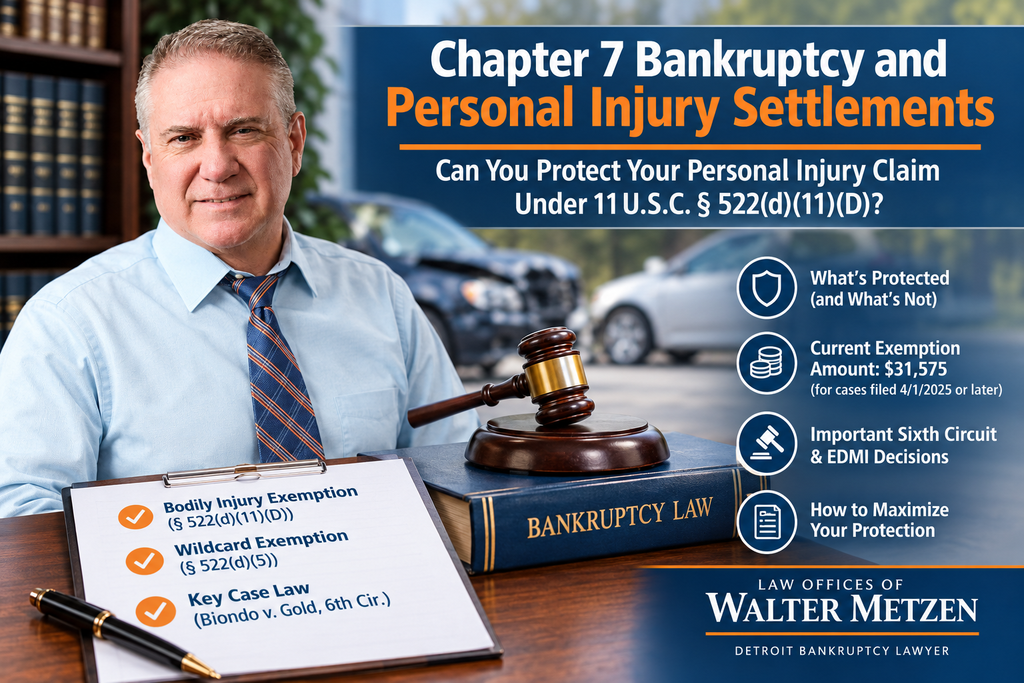
Chapter 7 Bankruptcy and Personal Injury Settlements: Can You Protect Your Personal Injury Claim Under 11 U.S.C. § 522(d)(11)(D)?

Published
One issue that I pay particular attention to when representing someone in a Chapter 7 bankruptcy is whether that person has a pending personal injury claim, has already received a settlement offer, or may be entitled to receive money from an insurance company as a result of an accident.
Many people do not realize that a personal injury claim can become an asset of their Chapter 7 bankruptcy estate. This is true even when the accident occurred before the bankruptcy filing, the lawsuit has not yet been filed, or the debtor has not yet received a settlement offer.
The Chapter 7 bankruptcy trustee will almost always be interested in investigating a potential personal injury claim. Depending on the nature and severity of the injuries, the available insurance coverage, and the circumstances surrounding the accident, a personal injury case could potentially produce a substantial settlement or jury award.
Unfortunately, the bankruptcy exemptions available to protect personal injury recoveries are relatively limited. This creates a potential problem for someone who needs bankruptcy relief but also has a legitimate personal injury claim.
Fortunately, there is an exemption under federal bankruptcy law that can provide some protection.
It is found at 11 U.S.C. § 522(d)(11)(D).
In my practice, when a client has a personal injury claim, I routinely examine whether this exemption can be used to protect some or all of the qualifying portion of the potential recovery. I also look for additional exemptions that may be available to protect as much of the claim as possible.
However, this is an area of bankruptcy law that is considerably more complicated than most people realize. The statutory language is confusing, the distinction between different categories of personal injury damages is important, and even experienced bankruptcy attorneys and bankruptcy judges have to examine the precise nature of the damages being claimed.
Let’s take a closer look.
Table of Contents
- What Does 11 U.S.C. § 522(d)(11)(D) Actually Protect?
- What Does “Personal Bodily Injury” Mean?
- What Personal Injury Damages Are NOT Protected?
- I Also Claim the Available Wildcard Exemption Under § 522(d)(5)
- Why Is This Exemption So Confusing?
- The Sixth Circuit’s Decision in Biondo v. Gold: An Important Warning for Bankruptcy Debtors and Attorneys
- What About Other Michigan Bankruptcy Decisions?
- Why You Need an Experienced Bankruptcy Attorney When You Have a Personal Injury Claim
- The Bottom Line: What Does the Personal Bodily Injury Exemption Actually Protect?
What Does 11 U.S.C. § 522(d)(11)(D) Actually Protect?
Section 522(d)(11)(D) of the Bankruptcy Code allows a debtor to exempt:
“A payment, not to exceed $31,575, on account of personal bodily injury, not including pain and suffering or compensation for actual pecuniary loss, of the debtor or an individual of whom the debtor is a dependent.”
The current maximum exemption as of this writing is $31,575 for bankruptcy cases filed on or after April 1, 2025.
This is an important exemption because it allows a debtor to protect certain compensation received because of an actual physical injury.
However, there is a catch.
The statute specifically excludes pain and suffering and compensation for actual pecuniary loss.
That distinction is extremely important.
A personal injury settlement is commonly made up of several different categories of damages. These may include:
- Pain and suffering.
- Medical expenses.
- Lost wages.
- Future lost earnings.
- Permanent impairment.
- Disfigurement.
- Loss of use of a body part.
- Loss of bodily function.
- Other economic and noneconomic damages.
Unfortunately, not all of these categories qualify for protection under § 522(d)(11)(D).
In fact, the statute is considerably narrower than many personal injury clients initially expect.
What Does “Personal Bodily Injury” Mean?
This is where the analysis becomes particularly interesting.
The exemption is not intended to protect every dollar a person receives because of an accident. Rather, it is intended to protect compensation attributable to the actual bodily injury itself.
A good way to understand the distinction is to consider someone who loses a finger, suffers the loss of a limb, or sustains a permanent physical impairment as a result of an automobile accident.
The physical loss or impairment is the bodily injury.
The pain experienced as a result of that injury is pain and suffering.
The hospital bills and physical therapy expenses are economic losses.
The wages missed while recovering from the injury are lost earnings.
These are different elements of damages, even though they all arise from the same accident.
The legislative history accompanying § 522(d)(11)(D) specifically discusses the loss of a limb as an example of the type of actual bodily injury that Congress intended to protect. The accompanying medical expenses, pain and suffering, and lost earnings are treated separately.
This distinction is important.
For example, consider someone who is involved in a serious automobile accident and suffers a permanent loss of function in one of their arms.
The claim might include compensation for the physical impairment itself, medical bills, lost wages, and pain and suffering.
The debtor cannot simply take the entire settlement and claim that it is exempt because the accident involved a serious physical injury.
Instead, the attorney must determine which portions of the recovery actually compensate for the bodily injury itself and which portions compensate for the excluded categories of damages.
That is not always an easy exercise.
Does the Personal Bodily Injury Have to Be Permanent?
One question that frequently arises when applying 11 U.S.C. § 522(d)(11)(D) is whether the debtor must have suffered a permanent bodily injury to qualify for the exemption.
The answer is no.
Although the legislative history uses the loss of a limb as an example of the type of injury Congress intended to protect, the statute itself does not require that the injury be permanent.
Several bankruptcy courts have expressly held that a temporary bodily injury can qualify for the exemption. The important distinction is that the debtor must have sustained an actual, appreciable physical injury. Simply experiencing emotional distress, anxiety, or subjective complaints of pain, without an identifiable underlying physical injury, may not be sufficient.
For example, someone who suffers a fracture, a torn ligament, a significant physical injury to the spine, or another demonstrable physical injury in an automobile accident may have a qualifying bodily injury even if that person ultimately makes a full recovery.
The fact that the injury heals does not necessarily eliminate the possibility of claiming the exemption.
In In re Ciotta, 222 B.R. 626 (Bankr. C.D. Cal. 1998), the court specifically rejected the proposition that an injury must be permanent to qualify under § 522(d)(11)(D). Similarly, In re Lawton, 324 B.R. 20 (Bankr. D. Conn. 2005), concluded that the statute does not impose a permanency requirement.
This is an important distinction because many people who suffer serious automobile accident injuries eventually recover, sometimes completely. That does not necessarily mean that the underlying physical injury falls outside the scope of the exemption.
Of course, establishing that someone suffered a qualifying bodily injury is only the first step. The debtor must still establish that the particular payment being claimed as exempt is attributable to the bodily injury itself, rather than excluded compensation for pain and suffering or actual pecuniary losses.
In my practice, I therefore examine the actual injuries sustained, the medical records, the treatment received, and the nature of the damages being pursued before determining how to claim the exemption.
What Personal Injury Damages Are NOT Protected?
There are three particularly important exclusions that bankruptcy attorneys need to understand.
1. Pain and suffering
Compensation for pain and suffering is expressly excluded by the statute.
It does not matter whether the debtor experienced significant pain, underwent multiple surgeries, or endured months of physical therapy. The pain and suffering component of the recovery is not protected by § 522(d)(11)(D).
2. Medical expenses and other actual pecuniary losses
The statute also excludes compensation for actual pecuniary loss.
This includes compensation for medical expenses and other out-of-pocket economic losses.
The Sixth Circuit has specifically discussed the treatment of medical expenses under this exemption and recognized that courts typically interpret the statute to exclude payments for medical bills.
3. Lost wages
Compensation for lost wages is also excluded from § 522(d)(11)(D).
However, there is another important provision of the Bankruptcy Code that may apply.
Section 522(d)(11)(E) provides an exemption for payments compensating for the loss of future earnings, but only to the extent reasonably necessary for the support of the debtor and any dependent of the debtor.
This is a separate exemption with its own requirements.
It is important not to confuse the two provisions.
A debtor may have a claim involving bodily injury, past lost wages, future lost earnings, medical expenses, and pain and suffering. Each category must be examined separately to determine whether another exemption is available.
I Also Claim the Available Wildcard Exemption Under § 522(d)(5)
When I represent someone with a personal injury claim in a Chapter 7 bankruptcy, I do not stop with the $31,575 exemption available under § 522(d)(11)(D).
I also examine the availability of the federal wildcard exemption under § 522(d)(5).
This exemption is particularly useful because it can be applied to virtually any type of property, including an otherwise nonexempt portion of a personal injury claim.
As of this writing, for bankruptcy cases filed on or after April 1, 2025, § 522(d)(5) provides:
- $1,675 in general wildcard exemption.
- An additional amount of up to $15,800 representing the unused portion of the federal homestead exemption under § 522(d)(1).
The additional $15,800 is available only to the extent the debtor has not used the corresponding homestead exemption.
Consequently, a debtor who does not need the federal homestead exemption to protect a residence may have additional wildcard protection available.
This is particularly important when dealing with personal injury claims because the $31,575 bodily injury exemption alone may not be sufficient to protect all qualifying damages or other portions of a settlement.
For example, if a debtor has a substantial personal injury claim, I will examine the potential application of both § 522(d)(11)(D) and § 522(d)(5), along with any other applicable exemptions.
The goal is to protect as much of the personal injury recovery as the Bankruptcy Code permits.
Of course, the wildcard exemption does not change the definition of bodily injury under § 522(d)(11)(D). It is a separate exemption that may be applied to otherwise nonexempt property, subject to its available dollar limits.
Why Is This Exemption So Confusing?
I have practiced bankruptcy law exclusively for more than 35 years, and I can tell you that § 522(d)(11)(D) is one of those provisions that can create considerable confusion.
Part of the problem is the wording of the statute itself.
It refers to payments “on account of personal bodily injury,” but then specifically excludes pain and suffering and compensation for actual pecuniary loss.
A personal injury settlement, however, is generally negotiated as a single amount, even though it may compensate the injured person for several different types of damages.
How does a bankruptcy attorney determine what portion of a lump-sum settlement represents the actual bodily injury?
What happens when the settlement agreement does not allocate the proceeds among the various categories of damages?
What happens when the insurance company simply issues a settlement check without identifying precisely what the payment represents?
And what happens when the trustee believes that the settlement primarily compensates the debtor for pain and suffering, medical expenses, and lost wages?
These are not merely academic questions. They can determine whether a debtor receives the settlement proceeds or whether some or all of the money becomes available to creditors.
In my experience, this is an area where careful preparation and a thorough understanding of both bankruptcy law and personal injury damages are essential.
The Sixth Circuit’s Decision in Biondo v. Gold: An Important Warning for Bankruptcy Debtors and Attorneys
One of the most important decisions involving this exemption is Biondo v. Gold, Lange, Majoros & Smalarz, P.C., 2023, decided by the United States Court of Appeals for the Sixth Circuit on February 8, 2023.
This case is particularly significant because it arose out of a Chapter 7 bankruptcy filed in the Eastern District of Michigan.
In fact, it involved a personal injury claim arising from an automobile accident, making it especially relevant to bankruptcy practitioners in Michigan.
The debtor, Caterina Biondo, had been involved in an automobile accident before filing Chapter 7 bankruptcy.
She claimed an exemption under § 522(d)(11)(D), attempting to protect $23,675, which was the applicable maximum at the time.
The Chapter 7 trustee did not initially object to the exemption and retained a personal injury law firm to pursue the claims against the insurance company and the other driver.
Eventually, two separate settlements were reached.
The insurance company settled for $48,500. That settlement included medical expenses, attorney fees, lost wages, and other economic and noneconomic losses.
The other driver’s settlement was for $70,000 and represented pain and suffering.
The debtor subsequently argued that she was entitled to receive the $23,675 exemption from the settlement proceeds because the trustee had failed to object to her original exemption claim within the required time.
The trustee disagreed.
The matter eventually reached the Sixth Circuit.
The Sixth Circuit recognized that § 522(d)(11)(D) excludes payments for pain and suffering and pecuniary losses. It also noted that courts typically interpret the statute to exclude payments for medical bills.
The court concluded that the trustee had reasonable grounds to challenge whether the settlements actually qualified for the exemption.
The court also addressed an important procedural issue: whether the trustee had forfeited the right to object by failing to object to the original exemption claim.
The Sixth Circuit concluded that the debtor’s original exemption claim was arguably limited to qualifying bodily injury payments. It did not necessarily cover every dollar of the eventual settlements.
In other words, simply claiming the statutory maximum under § 522(d)(11)(D) does not automatically exempt the first $31,575 of whatever money might eventually be recovered in a personal injury case.
The exemption must actually apply to the particular damages being recovered.
This is an extremely important distinction.
Biondo v. Gold, 22-1666 (6th Cir. Feb. 8, 2023), is particularly important for anyone filing Chapter 7 bankruptcy with a pending personal injury claim.
It demonstrates that the trustee can have a legitimate basis to challenge the application of this exemption, even when the debtor originally claimed the maximum available amount.
It also demonstrates why I believe the exemption should be carefully considered and properly described when the bankruptcy petition is initially filed.
What About Other Michigan Bankruptcy Decisions?
There is another important distinction worth mentioning.
The Eastern District of Michigan and the Sixth Circuit have addressed personal injury claims and related exemption issues, but not every decision involving personal injury proceeds necessarily interprets § 522(d)(11)(D).
For example, In re Dang, a 2012 decision from the Western District of Michigan, involved a substantial workers’ compensation settlement arising from an injury in which the debtor lost a finger and part of his hand.
The debtor received a settlement of approximately $193,000.
The bankruptcy court ultimately allowed the exemption of the funds under § 522(d)(10)(C) and/or § 522(d)(11)(E), based on the particular circumstances of the workers’ compensation award.
The court did not decide that the entire settlement qualified under § 522(d)(11)(D). Rather, it relied on the disability-benefit and future-earnings provisions.
Nevertheless, the case is instructive because it demonstrates that the same physical injury can give rise to several different categories of potentially exempt compensation.
It also illustrates why bankruptcy attorneys should not automatically assume that § 522(d)(11)(D) is the only exemption that might apply to a personal injury or workers’ compensation recovery.
Why You Need an Experienced Bankruptcy Attorney When You Have a Personal Injury Claim
When someone comes to my office considering Chapter 7 bankruptcy and tells me that they have been involved in an automobile accident, a workplace accident, or some other incident resulting in personal injuries, I pay particular attention to that information.
I want to know whether a claim has already been filed, whether an attorney has been retained, whether an insurance company has made an offer, and what types of damages are being pursued.
I also want to know the nature of the injuries, whether there is any permanent impairment, whether the client has experienced a loss of bodily function, and what insurance coverage is available.
The reason is simple.
A Chapter 7 trustee has a duty to investigate assets belonging to the bankruptcy estate. A pending personal injury claim is an asset that the trustee may pursue, even when the debtor has not yet received any money.
If the claim has substantial potential value, the trustee may retain a personal injury attorney to prosecute the claim for the benefit of the bankruptcy estate.
This is why it is so important to address the personal injury claim before filing bankruptcy rather than attempting to deal with it after the case has been filed.
I routinely examine the available exemptions, including § 522(d)(11)(D) and the remaining § 522(d)(5) wildcard exemption, to determine how much of a client’s potential recovery can be protected.
I also recognize that the exemption analysis may require coordination with the personal injury attorney, particularly when the damages have not yet been allocated or a settlement is being negotiated.
The objective is to protect my client’s interests to the greatest extent permitted by law.
The Bottom Line: What Does the Personal Bodily Injury Exemption Actually Protect?
Although § 522(d)(11)(D) specifically excludes compensation for pain and suffering and actual pecuniary losses, it does provide protection for compensation attributable to the debtor’s actual physical bodily injury.
This is an important distinction.
The exemption is intended to protect compensation for the physical injury itself, rather than the financial consequences or emotional and physical discomfort resulting from that injury.
Examples of injuries that may support a claim under this exemption include:
- Loss of a limb, hand, foot, finger, or other body part.
- Permanent or temporary physical impairment resulting in the loss or substantial reduction of bodily function.
- Damage to an organ or other bodily structure resulting in an actual loss of physical function.
- Other demonstrable physical injuries that result in the loss of bodily function.
For example, if someone is involved in an automobile accident and suffers a permanent loss of use of an arm, the compensation attributable to that actual physical impairment may qualify for protection under § 522(d)(11)(D).
Likewise, someone who loses a finger or suffers an injury resulting in permanent loss of physical function has a substantially different exemption argument than someone whose settlement consists entirely of compensation for medical bills, lost wages, and pain and suffering.
The important point is that the exemption protects compensation for the actual bodily injury, not simply money received because an accident occurred.
The nature of the injury, the medical evidence, the settlement documentation, and the manner in which the damages are allocated can all become important when determining how much of a personal injury recovery qualifies.
This is also why I look beyond § 522(d)(11)(D) and examine the availability of the wildcard exemption under § 522(d)(5), as well as other potentially applicable bankruptcy exemptions.
My objective is to protect as much of my client’s personal injury recovery as the law allows while making certain that the exemptions are properly claimed and supported.
If you have a personal injury claim and are considering Chapter 7 bankruptcy, do not assume that your settlement or potential recovery will automatically be lost to the bankruptcy trustee. There may be meaningful protection available, but it is essential to analyze the claim before filing bankruptcy.
Important case law
1. In re Ciotta, 222 B.R. 626 (Bankr. C.D. Cal. 1998)
The court specifically considered whether a bodily injury must be permanent to qualify under § 522(d)(11)(D).
It concluded that permanency is not required, reasoning that Congress did not intend to limit the exemption to permanent injuries. The debtor must, however, establish an actual, appreciable physical injury rather than merely emotional distress or subjective complaints.
2. In re Lawton, 324 B.R. 20 (Bankr. D. Conn. 2005)
This decision likewise concluded that a bodily injury does not have to be permanent to qualify for the exemption. The court emphasized that the statutory language contains no permanency requirement.
3. In re Keenan, 2010 (Bankr. D. Minn.)
This is particularly useful for explaining the distinction. The court concluded that the physical change to the body may be temporary or long-term. The injury must involve an actual physical alteration or disturbance of the body’s integrity or function, but it need not be permanent.
Law Offices of Walter Metzen
313-962-4656
Michigan Bankruptcy Lawyer