Is the High Cost of Car Insurance Contributing to Bankruptcy Filings in Michigan?

Published
For many Michigan residents, owning a car is not a luxury. It is a necessity. You need a vehicle to get to work, take your children to school, attend medical appointments, buy groceries, and take care of the ordinary responsibilities of daily life.
But what happens when the cost of keeping that vehicle on the road becomes unaffordable?
Over the years, I have seen how expensive automobile insurance can contribute to a financial crisis. A young driver may be paying an enormous premium because of age or a poor driving record. Someone else may receive a speeding ticket or have an accident, only to discover that their insurance premiums have increased beyond what they can afford. When that person falls behind on the payments and their insurance coverage lapses, the consequences can be devastating.
A car accident, a stolen vehicle, or a vehicle that is declared a total loss can suddenly leave someone with thousands of dollars in debt. If another driver is injured or their vehicle is damaged, the uninsured driver may face an additional lawsuit.
As a bankruptcy attorney who has practiced exclusively in bankruptcy for decades, I have seen how these circumstances can turn an otherwise manageable financial situation into one that seems impossible to escape.
The good news is that bankruptcy can often eliminate substantial debts arising from an uninsured vehicle, a vehicle repossession or total loss, and an automobile accident. In appropriate cases, bankruptcy may also help a driver regain the ability to legally drive.
Table of Contents
- Michigan Drivers Pay a High Price for Auto Insurance
- Young Drivers and Drivers With Poor Driving Records May Face Much Higher Premiums
- What Insurance Does Michigan Law Require, and What Does Your Lender Require?
- What Happens When You Cannot Afford the Insurance?
- Metro Detroit Makes It Difficult to Live Without a Car
- An Uninsured Accident Can Lead to a Lawsuit and a Large Judgment
- Can Bankruptcy Eliminate Car Loan Deficiencies and Accident Debts?
- Can Bankruptcy Help You Get Your Michigan Driver’s License Back?
- You Do Not Have to Live With Overwhelming Vehicle Debt Forever
Michigan Drivers Pay a High Price for Auto Insurance
Michigan has long been known as an expensive state in which to insure a vehicle. Although insurance rates vary considerably by driver, vehicle, location, and coverage, recent national comparisons confirm that Michigan remains above the national average for both minimum and full-coverage insurance.
According to Bankrate’s 2026 auto insurance analysis, based on rates collected in 2025, the average Michigan driver pays approximately:
- $897 per year for minimum-coverage insurance, or about $75 per month.
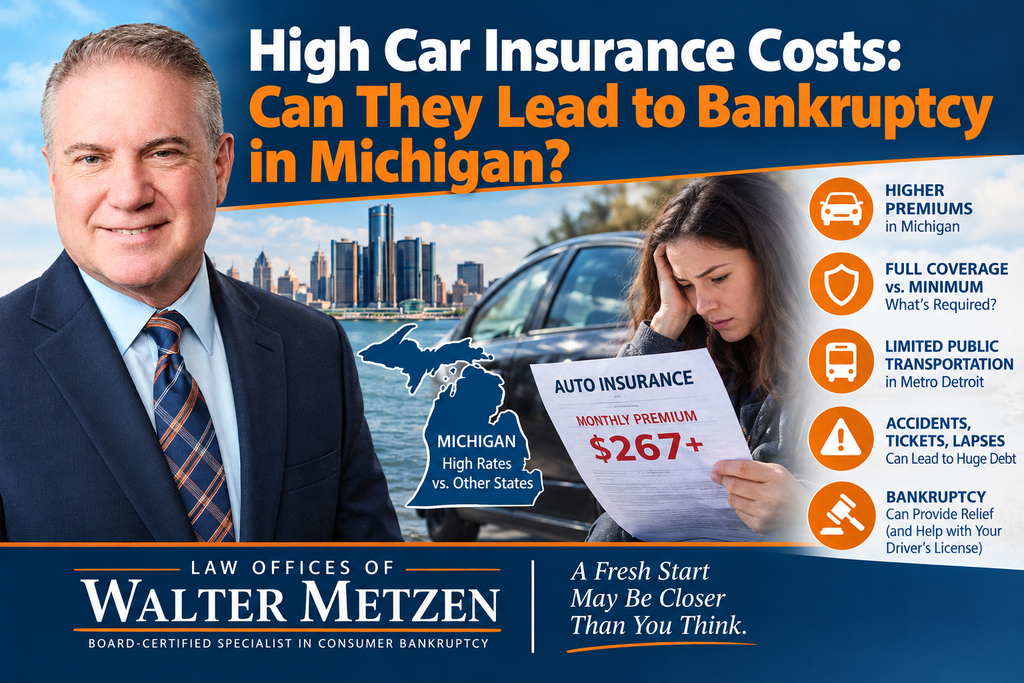
- $3,207 per year for full-coverage insurance, or about $267 per month.
Bankrate reports that Michigan’s average full-coverage premium is approximately 19% above the national average, while its minimum-coverage premium is about 9% above the national average. These are sample rates, not guaranteed quotes, and individual premiums can be substantially higher. Source: Bankrate’s Michigan auto insurance analysis.
Consider what those figures mean for a person already struggling to pay rent, utilities, groceries, and a car payment. An average full-coverage premium of $267 per month represents more than $3,200 per year, before paying for gasoline, maintenance, repairs, or the vehicle itself.
For a driver with a clean record and a stable income, that expense may be manageable. For someone living paycheck to paycheck, it can be the expense that pushes the household over the edge.
And those averages do not tell the whole story.
Young Drivers and Drivers With Poor Driving Records May Face Much Higher Premiums
Insurance companies consider several factors when calculating premiums, including driving experience, accident history, traffic violations, the vehicle being insured, and the coverage selected.
Young drivers, particularly those with limited driving experience, may face substantially higher premiums than older drivers. A driver with an at-fault accident, speeding violations, or a serious driving offense may also see insurance costs increase dramatically.
Bankrate’s sample Michigan rates illustrate how significant those increases can be. Its 2026 analysis estimates an average annual full-coverage premium of approximately $4,753 following an at-fault accident, compared with its $3,207 baseline. For a driver with a DUI conviction, the sample average rises to approximately $8,055 per year. Actual rates vary by insurer and individual circumstances.
For some drivers, that can mean monthly premiums of several hundred dollars, or even more.
Imagine a young person who needs a car to get to work. They have a car payment, rent, utilities, and other living expenses. Their insurance premium increases after a traffic violation. They try to keep up, but eventually they have to choose which bills to pay.
They may decide to skip an insurance payment to keep the electricity on or make their car payment. Unfortunately, that decision can expose them to risks far greater than the amount of the missed premium.
What Insurance Does Michigan Law Require, and What Does Your Lender Require?
One important distinction is often overlooked: the insurance required by Michigan law is not necessarily the same insurance required by a company that finances your vehicle.
Understanding the difference can help explain why the cost of insuring a financed vehicle can be so high.
1. Insurance required by Michigan law
Michigan requires automobile owners to maintain the applicable mandatory no-fault insurance coverages. These generally include three basic components:
- Personal Injury Protection (PIP): Provides benefits for eligible medical expenses and other covered losses arising from automobile accident injuries, subject to the coverage and eligibility rules that apply to the policy.
- Property Protection Insurance (PPI): Generally covers up to $1 million for damage your vehicle causes to certain property in Michigan, including buildings and properly parked vehicles.
- Residual bodily injury and property damage liability (BI/PD): Provides liability coverage, up to your selected policy limits, for certain injuries or damages for which you are legally responsible.
Michigan drivers can select from available PIP medical coverage options, and the premium depends in part on those selections. The minimum required liability limits also differ from the default limits that apply when no lower limit is selected.
These required coverages are sometimes casually referred to as PLPD (Personal Liability/Property Damage) or no-fault insurance. However, PLPD is an informal industry term, not a precise description of every coverage Michigan law requires.
The important point is that the required insurance provides specified protection for injuries and certain liabilities. It does not ordinarily pay to repair or replace your own vehicle when you cause a crash, or when your vehicle is stolen.
The Michigan Department of Insurance and Financial Services explains the required coverages in its auto insurance purchasing guide.
2. Insurance required by your car loan or lease
Now consider someone who finances a $25,000 vehicle.
The lender has a financial interest in that vehicle. If the car is destroyed in an accident or stolen, the borrower may still owe thousands of dollars on the loan, even though the vehicle is no longer available.
For that reason, financing agreements commonly require the borrower to maintain comprehensive and collision coverage in addition to the insurance required by law.
These coverages protect against different risks:
Collision coverage generally pays for covered damage to your vehicle resulting from a collision, subject to your deductible and policy terms. Depending on the circumstances and policy, it can cover damage from hitting another vehicle or an object, or from a single-vehicle accident.
Comprehensive coverage generally covers certain non-collision losses, such as theft, fire, vandalism, hail, falling objects, and damage caused by striking an animal, subject to policy terms and deductibles.
Neither coverage is the same as liability insurance. Liability coverage protects against certain claims by others; collision and comprehensive coverage protect your own vehicle.
These additional coverages can make insurance considerably more expensive. And if the vehicle is financed, the borrower may have little practical choice about carrying them while the loan remains outstanding.
What Happens When You Cannot Afford the Insurance?
Here is where a financial problem can become a financial disaster.
A person who owns an older vehicle outright may decide that paying for collision and comprehensive coverage is not worthwhile. If the vehicle is not worth much, that decision may be understandable, although the driver must still maintain the coverage required by law.
A person who finances a vehicle is in a different position. The lender generally requires comprehensive and collision coverage, and allowing the policy to lapse can violate the financing agreement. The lender may obtain its own insurance protection and charge the borrower for it, subject to the loan documents and applicable law.
Unfortunately, some borrowers simply cannot afford the premium.
They may fall behind on insurance payments, lose their coverage, and continue driving because they have no practical alternative. Others may stop driving but leave the vehicle uninsured while it remains parked.
Then something goes wrong.
The car is stolen. The borrower gets into an accident. The vehicle is damaged beyond repair. Or a lender discovers that required coverage has lapsed and takes action under the financing agreement.
If the vehicle is a total loss and there is no applicable insurance coverage, the borrower may still owe the entire remaining loan balance. The same problem can arise after a repossession: selling the vehicle does not necessarily pay off the loan.
For example, suppose someone owes $22,000 on a vehicle that is totaled in an accident. If the vehicle has no applicable collision coverage and there is no other available source of recovery, the borrower could be left owing the lender $22,000 while having no usable vehicle.
Even if insurance had been in place, a claim might not fully pay off the loan. If the loan balance exceeds the vehicle’s covered value, the borrower may still owe the difference unless gap coverage or another applicable source pays it.
I often tell my clients in this situation that it is hard enough to pay for a car you have, let alone one you don’t have.
That is not just a catchy expression. It describes a real financial problem. A person can be left making payments on a vehicle that has been stolen, destroyed, or repossessed, while also having to find a way to get to work and meet everyday responsibilities.
When the remaining debt is several thousand dollars—or tens of thousands of dollars—the situation can become impossible to manage.
Metro Detroit Makes It Difficult to Live Without a Car
Michigan’s insurance problem is especially difficult for people who live and work in Metro Detroit.
Some major metropolitan areas have extensive subway systems, frequent commuter rail service, or broad public transportation networks that allow residents to get to work and run errands without owning a vehicle.
Metro Detroit has public transportation, including SMART and DDOT bus services, but coverage, frequency, service hours, and connections can make it difficult for many residents to rely on it for all their transportation needs. Someone who lives in one suburb and works in another may find that the trip is inconvenient or impractical, particularly for an early-morning, late-night, or rotating work shift.
For many Michigan residents, a car is essential to maintaining employment and earning a living.
That creates a difficult cycle. A driver cannot afford the insurance, but cannot realistically stop driving. If the driver loses the vehicle or driver’s license, getting to work becomes even more difficult. Losing the ability to work can make it harder to pay the very debts that caused the problem in the first place.
This is one reason I believe the relationship between auto insurance costs and financial distress deserves attention. An insurance premium is not an isolated household expense when reliable transportation is necessary to keep a job.
An Uninsured Accident Can Lead to a Lawsuit and a Large Judgment
The financial consequences can be even worse when an uninsured driver causes an accident involving someone else’s vehicle or injuries.
Michigan’s no-fault system does not mean a driver can never be sued for an automobile accident. Depending on the circumstances, another driver may bring a claim for property damage, and an injured person may pursue a claim for bodily injury when the applicable legal requirements are met.
The other driver’s insurance company may also pursue a subrogation claim. In a subrogation action, an insurer seeks to recover money it paid for a loss from a person or party allegedly responsible for that loss.
Consider a driver whose insurance lapsed because the premiums became unaffordable. That driver causes an accident, damaging another vehicle. The other driver’s insurer pays for the covered loss and then seeks reimbursement from the uninsured driver.
If the claim cannot be resolved, the insurer may file a lawsuit. If it obtains a judgment, the debtor may face collection efforts, potentially including garnishment or other lawful enforcement measures.
Where a driver is legally responsible for substantial bodily injuries, the claim can be far larger than the value of either vehicle. Medical expenses, lost income, and other legally recoverable damages can quickly add up.
Michigan law also has financial-responsibility rules that can affect a person’s driving privileges after an uninsured accident and an applicable judgment. The precise consequences depend on the type of judgment and the legal process involved.
A person who loses the ability to drive may have difficulty getting to work, caring for family members, or finding another job. In Metro Detroit, those consequences can be particularly severe.
Can Bankruptcy Eliminate Car Loan Deficiencies and Accident Debts?
In many cases, yes.
A Chapter 7 bankruptcy can discharge qualifying unsecured debts, including many debts arising from a vehicle loan deficiency, a repossession, a vehicle loss without insurance, or a judgment resulting from an automobile accident.
The fact that a debt arose from an accident does not automatically make it nondischargeable. However, the particular facts and applicable bankruptcy law matter.
For example, a borrower whose car is repossessed may still owe a deficiency balance after the lender sells the vehicle. If that deficiency is an ordinary dischargeable debt, a Chapter 7 bankruptcy may eliminate the borrower’s personal liability for it.
Likewise, an uninsured driver who is sued for property damage or other accident-related losses may be able to discharge the resulting debt, subject to the applicable legal requirements and exceptions.
There is an important exception involving injuries caused by operating a motor vehicle while legally intoxicated. Under federal bankruptcy law, certain debts for death or personal injury caused by the debtor’s unlawful operation of a motor vehicle while intoxicated are not dischargeable. Other facts, including fraud or other grounds for an exception to discharge, can also affect the outcome.
That is why it is important to have an experienced bankruptcy attorney review the circumstances rather than assume that every automobile-related debt will be treated the same way.
Can Bankruptcy Help You Get Your Michigan Driver’s License Back?
Potentially, yes—but the answer depends on why the license was suspended and what legal requirements apply.
Michigan has procedures addressing driver’s licenses suspended because of certain financial-responsibility judgments. Depending on the circumstances, a person may have to satisfy particular requirements involving payment arrangements, insurance, or other documentation.
Federal bankruptcy law also limits certain government actions against a person because they filed bankruptcy or failed to pay a debt that is dischargeable in bankruptcy. However, bankruptcy does not automatically restore every suspended license, erase every driving-related restriction, or excuse unrelated legal requirements.
When a qualifying debt has been discharged, bankruptcy may provide an important basis for seeking relief from a financial-responsibility suspension. The specific judgment, the reason for the suspension, and the Michigan Department of State’s requirements must be reviewed to determine the appropriate procedure.
For someone who needs a driver’s license to earn a living, this can be a critical part of resolving the financial problem.
You Do Not Have to Live With Overwhelming Vehicle Debt Forever
When people come to my office, they are often embarrassed about their financial circumstances. Some feel that they made a mistake by financing a vehicle they could not ultimately afford to insure. Others were doing their best to keep up with their bills until an accident, job loss, unexpected expense, or premium increase pushed them into financial trouble.
I do not believe that every person struggling with debt is financially irresponsible. Sometimes, an ordinary expense becomes unaffordable, and one unfortunate event triggers a chain reaction.
If you owe money on a vehicle that was totaled, stolen, or repossessed, or if you have been sued over an uninsured automobile accident, you should understand your legal options before assuming that you will be paying that debt for the rest of your life.
For more than 35 years, I have helped Michigan residents evaluate their options under Chapter 7 and Chapter 13 bankruptcy. Bankruptcy is not the right answer for every financial problem, but it can provide a fresh start when qualifying debts have become impossible to repay.
At the Law Offices of Walter Metzen, I evaluate each client’s circumstances individually, including the nature of the debt, the client’s income and assets, and whether bankruptcy may provide meaningful relief.
If unaffordable car insurance, an uninsured accident, a vehicle repossession, or a large automobile-related judgment has contributed to your financial problems, contact my office to discuss your options.
It may be possible to eliminate qualifying debts, stop collection efforts, and take steps toward restoring your financial stability.
Law Offices of Walter Metzen
Phone: 313-962-4656
This article provides general information about Michigan insurance and bankruptcy law. The outcome of an individual case depends on its facts and the applicable law. Consult a qualified attorney about your particular circumstances.