Should My LLC File Bankruptcy After I Filed Personal Bankruptcy?

Published
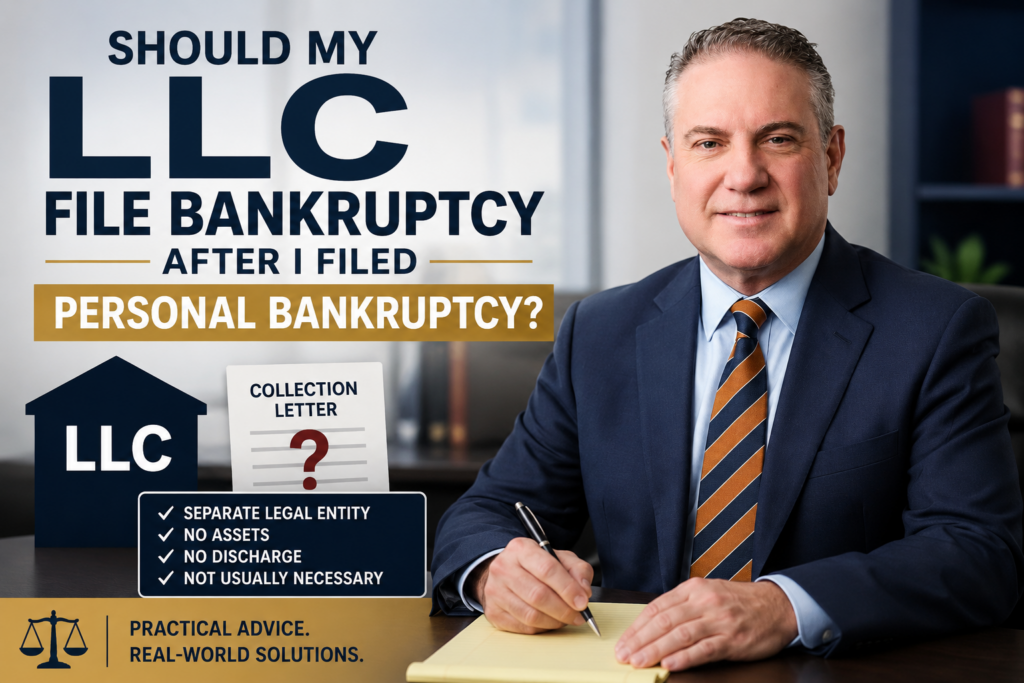
One question I have been hearing more frequently in my bankruptcy practice is this:
“I filed bankruptcy personally and received my discharge. Now my LLC is getting collection letters. Does my LLC need to file bankruptcy too?”
In most cases, the answer is no.
This issue has become much more common in recent years. During and after the pandemic, many people formed limited liability companies. Some of those LLCs became legitimate operating businesses. Others were formed with the intention of starting a business that never really got off the ground. And some people formed an LLC simply because they thought they needed one to conduct business, even though the LLC never actually operated.
In some cases, these LLCs obtained business credit cards, lines of credit, equipment loans or other financing. The individual owner often personally guaranteed or co-signed for the debt.
Then the individual owner runs into financial problems and files Chapter 7 bankruptcy.
The individual receives a bankruptcy discharge.
Then, months later, a collection letter arrives addressed to the LLC.
The former bankruptcy client immediately calls my office and says:
“I thought that debt was discharged. Why are they still trying to collect it?”
The answer usually lies in the difference between the individual debtor and the LLC.
Table of Contents
- Your Personal Bankruptcy Does Not Discharge a Debt Owed by Your LLC
- But What Does the LLC Own?
- Does an LLC With No Assets Need to File Chapter 7?
- When Might an LLC Chapter 7 Bankruptcy Make Sense?
- What About the Personal Guarantee?
- What Should You Do If a Creditor Is Trying to Collect From Your LLC?
- The Bottom Line
Your Personal Bankruptcy Does Not Discharge a Debt Owed by Your LLC
An LLC is a separate legal entity from its owner.
If you personally guaranteed a business credit card or loan, there may actually be two obligations involved. The LLC may be legally obligated on the debt, and you may also be personally obligated because you signed a guaranty.
When you file Chapter 7 bankruptcy, your personal obligation can be discharged.
That does not necessarily eliminate the LLC’s obligation.
For example, suppose your LLC owes a bank $30,000 on a business credit card. You personally guaranteed that credit card. You then file Chapter 7 bankruptcy and receive your discharge.
Your personal liability for the $30,000 may be discharged.
But the LLC did not file bankruptcy.
The bank may therefore still have the right to pursue the LLC for the debt.
This is often what causes the confusion.
The collection letter is not necessarily an attempt to collect a discharged debt from you. It may be an attempt to collect a debt from a separate legal entity—the LLC—which was never a bankruptcy debtor.
But What Does the LLC Own?
This is where things get interesting.
In many of these situations, the LLC has nothing.
The business may have stopped operating years ago. It may have no bank account, no inventory, no equipment, no real estate and no accounts receivable.
It may literally be an LLC on paper with no assets.
If that is the situation, the creditor may have a legal claim against the LLC, but there may be nothing for the creditor to collect.
And that is an important distinction.
Having a debt is not the same thing as having something from which the debt can be collected.
Does an LLC With No Assets Need to File Chapter 7?
Usually, no.
In fact, there is a fundamental difference between an individual Chapter 7 bankruptcy and a business Chapter 7 bankruptcy.
An individual debtor can claim exemptions. Michigan bankruptcy law provides exemptions that can protect certain property from creditors.
An LLC cannot claim individual exemptions.
An LLC is not entitled to protect its assets by claiming the Michigan homestead exemption, automobile exemption, household goods exemption or other individual exemptions.
There is another extremely important distinction:
An LLC does not receive a bankruptcy discharge in Chapter 7.
Chapter 7 bankruptcy is designed to liquidate the assets of an eligible debtor and, in the case of an individual, provide a discharge of qualifying personal debts.
A corporation or LLC can file Chapter 7, but the business does not receive the same type of discharge that an individual receives.
The Chapter 7 trustee’s job in a business Chapter 7 is generally to identify and liquidate nonexempt assets and distribute the proceeds to creditors according to the Bankruptcy Code.
So if your LLC has no assets, filing a Chapter 7 may accomplish very little.
You could end up paying attorneys’ fees and filing fees to put an LLC through a bankruptcy proceeding when there is nothing for a trustee to administer and no discharge to be obtained.
That is why I rarely, if ever, recommend that an inactive LLC with no assets file Chapter 7 bankruptcy simply because it is receiving collection letters.
When Might an LLC Chapter 7 Bankruptcy Make Sense?
There are circumstances in which a Chapter 7 bankruptcy for an LLC can make sense.
The most obvious situation is where the LLC actually has assets that need to be liquidated.
For example, an operating business might own:
- Equipment
- Inventory
- Vehicles
- Accounts receivable
- Real estate
- Business bank accounts
- Other property of value
If the LLC is unable to pay its creditors and has significant assets that need to be administered, a business bankruptcy may be appropriate.
There can also be other reasons to consider a business bankruptcy depending upon the circumstances, including the number and nature of creditors, pending lawsuits, judgments, collection activity and the existence of assets that could otherwise be seized.
But there is an important point I want former clients to understand:
Do not file an LLC bankruptcy simply because a creditor sends the LLC a collection letter.
The first question should be whether the LLC actually owns anything.
The second question should be whether there is some practical reason to put the LLC through a bankruptcy proceeding.
What About the Personal Guarantee?
This is another area where former bankruptcy clients sometimes become unnecessarily concerned.
If you personally guaranteed the LLC’s debt and your personal obligation was discharged in your Chapter 7 bankruptcy, the creditor generally cannot simply ignore your discharge and start collecting the debt from you personally.
The creditor may, however, still pursue the LLC to the extent the LLC remains liable.
That means you may receive correspondence that says something like:
“ABC LLC owes us $25,000.”
That does not necessarily mean:
“You personally owe us $25,000.”
The distinction is extremely important.
Your bankruptcy discharge protects you. It does not automatically discharge the debts of every separate legal entity in which you have an ownership interest.
What Should You Do If a Creditor Is Trying to Collect From Your LLC?
If you are one of my former bankruptcy clients and this happens, I would recommend that you do not panic and do not immediately file another bankruptcy.
Instead, take a few practical steps.
1. Determine who the creditor is trying to collect from
Look carefully at the collection letter.
Is it addressed to you personally?
Or is it addressed to the LLC?
That distinction can be critical.
2. Review the original debt
Find the original credit card agreement, loan documents, guaranty or other paperwork if you have it.
We want to know who actually borrowed the money and who signed the documents.
3. Determine whether the LLC has any assets
Ask yourself whether the LLC currently owns anything of meaningful value.
Does it have:
- A bank account?
- Equipment?
- Vehicles?
- Inventory?
- Accounts receivable?
- Real estate?
- Cryptocurrency or investment accounts?
- Money owed to the business?
- Other valuable property?
If the answer is no, that changes the situation considerably.
4. Do not transfer assets to or from the LLC
This is particularly important.
If the LLC owns assets, don’t start moving them around simply because a creditor is demanding payment.
Likewise, don’t transfer your personal property to the LLC to try to protect it from a creditor.
Those transactions can create entirely different legal problems.
5. Don’t ignore a lawsuit
A collection letter is one thing.
A lawsuit is something else.
If the LLC is served with a lawsuit, judgment or other legal proceeding, you should have the situation reviewed by an attorney.
Even if the LLC has no assets, you should not assume that a lawsuit can simply be ignored.
6. Talk to your bankruptcy attorney before filing another bankruptcy
This is probably the most important advice I can give my former clients.
Receiving a collection letter does not automatically mean that your LLC needs to file bankruptcy.
In many cases, the better solution is simply to determine that the LLC has no assets and no practical reason to file a Chapter 7 case.
Every situation is different, particularly where the LLC still operates, owns property, has receivables, has employees, or has significant outstanding obligations.
The Bottom Line
I have had many former bankruptcy clients contact me after receiving collection letters addressed to an LLC that they owned.
Their first reaction is often:
“I already filed bankruptcy. Why is this happening?”
The answer is usually simple.
Your personal bankruptcy was filed by you. Your LLC is a separate legal entity.
Your bankruptcy discharge may eliminate your personal liability on a debt that you guaranteed, while leaving the LLC’s separate obligation intact.
But that does not mean that the LLC automatically needs to file bankruptcy.
If the LLC has no assets, there may be nothing for a creditor to collect. And because an LLC does not receive an individual Chapter 7 discharge and cannot claim individual bankruptcy exemptions, filing a Chapter 7 for an essentially empty LLC often provides little or no practical benefit.
So before you assume that your LLC needs to file bankruptcy, look at what the LLC actually owns and what the creditor is actually trying to collect.
And if you are a former client of mine, don’t hesitate to contact my office when you receive one of these letters. We can look at the collection letter and the circumstances surrounding the LLC and determine whether there is actually a problem that needs to be addressed—or whether the letter is simply something that can be dealt with without filing another bankruptcy case.