Are Debts Due to Drunk Driving Dischargeable in Bankruptcy?

Published
One question that occasionally comes up in bankruptcy practice is whether someone who causes an automobile accident while driving under the influence of alcohol can discharge the resulting debt in bankruptcy.
The answer may surprise you.
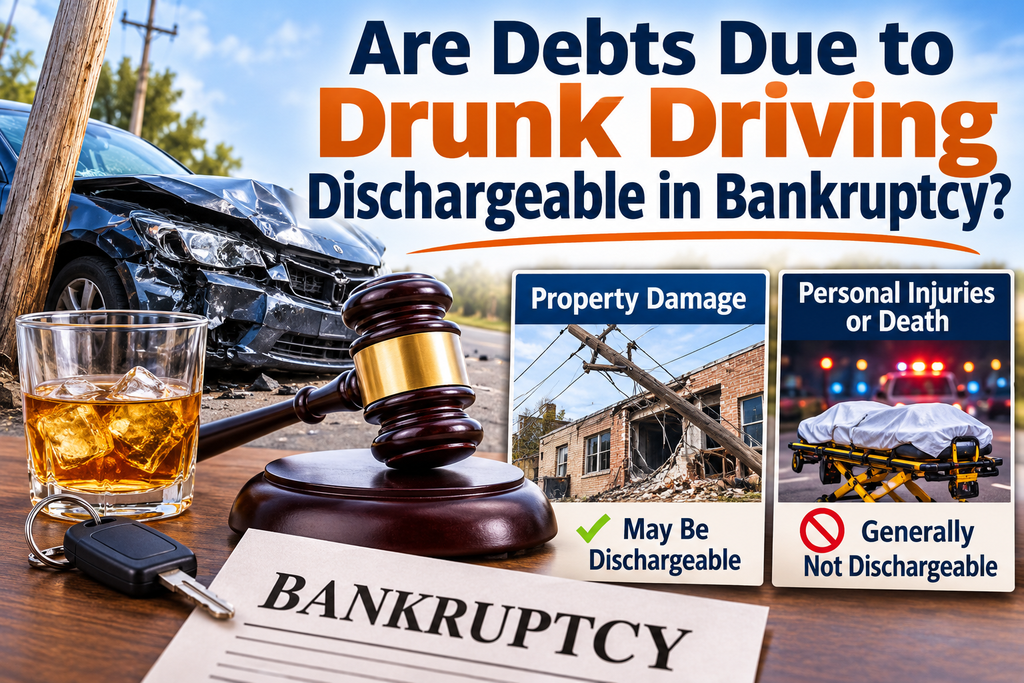
A debt resulting from hundreds of thousands of dollars in property damage caused by drunk driving may be dischargeable in Chapter 7 bankruptcy. However, a debt arising from personal injuries or death caused by drunk driving is generally not dischargeable.
The distinction is found in Section 523(a)(9) of the Bankruptcy Code. Congress specifically created an exception to bankruptcy discharge for debts resulting from death or personal injury caused by the debtor’s unlawful operation of a motor vehicle while intoxicated.
But the statute does not include ordinary property damage.
Let’s look at how this works and, more importantly, what happens when someone files bankruptcy after causing a serious accident while intoxicated.
Table of Contents
- A Drunk Driving Accident That Caused More Than $200,000 in Property Damage
- Section 523(a)(9): Personal Injury and Death Are Not Dischargeable
- What About Property Damage Caused by Drunk Driving?
- Could Property Damage Be Nondischargeable Under Section 523(a)(6)?
- Does the Injured Person Have to File an Adversary Proceeding in Bankruptcy Court?
- Does a Drunk Driving Conviction Automatically Make the Debt Nondischargeable?
- What If the Accident Causes Both Personal Injury and Property Damage?
- The Bottom Line: Drunk Driving Does Not Automatically Make Every Debt Nondischargeable
A Drunk Driving Accident That Caused More Than $200,000 in Property Damage
I once represented a client who, while intoxicated, lost control of his vehicle and struck a telephone pole.
The collision was substantial enough that the telephone pole collapsed and came down on a nearby building, causing extensive property damage. The falling pole also brought down the traffic signals, effectively shutting down the entire intersection.
My client had no automobile insurance and received a ticket for drunk driving, ultimately resulting in a conviction for DUI. The resulting property damage exceeded $200,000.
You might reasonably assume that someone who causes that kind of destruction while driving drunk would be prohibited from discharging the resulting debt in bankruptcy.
Not necessarily.
Despite the drunk-driving citation and the substantial property damage, the debt was dischargeable in bankruptcy court.
Why?
Because the Bankruptcy Code makes a distinction between debts arising from property damage and debts arising from personal injury or death.
Section 523(a)(9) specifically excludes debts for death or personal injury caused by the debtor’s unlawful operation of a motor vehicle while intoxicated. It does not include property damage.
In other words, Congress chose to make debts arising from drunk-driving injuries and fatalities nondischargeable without creating the same automatic exception for property damage.
This is an important distinction that many people, including creditors, do not understand.
Section 523(a)(9): Personal Injury and Death Are Not Dischargeable
Section 523(a)(9) of the Bankruptcy Code provides that a bankruptcy discharge does not eliminate a debt:
“For death or personal injury caused by the debtor’s operation of a motor vehicle, vessel, or aircraft if such operation was unlawful because the debtor was intoxicated from using alcohol, a drug, or another substance.”
This provision is relatively straightforward.
If someone operates a motor vehicle while unlawfully intoxicated and causes an accident resulting in personal injury or death, the resulting debt generally survives bankruptcy.
For example, consider these situations:
Drunk driving causing personal injury:
- A driver operates a vehicle while intoxicated.
- The driver runs a red light and strikes another vehicle.
- The occupants of the other vehicle suffer broken bones, permanent injuries, or other bodily harm.
- The injured parties sue and obtain a substantial judgment for medical expenses, lost wages, pain and suffering, and other damages.
If the driver subsequently files Chapter 7 bankruptcy, the debt arising from those personal injuries is generally nondischargeable under Section 523(a)(9).
Drunk driving causing death:
The same principle applies when an intoxicated driver causes a fatal accident.
A wrongful death judgment or settlement arising from the death generally cannot be eliminated through bankruptcy.
The important point is that the statute applies to debts for death or personal injury, not simply to any debt arising from an automobile accident.
The statute also covers unlawful intoxicated operation of vessels and aircraft, not just automobiles.
What About Property Damage Caused by Drunk Driving?
This is where things get interesting.
Section 523(a)(9) does not include property damage.
Consequently, if someone drives while intoxicated and destroys another person’s vehicle, damages a building, knocks down a telephone pole, or causes other substantial property damage, the resulting debt may be dischargeable in Chapter 7 bankruptcy.
The amount of the damage does not change the analysis.
Whether the damage is $5,000, $50,000, or $200,000, Section 523(a)(9) does not make the debt nondischargeable merely because the debtor was intoxicated.
This is precisely the distinction illustrated by my client’s case involving the telephone pole and the building.
He had caused a substantial amount of property damage, and the police issued a drunk-driving citation. Nevertheless, the resulting property damage debt was dischargeable.
Of course, there is another bankruptcy exception that must be considered.
Could Property Damage Be Nondischargeable Under Section 523(a)(6)?
Although Section 523(a)(9) does not protect property damage claims from discharge, creditors sometimes attempt to use another provision of the Bankruptcy Code.
Section 523(a)(6) excludes debts arising from “willful and malicious injury by the debtor to another entity or to the property of another entity.”
This provision is important because it can apply to intentional damage to someone else’s property.
However, there is a significant distinction between intentionally causing damage and committing an intentional act that accidentally causes damage.
For example, intentionally driving a vehicle into someone’s building with the purpose of destroying it could potentially create a nondischargeable debt under Section 523(a)(6).
On the other hand, simply choosing to drive while intoxicated, losing control of the vehicle, and accidentally striking a building does not automatically establish a willful and malicious injury.
In the United States Supreme Court decision of Kawaauhau v. Geiger, 523 U.S. 57 (1998), the Court explained that Section 523(a)(6) requires an intentional injury, not merely an intentional act that results in injury.
Negligent or reckless conduct, standing alone, is insufficient.
Therefore, a drunk-driving accident that causes extensive property damage does not automatically become nondischargeable simply because the driver knowingly operated a vehicle while intoxicated.
The creditor would have to establish the additional elements required by Section 523(a)(6).
This is an important distinction. Otherwise, virtually every serious drunk-driving accident involving property damage could be argued to be nondischargeable, which is not what Congress wrote into the Bankruptcy Code.
Does the Injured Person Have to File an Adversary Proceeding in Bankruptcy Court?
This is another important distinction, and one that bankruptcy attorneys and personal injury attorneys should understand.
In most Chapter 7 cases, creditors who want to establish that a particular debt is nondischargeable under certain provisions of the Bankruptcy Code must file an adversary proceeding.
For example, claims involving fraud under Section 523(a)(2), fiduciary misconduct under Section 523(a)(4), and willful and malicious injury under Section 523(a)(6) are subject to the special filing deadline in Bankruptcy Rule 4007(c).
Generally, that deadline is 60 days after the first date set for the meeting of creditors under Section 341.
If the creditor fails to file a timely complaint under one of those provisions, the debt generally becomes dischargeable.
But Section 523(a)(9) is different.
The 60-day adversary proceeding deadline does not apply to claims under Section 523(a)(9).
Federal Bankruptcy Rule 4007(b) specifically provides that a complaint to determine dischargeability, other than one governed by Section 523(c), may be filed at any time.
The Advisory Committee Notes to Rule 4007 specifically identify Section 523(a)(9) as one of the exceptions that is not subject to the 60-day deadline.
There is an additional important distinction: Section 523(a)(9) does not require the injured person to file an adversary proceeding in bankruptcy court at all to preserve the nondischargeable nature of the debt.
In fact, the injured party may pursue the matter in state court because jurisdiction over these dischargeability questions is concurrent between the bankruptcy court and an appropriate nonbankruptcy court.
This means that a creditor with a qualifying drunk-driving personal injury judgment does not lose the benefit of Section 523(a)(9) simply because the creditor failed to file an adversary proceeding within 60 days of the bankruptcy filing.
The creditor can also file a complaint in bankruptcy court later if a determination of dischargeability becomes necessary.
There is no 60-day deadline under Section 523(a)(9).
This is a significant difference from many other nondischargeability claims.
Does a Drunk Driving Conviction Automatically Make the Debt Nondischargeable?
Not necessarily.
The language of Section 523(a)(9) requires that the death or personal injury be caused by the debtor’s operation of a motor vehicle when that operation was unlawful because the debtor was intoxicated.
The relevant questions include:
- Was the debtor operating a motor vehicle?
- Was the operation unlawful because the debtor was intoxicated?
- Did that operation cause the death or personal injury?
- Does the debt arise from that death or personal injury?
A criminal conviction for operating while intoxicated can be important evidence, but the bankruptcy statute does not expressly require a criminal conviction.
Likewise, the mere fact that someone received a drunk-driving ticket does not automatically make every debt arising from the accident nondischargeable.
For example, a property damage claim remains outside Section 523(a)(9), even when the debtor was convicted of drunk driving.
The nature of the damages and the circumstances surrounding the accident matter.
What If the Accident Causes Both Personal Injury and Property Damage?
Many serious automobile accidents involve both.
For example, an intoxicated driver strikes another vehicle, injuring its occupants and totaling the vehicle.
There may be several different claims:
- The other driver’s vehicle damage.
- Medical expenses incurred by injured passengers.
- Lost wages resulting from bodily injuries.
- Pain and suffering.
- Permanent disability.
- Wrongful death damages, if someone dies.
The personal injury and wrongful death debts generally fall within Section 523(a)(9).
The property damage portion does not automatically qualify under that provision.
It is important to recognize that the existence of a personal injury claim does not necessarily transform every separate property damage claim arising from the same accident into a nondischargeable debt.
Each claim must be analyzed according to the applicable Bankruptcy Code provisions.
The Bottom Line: Drunk Driving Does Not Automatically Make Every Debt Nondischargeable
Bankruptcy law makes a very specific distinction between property damage and personal injury or death resulting from intoxicated driving.
Someone who drives drunk and causes $200,000 in property damage may still be able to discharge that debt in Chapter 7 bankruptcy.
Someone who drives drunk and causes another person to suffer bodily injuries or death generally cannot discharge the resulting liability.
And unlike many other nondischargeability claims, a personal injury creditor relying on Section 523(a)(9) does not have to file an adversary proceeding within the usual 60-day deadline.
These distinctions are important for both bankruptcy debtors and personal injury creditors.
If you have been involved in an automobile accident, have outstanding liability from a drunk-driving incident, or have a judgment against you arising from an accident, it is important to understand which portions of that debt can and cannot be eliminated through bankruptcy.
I have practiced bankruptcy law exclusively for more than 35 years and have represented more than 25,000 people in bankruptcy matters. The dischargeability of a debt is not always determined by how large the judgment is or how serious the underlying conduct may seem. It is determined by the specific exceptions Congress included in the Bankruptcy Code.
If you have questions about whether an automobile accident judgment can be discharged in Chapter 7 bankruptcy, contact my office for a consultation.
Walter Metzen, Attorney at Law
Law Offices of Walter Metzen
313-962-4656
Detroit Bankruptcy Lawyer