Major Changes to Bankruptcy Debt Limits: President Trump Signs New Law Expanding Chapter 13 and Small Business Bankruptcy Eligibility

Published
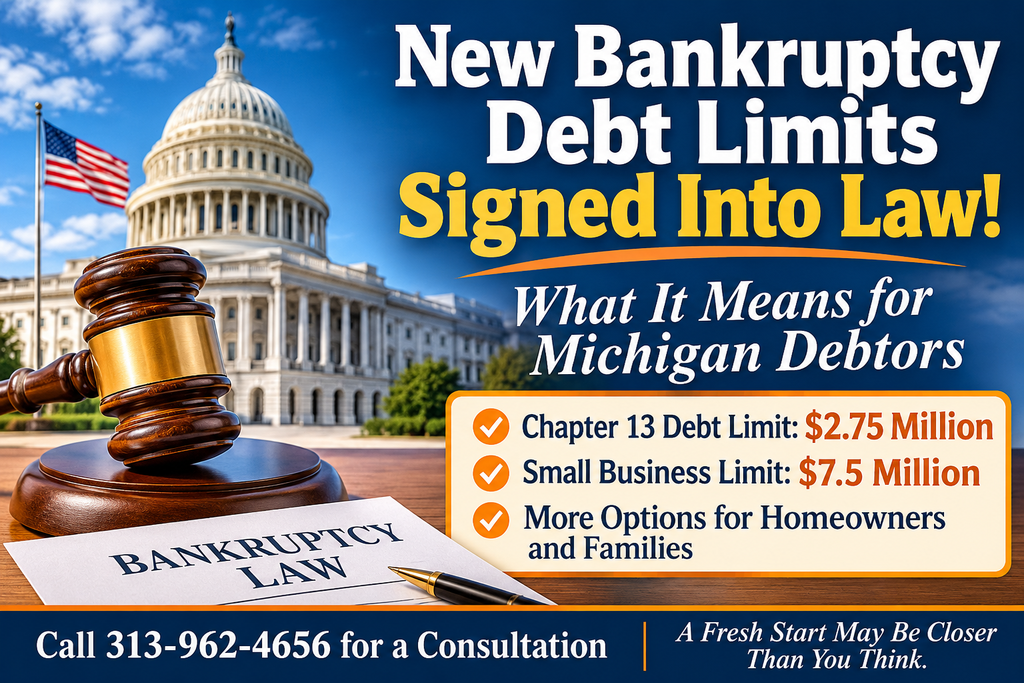
A significant change to federal bankruptcy law took effect on November 10, 2026. President Donald Trump has signed the Bankruptcy Threshold Adjustment Act of 2026 into law, permanently increasing the debt limits for individuals filing Chapter 13 bankruptcy and small businesses filing under Subchapter V of Chapter 11.
For many people struggling with substantial debt, particularly homeowners with large mortgages, this is welcome news. The new law expands access to Chapter 13 bankruptcy and eliminates an important obstacle that previously prevented some individuals from qualifying for a repayment plan.
I have practiced bankruptcy law exclusively for more than 35 years, and I have seen firsthand how bankruptcy debt limits can affect a person’s ability to obtain relief. This change is particularly important for individuals who previously had too much debt to qualify for Chapter 13 but did not necessarily need the more complicated and expensive Chapter 11 process.
Let’s take a closer look at what changed and what it means for Michigan residents considering bankruptcy.
Table of Contents
- 1. The New Chapter 13 Bankruptcy Debt Limit Is $2.75 Million
- 2. Why This Is Particularly Important for Homeowners
- 3. What Happens to Credit Card Debt, Medical Bills, and Other Unsecured Debts?
- 4. The New Law Also Increases the Debt Limit for Small Businesses
- 5. When Do the New Bankruptcy Debt Limits Take Effect?
- 6. Does This Change the Requirements for Filing Chapter 7 Bankruptcy?
- 7. What Should You Do If You Previously Did Not Qualify for Chapter 13?
- Conclusion: A Significant Expansion of Bankruptcy Relief
1. The New Chapter 13 Bankruptcy Debt Limit Is $2.75 Million
Perhaps the most important change for individual consumers is the increase and restructuring of the Chapter 13 debt limits.
Before November 10, 2026, an individual filing Chapter 13 bankruptcy had to satisfy two separate debt limitations:
- Unsecured debts had to be less than $526,700.
- Secured debts had to be less than $1,580,125.
These were separate requirements. Exceeding either limit could disqualify someone from filing Chapter 13, regardless of whether the individual had sufficient income to make payments under a repayment plan.
The new law eliminates these separate debt limitations and replaces them with a single combined debt limit of less than $2.75 million.
This means that an individual with regular income can now qualify for Chapter 13 bankruptcy with combined secured and unsecured debts of less than $2.75 million, provided the other eligibility requirements are satisfied.
This is a substantial improvement over the previous law.
For example, consider someone who owns a home worth $800,000 but still owes $1.7 million on the mortgage. That individual would have exceeded the former secured debt limit and would not have qualified for Chapter 13 based on the debt-limit test.
Under the new law, that person may qualify because the combined debt is below $2.75 million.
The distinction is important. The new law does not simply increase the old limits. It combines secured and unsecured debts into one overall limit, providing considerably more flexibility.
2. Why This Is Particularly Important for Homeowners
One of the most significant benefits of the new law involves homeowners who are behind on their mortgage payments.
Chapter 13 bankruptcy is often an excellent tool for homeowners who have fallen behind on their mortgage but want to keep their homes.
Unlike Chapter 7 bankruptcy, Chapter 13 allows an individual to propose a repayment plan, generally lasting three to five years, to catch up on missed mortgage payments while continuing to make regular monthly mortgage payments.
For example, suppose you owe $40,000 in past-due mortgage payments. Rather than having to come up with that entire amount immediately, Chapter 13 may allow you to spread those arrears over a repayment plan.
The bankruptcy filing also triggers the automatic stay, which generally stops foreclosure proceedings and collection activity, subject to certain exceptions and the possibility that a creditor may obtain relief from the stay.
Before this new legislation, some homeowners with substantial mortgage balances could not use Chapter 13 because their secured debt exceeded the statutory limit.
That could create a difficult situation. A homeowner might have a good income, substantial equity, and the ability to catch up on mortgage payments over time, but still be disqualified from Chapter 13 because of the amount owed on the mortgage.
The new law removes that obstacle for many of these homeowners.
It is important to understand that the new law does not eliminate mortgage debt or guarantee that someone can save their home. The debtor must still be able to propose and complete a feasible repayment plan. However, it provides more homeowners with access to a bankruptcy procedure specifically designed to help them deal with mortgage arrears.
3. What Happens to Credit Card Debt, Medical Bills, and Other Unsecured Debts?
The new $2.75 million limit includes both secured and unsecured debt.
Unsecured debts generally include:
- Credit card balances.
- Medical bills.
- Personal loans.
- Certain deficiency balances.
- Other debts that are not secured by collateral.
Secured debts generally include:
- Mortgages.
- Home equity loans.
- Vehicle loans.
- Other debts secured by property.
Under the former law, an individual could be disqualified from Chapter 13 by exceeding the unsecured debt limit even when the person’s total debt was relatively modest.
The new law removes that separate unsecured debt ceiling.
For example, someone with $1 million in unsecured debt and $1 million in secured debt may now qualify for Chapter 13, assuming the debts meet the statutory requirements and the individual otherwise qualifies.
This can be particularly helpful for individuals who own businesses, have substantial personal guarantees, or have accumulated significant medical and credit card debt.
4. The New Law Also Increases the Debt Limit for Small Businesses
The Bankruptcy Threshold Adjustment Act also makes an important change for small business owners.
The debt limit for businesses seeking bankruptcy protection under Subchapter V of Chapter 11 has increased from approximately $3.424 million to $7.5 million.
Subchapter V was created to provide small businesses with a less expensive and more streamlined alternative to traditional Chapter 11 bankruptcy.
A traditional Chapter 11 case can be extremely expensive and complicated. Subchapter V was designed to make reorganization more accessible to smaller businesses that need to restructure their debts while continuing to operate.
The increased $7.5 million limit means that many businesses that previously exceeded the eligibility threshold may now qualify.
There are additional eligibility requirements. For example, at least 50% of qualifying debts generally must arise from commercial or business activities. Certain entities, including single-asset real estate businesses, are excluded.
For small business owners who are struggling with debt but want to keep their businesses operating, this change may provide a valuable opportunity to reorganize.
5. When Do the New Bankruptcy Debt Limits Take Effect?
The effective date is particularly important.
President Trump signed the Bankruptcy Threshold Adjustment Act into law on November 10, 2026.
The increased Chapter 13 and Subchapter V debt limits apply to bankruptcy cases commenced on or after November 10, 2026.
This means that individuals filing Chapter 13 bankruptcy on or after that date can take advantage of the new $2.75 million combined debt limit.
The new law does not automatically change the eligibility requirements for bankruptcy cases that were filed before November 10, 2026.
The legislation also makes these increased debt limits permanent. They are no longer subject to the temporary expiration provisions that caused the previous increases to disappear in June 2024.
6. Does This Change the Requirements for Filing Chapter 7 Bankruptcy?
No. The new legislation does not change the basic eligibility requirements for filing Chapter 7 bankruptcy.
Chapter 7 remains available to individuals who qualify under the applicable bankruptcy laws, including the means test where applicable.
There is no comparable $2.75 million debt ceiling for an individual filing Chapter 7.
In other words, someone with substantial debts does not necessarily need to file Chapter 13 simply because of the amount owed. Depending on income, assets, and other circumstances, Chapter 7 may still be the better option.
In my practice, I generally prefer Chapter 7 when a client qualifies and Chapter 7 will accomplish the client’s objectives. Chapter 13 is an excellent tool in the right circumstances, particularly when someone needs to catch up on mortgage payments, protect property, or address other financial problems that cannot be resolved through Chapter 7.
The fact that someone now qualifies for Chapter 13 does not automatically mean that Chapter 13 is the best choice.
7. What Should You Do If You Previously Did Not Qualify for Chapter 13?
If you previously consulted with a bankruptcy attorney and were told that you could not file Chapter 13 because your secured or unsecured debts exceeded the statutory limits, it may be worth having your situation reviewed again.
This is particularly true if you:
- Have a substantial mortgage balance.
- Are behind on your mortgage and facing foreclosure.
- Have significant credit card or medical debt.
- Have personally guaranteed business loans.
- Have substantial secured and unsecured debts that previously exceeded one of the Chapter 13 limitations.
- Have regular income but need time to repay creditors.
The new law may open the door to a bankruptcy option that was previously unavailable.
However, the $2.75 million limit is not a guarantee of eligibility. The debts must be noncontingent and liquidated, and the debtor must meet the other requirements of Chapter 13, including having regular income and proposing a plan that satisfies the Bankruptcy Code.
Conclusion: A Significant Expansion of Bankruptcy Relief
The Bankruptcy Threshold Adjustment Act of 2026 is one of the more meaningful changes to bankruptcy eligibility requirements in recent years.
For individual consumers, the new $2.75 million combined debt limit makes Chapter 13 available to people who previously could not qualify because of separate secured and unsecured debt restrictions.
For small business owners, the permanent increase of the Subchapter V debt limit to $7.5 million provides access to a streamlined reorganization process that can help preserve an otherwise viable business.
If you are struggling with debt, facing foreclosure, or simply believe that your debt level prevents you from filing bankruptcy, do not assume that you are ineligible.
I have represented more than 25,000 individuals and families in bankruptcy matters throughout my career. My practice is devoted exclusively to bankruptcy law, and I have spent more than 35 years helping people understand their options under the Bankruptcy Code.
If you live in southeastern Michigan and are considering bankruptcy, contact my office at 313-962-4656 for a consultation. We can review your debts, income, assets, and financial circumstances and determine whether Chapter 7 or Chapter 13 is the better option under the new law.
You may have more options than you think.