What Is a HUD Partial Claim Mortgage (Subordinate Mortgage), and How Does It Affect Bankruptcy?

Published
If you fell behind on your FHA-insured mortgage because of a financial hardship, you may have been offered something called a HUD Partial Claim. Many homeowners don’t even realize they have one until they are preparing to file bankruptcy, refinance, or sell their home.
I’ve had many clients come into my office believing they only have one mortgage, only to discover there is also a HUD Partial Claim, sometimes called a subordinate mortgage or junior lien, recorded against their property.
Understanding how this loan works—and how it is treated in bankruptcy—is important.
What Is a HUD Partial Claim?
A HUD Partial Claim is a program offered through the Federal Housing Administration (FHA) to help homeowners who have fallen behind on their mortgage payments due to a temporary financial hardship.
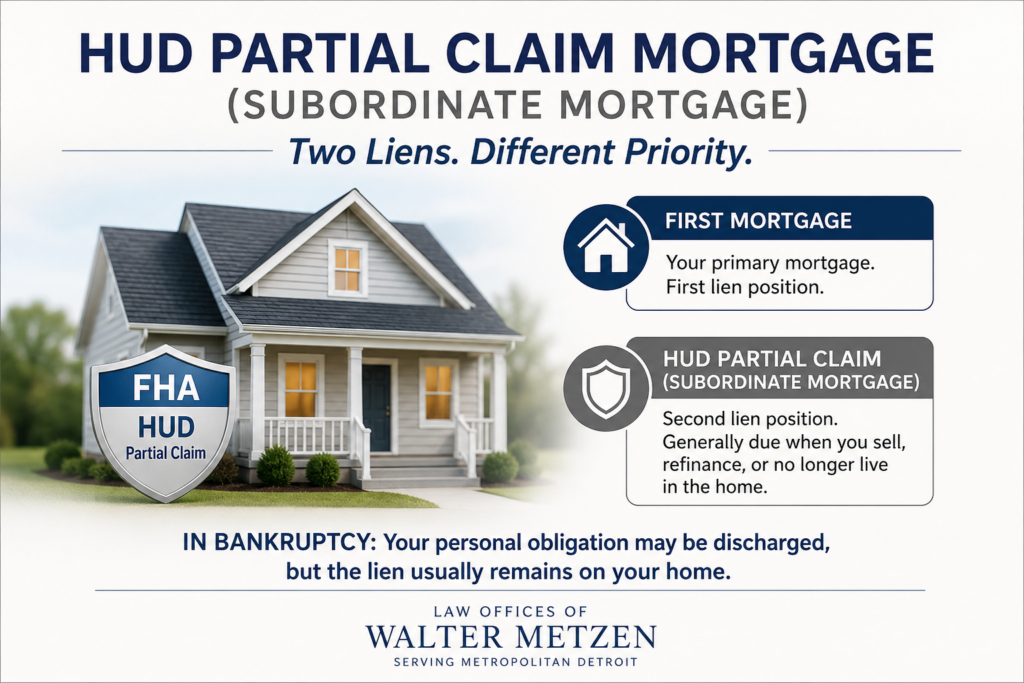
Rather than requiring you to immediately repay the missed mortgage payments, HUD advances the money needed to bring your primary mortgage current. In return, you sign a promissory note and a subordinate mortgage in favor of HUD.
The result is:
- Your first mortgage is brought current.
- You continue making your regular monthly mortgage payments to your mortgage servicer.
- You generally do not make monthly payments on the HUD Partial Claim.
Instead, the subordinate mortgage typically becomes due when one of the following occurs:
- You sell the home.
- You refinance the first mortgage.
- The first mortgage is paid in full.
- The property is no longer your principal residence.
For many homeowners, this means the loan simply sits in the background for years.
Why Does This Matter in Bankruptcy?
When preparing a bankruptcy case, it is critical that every creditor holding a claim against your property is listed in your schedules, including HUD if it holds a Partial Claim mortgage.
Many homeowners forget about this loan because they never receive monthly bills or make monthly payments.
However, the subordinate mortgage is still a valid lien against your home and should be disclosed in your bankruptcy paperwork.
What Happens in a Chapter 7 Bankruptcy?
In a typical Chapter 7 bankruptcy, your personal obligation to repay the HUD Partial Claim may be discharged along with your other unsecured personal liability.
However, just like your first mortgage, the lien itself generally survives the bankruptcy unless it is avoided through another legal procedure.
This means HUD’s subordinate mortgage normally remains attached to your property even after you receive your bankruptcy discharge.
If you later sell or refinance your home, the HUD Partial Claim generally must still be addressed.
Can a HUD Partial Claim Be Eliminated?
Sometimes.
Whether a subordinate mortgage can be removed depends on several factors, including:
- The value of your home.
- The amount owed on your first mortgage.
- Whether there is any equity securing the HUD lien.
- Whether you are filing Chapter 7 or Chapter 13.
In some Chapter 13 cases, a wholly unsecured junior mortgage may qualify for lien stripping. Whether a HUD Partial Claim qualifies depends upon the specific facts of your case and applicable bankruptcy law. It’s quite rare these days with the high values of real estate since the pandemic.
Every case should be carefully evaluated before assuming a subordinate mortgage can be eliminated.
Should You Continue Paying Your First Mortgage?
Absolutely.
The HUD Partial Claim was designed to help homeowners remain in their homes by bringing the first mortgage current. If you intend to keep your home after bankruptcy, you generally must continue making your regular mortgage payments on the first mortgage.
Your bankruptcy discharge does not eliminate the lender’s right to foreclose if future mortgage payments are not made.
We Carefully Review Every Mortgage
One of the things I do during every bankruptcy consultation is review your mortgage documents and title information to identify all recorded liens against your property.
Many clients are surprised to learn they have:
- A HUD Partial Claim mortgage.
- A second mortgage they forgot about.
- A home equity line of credit with a zero balance but an unreleased lien.
- Old judgment liens that may affect the title to their property.
Identifying these issues before filing bankruptcy helps avoid surprises later.
Free Bankruptcy Consultation
If you’re considering filing Chapter 7 or Chapter 13 bankruptcy and own a home, don’t assume your mortgage situation is straightforward.
We’ll review your mortgage documents, determine whether a HUD Partial Claim or other subordinate mortgage exists, explain how it will be treated in bankruptcy, and discuss your options for protecting your home.
I offer free bankruptcy consultations to help you understand your rights before you file. With more than 25,000 consumer bankruptcy cases filed throughout Metropolitan Detroit, I’ve helped thousands of homeowners navigate complex mortgage issues while obtaining the fresh financial start they deserve.