Why Do I List Creditors Showing a $0 Balance on Your Credit Report?

Published
One of the questions I occasionally hear from clients after I review their credit reports is:
“Walter, why are you listing this creditor in my bankruptcy? My credit report says I don’t owe them anything anymore.”
That’s a great question, and the answer is simple:
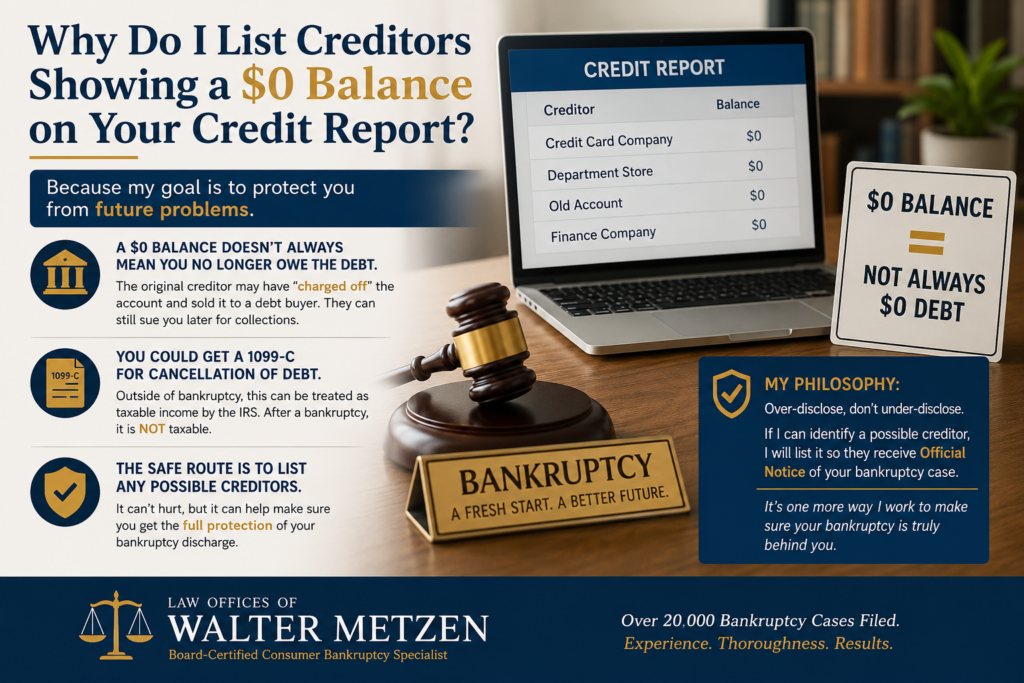
Because I want to protect you from future problems.
When I prepare your bankruptcy petition, my goal is not simply to list the debts that appear to be owed today. My goal is to make sure every possible creditor receives official notice of your bankruptcy case so that you receive the broadest protection possible under the Bankruptcy Code.
A $0 Balance Does Not Always Mean You No Longer Owe the Debt
Many people assume that when a credit report shows a $0 balance, the debt has disappeared.
Unfortunately, that’s often not true.
In many cases, the original lender has simply charged off the account.
What Does “Charged Off” Mean?
A charge-off is an accounting decision made by the creditor.
Federal banking regulations generally require creditors to classify seriously delinquent accounts as losses after they have gone unpaid for a certain period of time. The creditor removes the account from its active receivables and records it as a business loss for accounting purposes.
A charge-off does NOT mean the debt has been forgiven.
In most cases, the creditor still has every legal right to collect the money.
Very often, the original creditor sells the charged-off account to a debt buyer for pennies on the dollar. That debt buyer may then spend months—or even years—trying to collect the debt.
I’ve seen clients sued by companies they had never even heard of because the original debt had been sold multiple times.
Debt Buyers May Appear Years Later
One reason I like to list these old accounts is because debt buyers frequently purchase old charged-off accounts long after the original creditor has disappeared from the credit report.
If that debt buyer later claims it never received notice of your bankruptcy, you may have unnecessary headaches proving the debt was discharged.
Giving every possible creditor official notice from the beginning is simply the safer approach.
Another Hidden Risk: A 1099-C for Cancellation of Debt
There is another reason I list these creditors.
Sometimes, instead of continuing collection efforts, a creditor eventually decides to cancel the debt.
When that happens, the creditor may issue an IRS Form 1099-C (Cancellation of Debt).
Outside of bankruptcy, this can create a nasty surprise.
The IRS generally treats canceled debt as taxable income. In other words, if a creditor forgives a $15,000 debt, the IRS may view that $15,000 as income you received—even though you never actually received any money.
Many people are shocked when they receive a tax bill because of an old debt they thought had simply gone away.
Fortunately, debts discharged in bankruptcy are generally excluded from taxable income. Bankruptcy provides an important exception that often prevents this tax consequence.
It Doesn’t Hurt to List the Creditor
Some clients worry that listing a creditor showing a $0 balance could somehow create a problem.
The answer is almost always no.
If the debt truly no longer exists, listing the creditor simply ensures they receive notice of your bankruptcy.
If the debt does still exist—even if it has been sold to someone else—you’ve taken an important step toward making sure it is discharged.
In bankruptcy, it is almost always better to over-disclose than under-disclose.
My Philosophy
After filing well over 25,000 consumer bankruptcy cases, I’ve learned that being thorough protects my clients.
If I can identify a possible creditor from your credit report, old paperwork, collection letters, or your own memory, I usually recommend listing it.
There is very little downside to giving a creditor notice of your bankruptcy.
There can, however, be unnecessary complications if a legitimate creditor is left off the schedules.
That’s why you’ll often see me include creditors showing a $0 balance on your credit report.
It’s simply one more way I work to make sure that when your bankruptcy is over, it’s truly behind you.