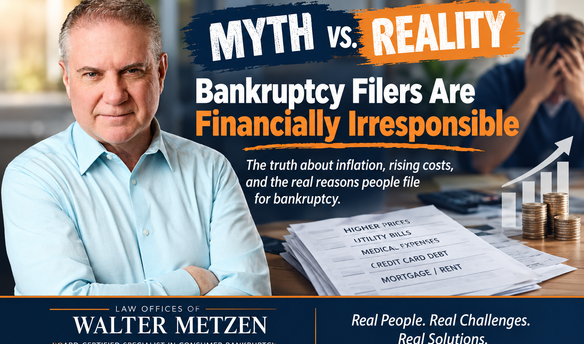
Myth vs. Reality: Married Couples Will Both Have to File Bankruptcy

Published

One of the most common misconceptions I hear from married couples who are struggling with debt is that if one spouse files for bankruptcy, the other spouse must file, too. After 35 years of practicing bankruptcy law, I can tell you that this is simply not true.
Myth: If you are married and file bankruptcy, your spouse must file with you.
Reality: You can file bankruptcy without your spouse. In fact, I have filed thousands of bankruptcy cases over the years for individuals whose spouses did not file bankruptcy. This is true for both Chapter 7 and Chapter 13 bankruptcy cases.
Table of Contents
- Can I File Chapter 7 Bankruptcy Without My Spouse?
- Will My Spouse’s Credit Be Ruined If I File Bankruptcy?
- What If We Have Joint Debts?
- Do I Have to Include My Spouse’s Income If I File Alone?
- Should Both Spouses File Bankruptcy Together?
- Do Not Assume You Both Have to File
- Contact an Experienced Michigan Bankruptcy Attorney
Can I File Chapter 7 Bankruptcy Without My Spouse?
Yes. Federal bankruptcy law allows one spouse to file an individual bankruptcy case without the other spouse filing. You do not have to file a joint bankruptcy case simply because you are married.
For example, suppose a husband has accumulated $50,000 in credit card debt in his own name. His wife has good credit, has no significant debt of her own, and wants to keep her credit history intact. Depending on their circumstances, the husband may be able to file Chapter 7 bankruptcy individually without requiring his wife to file.
The same is true if the wife is the spouse experiencing financial difficulties. She may be able to file bankruptcy individually while her husband does not file.
I have represented thousands of married individuals in situations like these throughout my career. Filing bankruptcy is a personal financial decision, and the appropriate approach depends on the circumstances of each household.
Will My Spouse’s Credit Be Ruined If I File Bankruptcy?
No. Your bankruptcy filing does not automatically appear on your spouse’s credit report simply because you are married.
If you file an individual Chapter 7 bankruptcy, your spouse does not become a bankruptcy debtor just because you are married. Your spouse’s credit history is not automatically destroyed by your filing.
However, there are some important distinctions. If you and your spouse have joint credit card accounts, loans, or other debts, your bankruptcy may affect how those creditors pursue collection of the debt. A creditor may still be able to pursue a nonfiling spouse for a debt for which that spouse is legally responsible.
Also, while your spouse’s income and certain household financial information may need to be considered when determining eligibility for bankruptcy relief, that does not mean your spouse must file.
The important point is that filing bankruptcy individually does not automatically ruin your spouse’s credit or require your spouse to file bankruptcy.
What If We Have Joint Debts?
Joint debts require special attention.
Suppose a husband and wife have a joint credit card with a $20,000 balance. The husband files Chapter 7 bankruptcy, but his wife does not.
The bankruptcy discharge may eliminate the husband’s personal legal obligation to pay that debt. However, the wife may remain legally responsible for the balance because she did not receive a discharge in her own bankruptcy case.
The same issue can arise with jointly signed vehicle loans, personal loans, and other obligations.
This is one reason I carefully review a married couple’s debts before recommending whether one spouse or both spouses should file.
Sometimes, an individual filing makes sense. In other situations, filing a joint bankruptcy case may provide a more complete solution to the family’s financial problems.
There is no one-size-fits-all answer.
Do I Have to Include My Spouse’s Income If I File Alone?
This is another important question.
Even if only one spouse files bankruptcy, the other spouse’s income may be relevant when determining whether the filing spouse qualifies for Chapter 7 relief under the bankruptcy means test.
The calculation can depend on several factors, including household income, marital expenses, how the spouses manage their finances, and applicable bankruptcy rules.
In other words, you may be able to file bankruptcy without your spouse, but that does not necessarily mean your spouse’s income can be ignored.
An experienced bankruptcy attorney can review your circumstances and determine how the means test and applicable income rules affect your eligibility.
Should Both Spouses File Bankruptcy Together?
Sometimes, filing a joint bankruptcy case is the best solution. Other times, having only one spouse file is the better option.
A joint filing may make sense when both spouses have substantial debts, both are legally responsible for those debts, and they need the protection of bankruptcy.
An individual filing may be worth considering when most of the debt belongs to one spouse, the other spouse has little or no debt, or there are other financial circumstances that make a separate filing appropriate.
There may also be important considerations involving jointly owned property, secured loans, co-signed debts, and Michigan’s property and exemption laws.
The goal should not simply be to file bankruptcy. The goal should be to determine the best legal and financial strategy for your particular situation.
Do Not Assume You Both Have to File
After more than 35 years practicing bankruptcy law, I have seen many married couples who mistakenly believed they had no choice but to file bankruptcy together. That simply is not the law.
I have helped individuals and married couples evaluate their options in thousands of Chapter 7 and Chapter 13 cases. In many situations, one spouse can obtain bankruptcy relief without the other spouse filing.
Before you decide what to do, it is important to understand which debts belong to each spouse, which debts are joint, how your income affects eligibility, and what property may be involved.
These details can make a substantial difference in the outcome.
Contact an Experienced Michigan Bankruptcy Attorney
I am Walter Metzen, a Board-Certified Specialist in Consumer Bankruptcy. I exclusively practice bankruptcy law and have represented more than 25,000 people during my career.
My practice focuses on helping individuals and families understand their options under the federal bankruptcy laws and Michigan law. I will review your circumstances, explain whether an individual or joint filing may be appropriate, and help you understand the consequences before you make a decision.
Do not assume that both spouses must file bankruptcy simply because you are married.
If you are struggling with debt and live in the Eastern District of Michigan, contact my office to discuss your options.
Law Offices of Walter Metzen
Phone: 313-962-4656
An informed decision can help you protect your financial future while choosing the bankruptcy strategy that best fits your circumstances.