The Supreme Court’s Keathley Decision: A Reminder That Honesty Is Still the Best Bankruptcy Strategy

Published
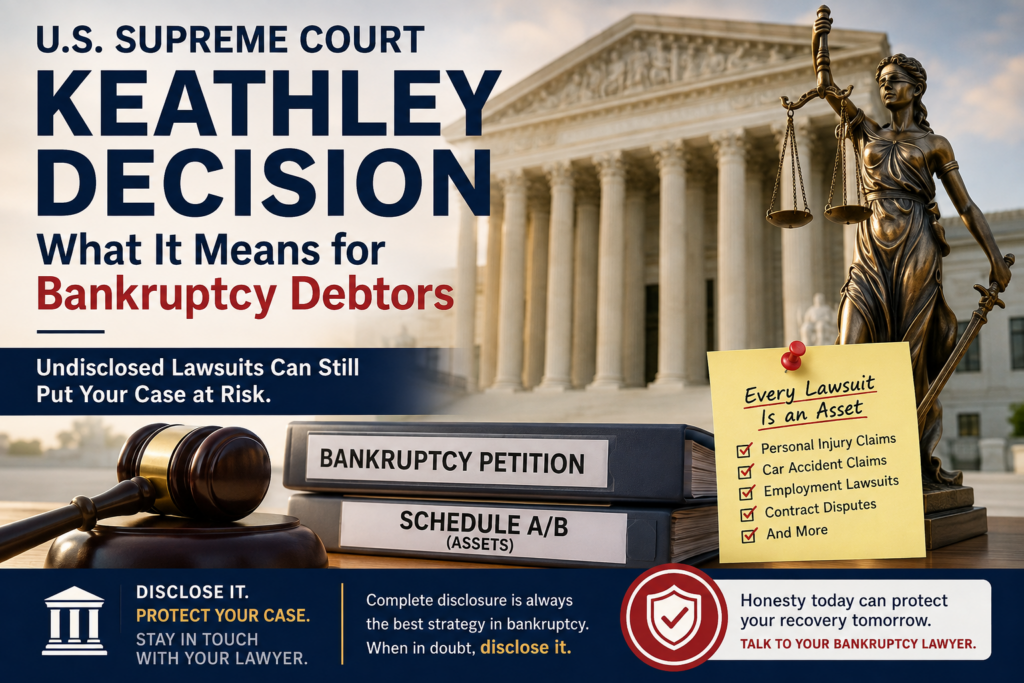
One of the most common mistakes I see in bankruptcy cases has nothing to do with credit cards, medical bills, or mortgages. It involves lawsuits and personal injury claims that debtors simply forget—or fail—to disclose in their bankruptcy case.
The United States Supreme Court recently addressed this issue in Keathley v. Buddy Ayers Construction, Inc., a unanimous decision that will undoubtedly become an important case in both bankruptcy and civil litigation. While the decision provides some welcome flexibility for honest debtors who make genuine mistakes, it should not be viewed as permission to leave claims off your bankruptcy schedules. If anything, it reinforces why complete disclosure is always the safest course.
Every Lawsuit Is an Asset
Many people don’t realize that a personal injury claim, employment lawsuit, contract dispute, or any potential right to recover money is considered an asset in bankruptcy.
That means if you have:
- A pending personal injury claim,
- A car accident claim,
- A workers’ compensation matter,
- A discrimination lawsuit,
- A breach of contract claim,
- Or even a claim you have not yet filed,
it generally must be disclosed on Schedule A/B of your bankruptcy petition.
This is true even if the lawsuit has not yet been filed or no settlement offer has been made.
The Problem with Failing to Disclose
For years, debtors who failed to disclose a legal claim often faced devastating consequences.
Defense attorneys routinely searched bankruptcy filings. If they discovered that the plaintiff had failed to disclose the lawsuit as an asset, they would argue that the plaintiff should be barred from pursuing the claim under the doctrine of judicial estoppel.
Although people sometimes loosely refer to this as “collateral estoppel,” the doctrine typically applied in these cases is judicial estoppel. Collateral estoppel generally prevents parties from relitigating issues that have already been decided by a court, while judicial estoppel prevents a party from taking inconsistent positions in different court proceedings.
The argument was simple:
- In bankruptcy, the debtor told the court, under penalty of perjury, that no such asset existed.
- Later, in another court, the same debtor claimed to have a valuable lawsuit.
Defense lawyers argued that the plaintiff should not be allowed to “have it both ways.”
Unfortunately, courts often agreed.
The Sixth Circuit Has Been Tough
Here in Michigan, bankruptcy practitioners have long warned clients about this issue because Sixth Circuit decisions have frequently allowed judicial estoppel arguments when debtors failed to disclose pending claims.
In many cases, defendants were able to seek dismissal of lawsuits simply because the claim had not been listed in the bankruptcy schedules. That could leave an injured plaintiff with no recovery at all—even when the underlying injury claim had merit.
The lesson was clear then, and it remains clear today:
Disclose every possible claim.
What Did the Supreme Court Decide?
In Keathley, the debtor filed Chapter 13 bankruptcy and later suffered injuries in an automobile accident while the bankruptcy case remained open.
He informed his bankruptcy attorney about the accident, but the claim was never disclosed to the bankruptcy court. When he later filed a personal injury lawsuit, the defendant argued that judicial estoppel automatically barred his case because the claim had not been disclosed.
The Supreme Court rejected the Fifth Circuit’s rigid approach.
Instead of automatically assuming bad faith whenever a debtor knew about the claim and had some theoretical motive to conceal it, the Court held that judges must examine the totality of the circumstances to determine whether the omission was truly inadvertent or mistaken.
That is an important clarification.
It means courts should look at the entire picture rather than applying a mechanical rule that punishes every omission the same way.
But Don’t Misread Keathley
Some headlines have suggested this is a major victory for debtors.
It certainly gives courts more flexibility to distinguish honest mistakes from intentional concealment.
But Keathley does not eliminate the duty to disclose assets.
The Bankruptcy Code still requires complete disclosure.
The bankruptcy schedules are signed under penalty of perjury.
Failing to disclose a claim can still create enormous problems, including:
- Motions based upon judicial estoppel;
- Loss of credibility before both courts;
- Trustee involvement;
- Delays in settlements;
- Litigation over ownership of the claim; and
- In extreme cases, allegations of bankruptcy fraud.
No Supreme Court decision changes those obligations.
Chapter 13 Debtors Must Stay in Touch With Their Lawyer
This issue comes up especially often in Chapter 13 cases because they remain open for three to five years.
A great deal can happen during that time.
You may:
- Be involved in an automobile accident.
- Develop a medical malpractice claim.
- Become entitled to an inheritance.
- Receive a settlement offer.
- File an employment lawsuit.
When any significant financial event occurs during an open Chapter 13 case, contact your bankruptcy attorney immediately.
Do not assume your personal injury attorney will notify the bankruptcy court.
Do not assume someone else is handling it.
Do not assume that because your case was confirmed several years ago, you no longer have reporting obligations.
Ask your bankruptcy lawyer first.
My Advice
After filing more than 25,000 consumer bankruptcy cases over the years, I can tell you that the easiest bankruptcy problems to solve are the ones we know about early.
If you think you might have a lawsuit—or if something happens after your bankruptcy is filed—tell your attorney.
There is rarely any downside to disclosure.
There can be tremendous downside to silence.
The Supreme Court’s decision in Keathley recognizes that honest mistakes happen and that courts should evaluate the full circumstances before applying judicial estoppel. That is a welcome development.
But the safest practice has not changed.
When in doubt, disclose it.
That one phone call to your bankruptcy attorney could protect both your bankruptcy discharge and your right to recover on a valuable legal claim.