Creditor Contacts After Bankruptcy Is Filed: What Should You Do?

Published
One of the biggest changes I have seen in consumer bankruptcy practice since I first started practicing in the early 1990s is the way creditors communicate with people who owe them money.
Back when I started practicing, if you were behind on a credit card, medical bill, personal loan or other debt, you might receive a collection letter. More likely, you would receive a telephone call from an actual human being working for the creditor or collection agency.
Today, things are very different.
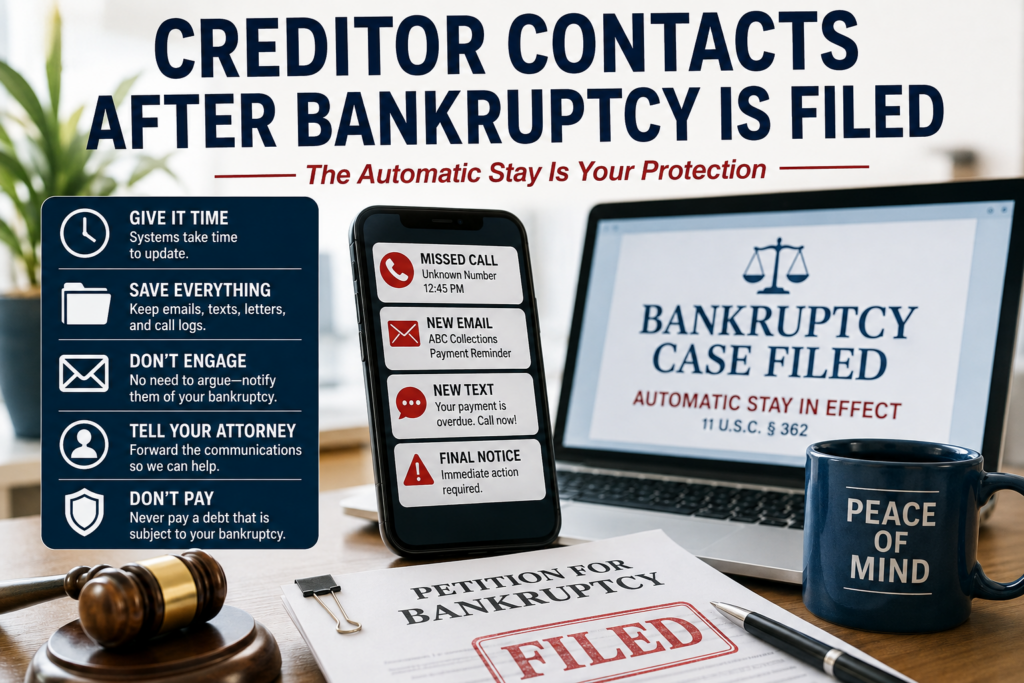
My clients frequently tell me that before filing bankruptcy they were subjected to a constant barrage of computer-generated collection calls. They receive calls from telephone numbers that seem to change constantly. They receive emails from different collection agencies representing the same creditor. They receive computer-generated text messages. They receive automated letters.
It can seem as though the creditor’s computer system never sleeps.
Fortunately, one of the major benefits of filing bankruptcy is the automatic stay.
Table of Contents
- What Happens to Creditor Collection Efforts When Bankruptcy Is Filed?
- Why Am I Still Getting Emails and Text Messages?
- Give It a Little Time
- What Should I Do If the Contacts Continue?
- What If the Creditor Says It Didn’t Know About the Bankruptcy?
- What Happens After the Bankruptcy Discharge?
- Don’t Pay a Debt Just Because a Computer Tells You To
- The Good News: Most of the Noise Usually Stops
- What I Tell My Clients
What Happens to Creditor Collection Efforts When Bankruptcy Is Filed?
When a bankruptcy petition is filed, the automatic stay generally goes into effect immediately. Under 11 U.S.C. § 362, the automatic stay prohibits most attempts to collect debts that arose before the bankruptcy filing.
The automatic stay is one of the most important protections provided by the bankruptcy laws.
It is designed to give a person who files bankruptcy a breathing spell from creditors.
That means creditors generally should not continue:
- Calling you demanding payment;
- Sending collection letters;
- Sending collection emails;
- Sending collection text messages;
- Garnishing your wages;
- Continuing collection lawsuits; or
- Taking other actions to collect a debt that is subject to the automatic stay.
There are exceptions to the automatic stay, and certain creditors may ask the bankruptcy court for permission to proceed with collection activity. Secured creditors, for example, may seek relief from the stay under appropriate circumstances.
But for the ordinary unsecured creditor trying to collect an ordinary pre-bankruptcy debt, the bankruptcy filing generally means that collection activity needs to stop.
Why Am I Still Getting Emails and Text Messages?
This is where things get interesting.
Sometimes the creditor does not immediately stop contacting you.
That does not necessarily mean that your bankruptcy filing has failed to protect you.
Modern collection systems are often automated. A creditor may have one computer system handling its accounts, another system handling email, another system handling text messages and another system being used by a collection agency.
The creditor may receive the bankruptcy notice and stop its primary collection activity, while an automated system continues to send messages that were already scheduled.
I have seen this happen many times.
A client will call me and say:
“I filed bankruptcy. Why am I still getting these texts?”
Or:
“I received another email from the collection agency this morning. Don’t they know I filed bankruptcy?”
Sometimes the answer is simply that the creditor’s automated system has not caught up with the bankruptcy filing yet.
Give It a Little Time
The first thing I generally tell my clients is don’t panic over the first automated message you receive after filing bankruptcy.
Give the system a little time to catch up.
Your bankruptcy case has just been filed. The bankruptcy court has to process the filing, notices have to be generated, and creditors have to receive and process the bankruptcy information.
The automatic stay is not dependent upon a creditor first receiving a letter from your attorney. It generally arises when the bankruptcy case is filed.
But there is a practical difference between what the law requires and how quickly a large creditor’s computer system actually updates.
So, if you receive one or two automated emails, texts or letters shortly after your bankruptcy is filed, save them, but don’t immediately assume that something has gone terribly wrong.
What Should I Do If the Contacts Continue?
If the collection activity continues after you have given the creditor a reasonable amount of time to process the bankruptcy, I recommend taking several steps.
1. Do Not Ignore the Communications
Don’t simply delete everything.
Save the emails.
Save the text messages.
Keep the collection letters.
Take screenshots of the messages on your telephone.
If you receive telephone calls, keep a record of the date, time, telephone number and name of the creditor or collection agency, if available.
Documentation can become very important if the collection activity continues.
2. Don’t Get Into an Argument With the Collection Agency
You generally don’t need to spend your time arguing with a collection representative.
You have already filed bankruptcy.
If the creditor is subject to the automatic stay, the important issue is documenting what is happening and making sure your bankruptcy attorney knows about it.
If you receive a call, you can simply tell the caller:
“I filed bankruptcy. My bankruptcy case number is ______. Please update your records.”
You do not need to spend 30 minutes arguing with a computer-generated collection system—or with the person who happens to answer the telephone.
3. Offer to Give the Creditor Your Bankruptcy Information
If a creditor or collection agency actually reaches you by telephone, I generally think it is reasonable to offer to provide the basic information they need to locate your bankruptcy case.
Tell them that you have filed bankruptcy and offer to provide your bankruptcy case number.
You can also give them the name and telephone number of your bankruptcy attorney and tell them that any further questions about the bankruptcy can be directed to your attorney.
For example, you can say:
“I have filed bankruptcy. My case number is __________. My attorney is Walter Metzen, and his telephone number is __________. Please update your records. If you have any further questions concerning my bankruptcy, please contact my attorney.”
You do not need to discuss the underlying debt, negotiate a payment, make promises to pay or argue about whether you owe the money.
The purpose of providing the case number and your attorney’s contact information is simply to help the creditor locate the bankruptcy case and communicate with the appropriate person if it has questions.
If the creditor continues contacting you after you have provided that information, document the contact and notify your bankruptcy attorney.
4. Forward the Communications to Your Bankruptcy Attorney
This is particularly important if the collection activity continues.
Send your attorney copies of the emails and collection letters. Take screenshots of the text messages and forward them to the attorney’s office.
If your attorney has instructed you to report creditor contacts through a particular method, follow those instructions.
Your attorney can then determine whether the communication appears to be an innocent automated contact that should stop shortly or whether further action is appropriate.
5. Make Sure the Creditor Was Properly Listed
Sometimes there is a simple explanation for continued collection activity.
For example, the creditor may not have been listed correctly in the bankruptcy schedules or the creditor’s address may not have been the correct address for receiving bankruptcy notices.
This is one reason it is so important to provide your bankruptcy attorney with complete and accurate information about your creditors when preparing your bankruptcy petition.
If a creditor continues contacting you, tell your attorney who the creditor is.
Let the attorney check the bankruptcy schedules and the bankruptcy court’s records.
6. Keep a Collection Log
If the calls and messages continue, keep a simple log.
Write down:
Date — Time — Creditor/Collection Agency — Telephone Number — Type of Contact — What Happened
For example:
August 25 — 9:14 a.m. — ABC Collections — 800-555-1234 — Automated text demanding payment — Screenshot saved.
You don’t have to create a complicated spreadsheet.
Just create a reliable record.
If the contacts become significant, your attorney will have much better information to work with if you can show exactly what happened and when.
What If the Creditor Says It Didn’t Know About the Bankruptcy?
That is something your bankruptcy attorney can address.
A creditor’s internal computer system may not have been updated yet. A debt may have been transferred to another collection agency. Or the creditor may have sold or assigned the account before the bankruptcy was filed.
Those situations can create communication problems.
This is another reason I tell my clients not to try to solve the entire problem themselves.
Tell your attorney.
Give the attorney the documentation.
Let the attorney determine what needs to be done.
What Happens After the Bankruptcy Discharge?
There is another important distinction between the automatic stay and the discharge injunction.
The automatic stay generally protects you from collection activity while the bankruptcy case is pending.
When you receive your bankruptcy discharge, 11 U.S.C. § 524 provides a permanent injunction against acts to collect a discharged debt as a personal liability.
In other words, the protection does not simply disappear when the bankruptcy case is closed.
If a creditor attempts to collect a debt that has been discharged, that is a different and potentially very serious issue.
Don’t Pay a Debt Just Because a Computer Tells You To
This is probably the most important practical advice I can give.
If you have filed bankruptcy and a computer-generated text message says:
“Your payment is overdue. Pay now.”
Don’t panic.
If you receive an email saying:
“Final notice before further collection action.”
Don’t panic.
If you receive a letter saying:
“Call us immediately to discuss your account.”
Don’t panic.
You filed bankruptcy for a reason.
The creditor’s computer system may simply not have caught up with your bankruptcy filing yet.
Save the communication and let your bankruptcy attorney know what happened.
The Good News: Most of the Noise Usually Stops
In my experience, one of the most noticeable benefits my clients experience after filing bankruptcy is the sudden reduction in creditor contacts.
Before bankruptcy, the telephone may have been ringing constantly.
There may have been text messages in the morning, emails during the day and collection letters in the mailbox.
Then the bankruptcy is filed.
The automatic stay goes into effect.
And, in most cases, the noise starts to disappear.
It may not happen instantaneously because of the automated systems I described above. But eventually the creditor databases are updated, the collection accounts are placed on bankruptcy hold, and the barrage generally stops.
That is one of the reasons bankruptcy can provide not only financial relief, but peace of mind.
What I Tell My Clients
After more than 30 years of practicing consumer bankruptcy law, I have learned that clients sometimes become frightened by something that is actually a routine part of the bankruptcy process.
My advice is simple:
Don’t ignore creditor contacts, but don’t panic about them either.
Give the bankruptcy filing a little time to work its way through the creditor’s computer systems.
Save any letters, emails and text messages.
Keep track of continued telephone calls.
If a creditor actually reaches you, provide your bankruptcy case number and, if appropriate, offer the name and telephone number of your bankruptcy attorney so the creditor knows where to direct any further questions.
Don’t make payments simply because an automated system demands one.
And most importantly, tell your bankruptcy attorney what is happening.
The bankruptcy laws are designed to give you relief from the collection pressure that led you to seek bankruptcy protection in the first place. The automatic stay generally stops collection activity when the case is filed, and the discharge provides an additional, permanent injunction concerning debts that are discharged.
If the computers keep talking after you have filed bankruptcy, don’t spend your time fighting with the computers.
Save the evidence, send it to your bankruptcy attorney, and let your attorney determine what needs to be done.
This article is intended for general informational purposes and is not legal advice. Bankruptcy law contains important exceptions and the way the automatic stay and discharge apply depends upon the facts of each individual case.ividual case.