Myth vs. Reality: You Will Never Have Credit Again After Filing Bankruptcy

Published

One of the biggest fears I hear from people considering bankruptcy is that filing Chapter 7 will permanently destroy their credit. They worry that they will never qualify for another credit card, never be able to finance a vehicle, and never be able to buy a home.
After 35 years of practicing bankruptcy law and representing more than 25,000 people, I can tell you that this is one of the biggest myths about filing bankruptcy.
The reality is that bankruptcy can give you the opportunity to rebuild your credit, eliminate overwhelming debt, and put yourself in a much better financial position than you were in before filing.
Table of Contents
- Myth: You Will Never Have Credit Again After Filing Bankruptcy
- Can You Get a Car Loan Immediately After Filing Bankruptcy?
- Can You Get Another Credit Card After Bankruptcy?
- How Long Does a Chapter 7 Bankruptcy Stay on Your Credit Report?
- Can You File Chapter 7 Bankruptcy More Than Once?
- How Long After Bankruptcy Can You Buy a Home?
- Is Your Credit Score Ruined Forever?
- Why Bankruptcy Can Be a Fresh Financial Start
- My Advice After 35 Years of Practicing Bankruptcy Law
- The Bottom Line: The Myth Is Not the Reality
Myth: You Will Never Have Credit Again After Filing Bankruptcy
Reality: You May Be Surprised by How Quickly Credit Becomes Available
Let’s start with something that surprises many of my clients. Nearly all of my clients receive offers for new credit cards, personal loans, or vehicle financing shortly after filing their Chapter 7 bankruptcy cases.
Why? Because lenders know that bankruptcy can eliminate a person’s existing unsecured debts and leave them with more money available to make payments on new obligations.
I sometimes tell my clients, half-jokingly, that the credit card companies want you back in the game!
Of course, there is a reason for all those offers. Lenders make money when people borrow money, pay interest, and carry balances. Some lenders specialize in offering credit to people who have recently filed bankruptcy, often at higher interest rates and with less favorable terms.
That is why I always caution my clients to be careful about accepting new credit offers. I am happy when my clients get a fresh financial start, but I do not want to see them immediately get buried in credit card debt all over again.
The goal of bankruptcy is not to eliminate your old debts so that you can accumulate a new pile of debt. The goal is to give you a chance to start over financially.
Can You Get a Car Loan Immediately After Filing Bankruptcy?
One of the most interesting things I have seen in my bankruptcy practice is how filing bankruptcy can actually make it easier for some people to obtain vehicle financing.
I have had many clients who were unable to finance a vehicle before filing bankruptcy because their credit was in such poor condition. They had maxed-out credit cards, unpaid medical bills, collection accounts, or other delinquent debts. Their credit reports made them look like a risky borrower.
Then they filed Chapter 7 bankruptcy.
In some cases, almost immediately after the bankruptcy was filed, those same clients were able to purchase and finance a vehicle.
Why does this happen? Before bankruptcy, a borrower may have numerous unpaid obligations and a poor payment history. After filing, the bankruptcy process can stop collection activity, and eligible unsecured debts may ultimately be discharged. Some auto lenders are willing to consider borrowers in this situation, even while the bankruptcy case is pending.
That does not mean everyone will qualify, or that the interest rate will be attractive. Some lenders require the bankruptcy case to be completed before approving financing, and others may offer loans at very high rates.
My advice is to shop carefully, compare the total cost of the loan, and avoid buying more vehicle than you can comfortably afford. A fresh start should help you improve your financial situation, not create another financial problem.
Can You Get Another Credit Card After Bankruptcy?
Absolutely. Many of my clients receive credit card offers shortly after filing Chapter 7.
Some lenders offer secured credit cards, which require you to provide a refundable deposit. Others offer unsecured credit cards, sometimes with relatively low credit limits and high interest rates.
Used responsibly, a credit card can help you begin establishing a positive payment history after bankruptcy. Paying the balance in full each month, keeping balances low, and making every payment on time can help you rebuild your credit profile.
However, you do not need to carry a credit card balance or pay interest to build credit. If you choose to obtain a card, use it for purchases you can afford and pay the statement balance in full whenever possible.
Be especially careful with cards that charge substantial annual fees, application fees, or other charges. Not every offer you receive after bankruptcy is a good deal.
Remember, just because a lender is willing to give you credit does not mean you should accept it.
How Long Does a Chapter 7 Bankruptcy Stay on Your Credit Report?
A Chapter 7 bankruptcy may remain on your credit report for up to 10 years from the filing date.
That fact often causes people to assume that they cannot obtain credit during those 10 years. But those are two entirely different things.
A bankruptcy appearing on your credit report does not automatically prevent you from obtaining credit.
I have represented numerous clients who filed a second Chapter 7 bankruptcy eight years after their first case. Between those two filings, these clients accumulated substantial credit card debt, obtained vehicle financing, and even obtained mortgage debt, despite the fact that their first Chapter 7 bankruptcy was still being reported on their credit reports.
Their experiences demonstrate an important point: lenders do not necessarily refuse to extend credit simply because a bankruptcy appears on a credit report. They consider other factors, including income, employment, existing obligations, payment history, credit scores, and the lender’s own underwriting requirements.
The fact that a bankruptcy remains on your credit report for 10 years does not mean you must wait 10 years before obtaining another credit card, financing a car, or buying a home.
Can You File Chapter 7 Bankruptcy More Than Once?
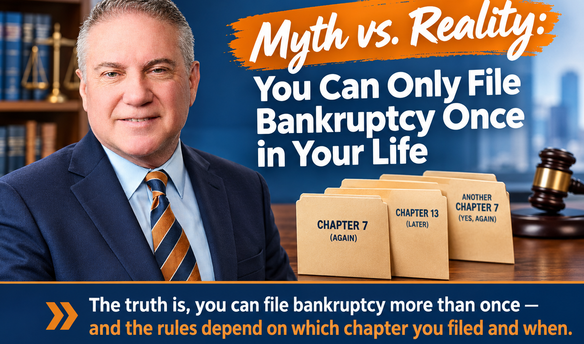
Yes, under the applicable rules, you can file Chapter 7 bankruptcy more than once.
Generally, a debtor who previously received a Chapter 7 discharge must wait eight years from the filing date of the first Chapter 7 case before filing another Chapter 7 case and becoming eligible for another Chapter 7 discharge.
There are important technical distinctions between filing a bankruptcy case and qualifying for a discharge, and other rules may apply depending on your prior bankruptcy history.
But the key point is that federal bankruptcy law does not limit you to filing bankruptcy only once in your lifetime.
In my practice, I have represented individuals and married couples who filed more than one bankruptcy case when circumstances required it. The fact that someone filed bankruptcy in the past does not automatically prevent that person from obtaining credit in the meantime.
Indeed, the ability to obtain new credit between cases is one reason the myth that bankruptcy permanently destroys your credit is simply not true.
How Long After Bankruptcy Can You Buy a Home?
This is one of the most common questions I receive from clients who want to eliminate their debts but eventually hope to purchase a home.
The answer depends on the type of mortgage you want, the date of your bankruptcy discharge, your financial circumstances, and the lender’s requirements.
As a general guide, the following waiting periods commonly apply to borrowers who have received a Chapter 7 discharge:
| Mortgage program | Typical waiting period after Chapter 7 discharge |
|---|---|
| FHA mortgage | 2 years |
| VA mortgage | 2 years |
| USDA mortgage | 3 years |
| Conventional mortgage backed by Fannie Mae | 4 years |
| Conventional mortgage backed by Freddie Mac | Generally 4 years |
These are general guidelines, not guarantees of approval. Exceptions may be available in certain documented circumstances, and individual lenders may impose additional requirements. The applicable program rules should always be verified when you are ready to apply.
For example, an FHA-insured mortgage generally requires a two-year waiting period after a Chapter 7 discharge, subject to limited exceptions. Conventional mortgages generally have longer waiting periods.
Keep in mind that the waiting period is only one part of qualifying for a mortgage. You will also need to meet the lender’s credit, income, employment, debt-to-income, and down-payment requirements.
During the waiting period, you can take practical steps to put yourself in a better position to qualify. Pay your bills on time, avoid taking on excessive new debt, save for a down payment and closing costs, and review your credit reports for errors.
You do not necessarily have to wait until the bankruptcy disappears from your credit report before you can buy a home. In many cases, borrowers can qualify for a mortgage years before the bankruptcy’s 10-year reporting period ends.
Is Your Credit Score Ruined Forever?
No. A bankruptcy can initially have a substantial negative effect on your credit score, particularly if you had a relatively high score before filing. But the impact varies from person to person.
For someone who already has severely delinquent accounts, collection judgments, maxed-out credit cards, and a history of missed payments, the credit picture may be very different from that of someone who had excellent credit before bankruptcy.
After filing, you can begin rebuilding by paying your remaining obligations on time, keeping credit card balances low, avoiding unnecessary applications for credit, and allowing your credit history to improve over time.
You should also check your credit reports to make sure debts discharged in bankruptcy are being reported accurately. A discharged debt may still appear on your report, but it should not be incorrectly reported as a currently owed balance or as a newly delinquent obligation.
There is no magic date when everyone’s credit suddenly improves. Rebuilding takes time, and individual results vary. Nevertheless, bankruptcy does not permanently prevent you from establishing a healthy credit history.
Why Bankruptcy Can Be a Fresh Financial Start
Think about what happens when someone is overwhelmed by unsecured debt.
Credit card balances continue to grow because of interest. Medical bills go unpaid. Collection agencies call. Lawsuits may be filed. Wages may be garnished. Even when someone makes regular payments, the balances can seem impossible to reduce.
Chapter 7 bankruptcy can eliminate qualifying unsecured debts, including credit card balances, medical bills, and personal loans. Certain debts, such as qualifying student loans, many domestic support obligations, and some taxes, may not be dischargeable. The outcome depends on the type of debt and the circumstances.
Once eligible debts are discharged, you may have substantially more income available to pay ordinary living expenses, save money, and plan for the future.
Instead of sending much of your paycheck to old creditors, you can begin building an emergency fund, saving for a vehicle, or preparing to buy a home.
That is the real benefit of bankruptcy. It is not simply about eliminating debt. It is about giving you an opportunity to regain control of your finances.
My Advice After 35 Years of Practicing Bankruptcy Law
I have seen firsthand how bankruptcy can help people move forward after years of financial difficulty. Many clients who were overwhelmed by debt go on to obtain credit cards, finance vehicles, and purchase homes.
Some eventually find themselves in circumstances that require a second bankruptcy filing. Others never need to file again. Every person’s financial situation is different.
What I tell my clients is straightforward: do not let the fear that you will never have credit again prevent you from exploring whether bankruptcy is the right option for you.
At the same time, do not mistake the availability of credit for financial success. Credit card companies and lenders may be willing to lend you money soon after bankruptcy, but your best financial decision may be to borrow less, save more, and avoid the debt problems that brought you to bankruptcy in the first place.
The purpose of Chapter 7 is to give you a fresh start, not a fresh set of financial problems.
The Bottom Line: The Myth Is Not the Reality
The myth is that filing bankruptcy means you will never have credit again.
The reality is that many people obtain new credit cards, finance vehicles, and qualify for mortgages well before the bankruptcy disappears from their credit reports.
A Chapter 7 bankruptcy can remain on your credit report for up to 10 years, but that does not mean you must go 10 years without credit. Nor does it mean your financial future is ruined.
After 35 years in bankruptcy practice, my message is simple: bankruptcy is not the end of your financial life. For many people, it is the beginning of a much better one.
If you are struggling with credit card debt, medical bills, personal loans, or collection actions, I encourage you to learn about your options before assuming there is no way out.
At the Law Offices of Walter Metzen, I help individuals and families understand Chapter 7 bankruptcy and determine whether it may be an appropriate solution for their financial circumstances. I offer free consultations by phone or in my office.
You may have more options than you realize.