Chime Credit Builder Accounts and Chapter 7 Bankruptcy: Why Some Debtors Cannot Access Their Own Money

Published
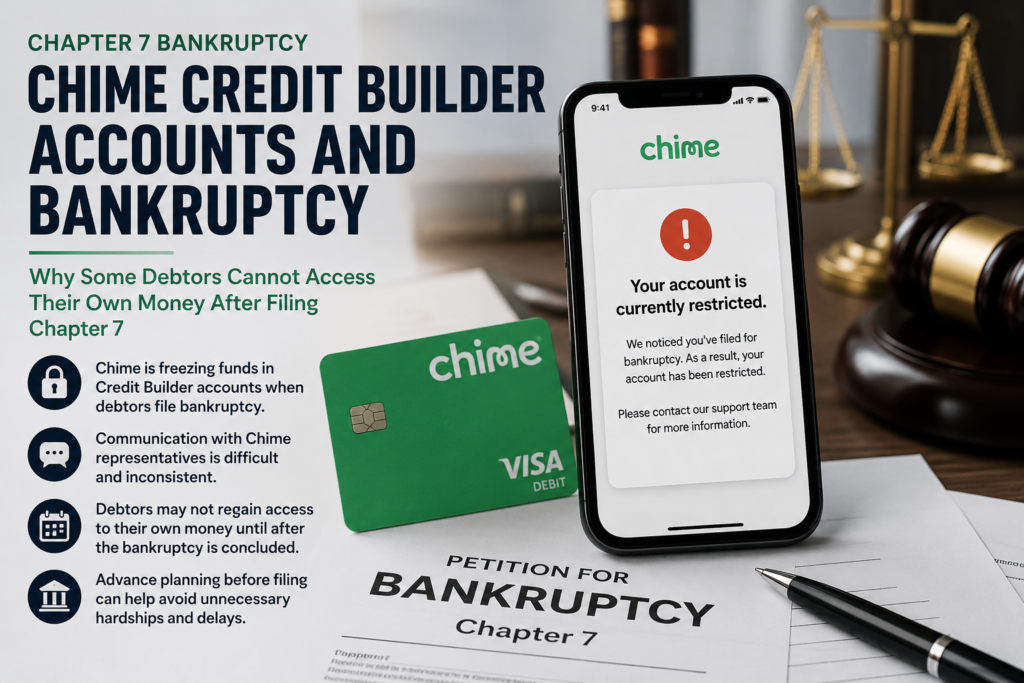
For many consumers, Chime® has become a popular alternative to traditional banking. Its Credit Builder account is marketed as a way to establish or improve credit while avoiding many of the fees associated with conventional banks. Unfortunately, we have recently seen an increasing number of Chapter 7 bankruptcy clients experience a frustrating problem: after filing bankruptcy, Chime freezes the money in their Credit Builder account and refuses to release it until the bankruptcy case is over.
If you are considering filing Chapter 7 bankruptcy and keep money in a Chime Credit Builder account, this issue is something you should discuss with your bankruptcy attorney before your case is filed.
Table of Contents
The Money Belongs to the Debtor
One of the most confusing aspects of this problem is that the money in a Chime Credit Builder account is the debtor’s own money.
Unlike a traditional credit card, the Credit Builder account is secured by funds that the customer has deposited. Those funds are not borrowed from Chime—they are the customer’s money.
In many Chapter 7 cases, those funds are:
- Fully protected by available bankruptcy exemptions.
- Listed on the bankruptcy schedules.
- Not subject to any claim by the Chapter 7 Trustee.
Despite this, many debtors report that they cannot access their own funds after filing bankruptcy.
Why Is Chime Freezing the Funds?
From what we have observed, Chime appears to take an extremely cautious approach whenever it learns that a customer has filed Chapter 7 bankruptcy.
Rather than determining whether the bankruptcy trustee actually has an interest in the funds, Chime often places a hold on the Credit Builder account until it believes the bankruptcy case has concluded or until it receives documentation that it considers sufficient to release the money.
Unfortunately, this can leave debtors without access to money they need for:
- Rent
- Utilities
- Gasoline
- Groceries
- Prescription medications
- Everyday living expenses
Ironically, these are precisely the types of financial hardships bankruptcy is intended to relieve.
Communication Can Be Extremely Difficult
One of the biggest complaints we have encountered is not merely the account freeze itself—it is the difficulty of getting meaningful assistance from Chime.
Customers frequently report that:
- Customer service representatives cannot explain exactly why the funds remain frozen.
- Representatives often provide inconsistent information.
- It can be difficult to reach someone with authority to resolve the issue.
- Requests for documentation or review may take weeks.
- Multiple phone calls and emails may produce little progress.
For someone who has just filed bankruptcy and needs immediate access to money for basic necessities, these delays can be incredibly stressful.
Your Bankruptcy Attorney May Also Experience Delays
Unfortunately, these communication difficulties can extend to bankruptcy attorneys as well.
Even after an attorney explains that the funds are exempt or that the Chapter 7 Trustee has no objection to the debtor accessing the account, obtaining a prompt resolution may still prove difficult.
Every additional day the account remains frozen can create unnecessary hardship for the debtor and the debtor’s family.
Can the Bankruptcy Trustee Release the Funds?
Generally speaking, the Chapter 7 Trustee does not “release” funds simply because a financial institution has chosen to freeze them.
If the money is properly exempt and the Trustee has no interest in administering it, there may be no legal reason for Chime to continue restricting access. Nevertheless, the institution may continue to require additional documentation before removing the hold.
This can create an unfortunate situation where everyone involved agrees the money belongs to the debtor, yet the debtor still cannot access it.
It is important to understand that a Chapter 7 Trustee’s job is not to act as the debtor’s personal attorney or advocate in disputes with financial institutions such as Chime. The Trustee’s primary duty under the Bankruptcy Code is to identify and collect any non-exempt assets that may be available for liquidation and distribution to unsecured creditors. If the Trustee determines that the funds in a Chime Credit Builder account are fully exempt or otherwise not property that will be administered for creditors, the Trustee has generally fulfilled his or her responsibility with respect to those funds. The Trustee is not obligated to contact Chime, negotiate with its customer service department, or write letters demanding that the account be unfrozen. Doing so falls outside the Trustee’s statutory duties and could be viewed as advocating for an individual debtor rather than remaining a neutral fiduciary for the bankruptcy estate and its creditors. As frustrating as this situation may be, debtors should not expect the Chapter 7 Trustee to intervene on their behalf in resolving disputes with Chime over access to their own funds.
Will the Debtor Ever Get Their Money Back?
The question most debtors ask is, “Will I ever get my money back?” Based on what we have seen so far, the answer appears to be yes, although the timing can be frustratingly slow. This appears to be a relatively new issue involving Chime Credit Builder accounts, and there is still very little published guidance regarding Chime’s internal procedures. Our expectation is that, once the Chapter 7 bankruptcy case has concluded, Chime will eventually release the funds to the debtor. In a typical Chapter 7 case, the bankruptcy discharge is entered approximately 60 days after filing, and the case often closes shortly thereafter.
Importantly, Chime is generally not a creditor with respect to the funds held in a Credit Builder account. Because the money belongs to the debtor and Chime is not owed that money, there does not appear to be a legal basis for Chime to permanently retain the funds. The real uncertainty is how Chime will ultimately return the money. It is currently unknown whether Chime will simply mail a check directly to the debtor after the bankruptcy case closes or, if the funds remain unclaimed for an extended period, whether Chime could instead remit the money to the unclaimed property (escheats) division of the state in which the debtor resides. Until Chime develops a more transparent and consistent process for handling these situations, debtors may unfortunately experience unnecessary delays in recovering funds that rightfully belong to them.
Planning Before Filing Bankruptcy
If you are thinking about filing Chapter 7 bankruptcy and have money in a Chime Credit Builder account, advance planning can be very important.
Depending upon your circumstances, your bankruptcy attorney may recommend discussing issues such as:
- Whether to leave funds in the Credit Builder account at filing.
- Whether another bank account would be more appropriate for future deposits.
- Timing of payroll deposits or government benefits.
- Ensuring sufficient funds are available for necessary living expenses after filing.
Every case is different, and these decisions should be made with the advice of experienced bankruptcy counsel.
The Bottom Line
The purpose of Chapter 7 bankruptcy is to give honest debtors a fresh financial start—not to leave them unable to buy groceries or pay rent because a financial institution has frozen money that belongs to them.
We have recently seen an increasing number of cases in which debtors with Chime Credit Builder accounts experience significant delays in regaining access to their own funds after filing bankruptcy. While every case is unique, consumers should be aware of this potential issue before filing and discuss it with their attorney during the planning stage.
Careful preparation before filing can often prevent unnecessary complications and help ensure that you have access to the money you need during one of the most important financial transitions of your life.
Disclaimer: This article is for general educational purposes only and is not legal advice. Bankruptcy laws and financial institution policies may change, and every case is unique. If you are considering filing Chapter 7 bankruptcy, consult with a qualified bankruptcy attorney regarding your specific circumstances.