What Is a Chapter 7 Trustee’s Application for Compensation, and Why Did I Receive One?

Published
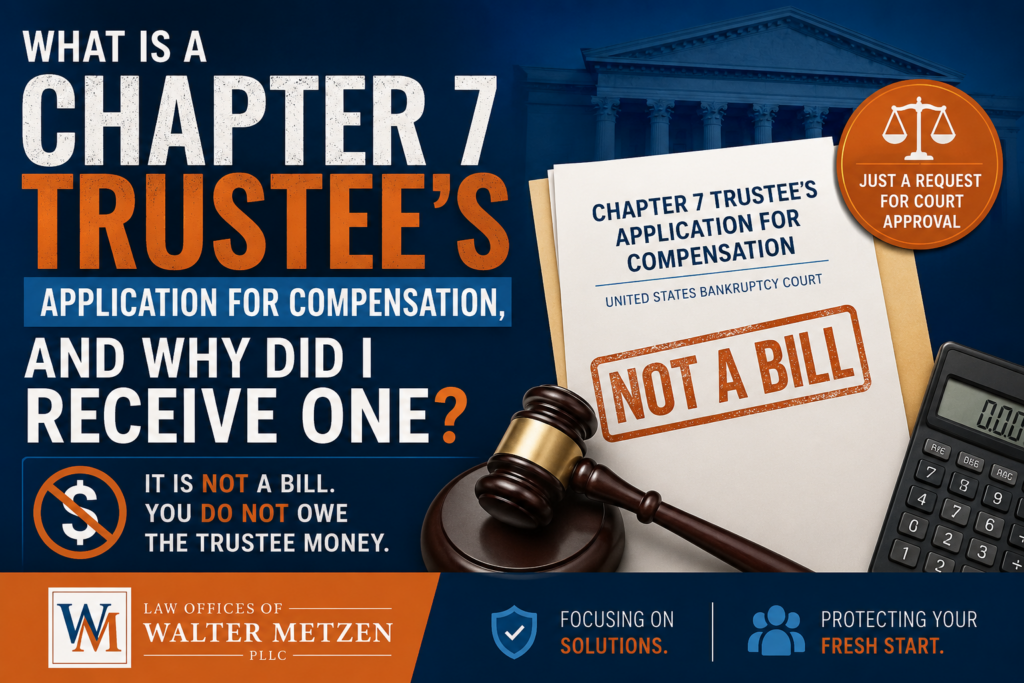
One of the most common phone calls I receive from former Chapter 7 clients goes something like this:
“Walter, I just received a document from the bankruptcy court called an ‘Application for Compensation’ from the Chapter 7 Trustee. Is this a bill? Do I owe the Trustee money?”
The good news is that in almost every consumer Chapter 7 bankruptcy case, the answer is no.
Let me explain what this document is and why you received it.
What Is a Chapter 7 Trustee?
When you file a Chapter 7 bankruptcy, the Bankruptcy Court appoints a Chapter 7 Trustee to administer your case. The Trustee’s job is to review your bankruptcy petition, conduct your Meeting of Creditors, determine whether there are any non-exempt assets that can be sold for the benefit of creditors, and make sure the bankruptcy laws are followed.
In the vast majority of Chapter 7 cases that I file, the Trustee determines that there are no non-exempt assets available for creditors. These are called “no-asset” cases.
Why Did I Receive an Application for Compensation?
The Trustee is not sending you a bill.
Instead, the Trustee is asking the Bankruptcy Court to approve payment of the compensation that the Bankruptcy Code allows for administering your case.
Federal law provides that Chapter 7 Trustees are entitled to receive compensation for performing their duties. Before that compensation can be paid, the Trustee must file an Application for Compensation with the Bankruptcy Court.
As a debtor, you receive a copy simply because you are a party to the bankruptcy case. The Bankruptcy Rules require that certain documents be served on all parties, even when they do not require any action on your part.
Think of it this way: you’re receiving a copy because the law requires notice—not because anyone expects you to pay anything.
Am I Personally Paying the Trustee?
In almost every Chapter 7 case, the answer is no.
The Trustee’s compensation generally comes from one of two sources:
- The filing fee that is paid when your bankruptcy case is filed, which includes a statutory amount paid to the Trustee in no-asset cases; or
- Funds recovered from non-exempt assets in cases where the Trustee collects money or property for the benefit of creditors.
That said, there are some Chapter 7 cases in which a debtor has already paid money to the Trustee or entered into a settlement agreement with the Trustee. For example, the Trustee may have asserted a claim to a non-exempt asset, a tax refund, an inheritance, or another asset of the bankruptcy estate. Rather than requiring the Trustee to sell the asset or pursue litigation, the debtor and the Trustee may reach an Offer in Compromise or other negotiated settlement in which the debtor pays an agreed-upon amount to the bankruptcy estate in exchange for resolving the Trustee’s claim.
If that occurred in your case, the Trustee’s Application for Compensation is still not a new bill and does not mean you owe additional money. It is simply the Trustee asking the Bankruptcy Court to approve the compensation that the Bankruptcy Code allows after administering the bankruptcy estate. Any payments you previously agreed to make under a court-approved settlement or compromise are entirely separate from the Trustee’s Application for Compensation.extraordinarily uncommon in an ordinary consumer Chapter 7 case.
Do I Need to File Anything?
Usually, no.
For most debtors, receiving the Application for Compensation is simply informational.
You can keep it with your bankruptcy papers and move on.
Unless I contact you and tell you otherwise, there is generally nothing you need to do.
Why Does the Court Have to Approve the Fee?
Bankruptcy Trustees cannot simply pay themselves.
Their compensation must be reviewed and approved by the Bankruptcy Court. The court examines the application to ensure that the requested compensation complies with the Bankruptcy Code and is appropriate under the circumstances.
This process helps ensure transparency and accountability in every bankruptcy case.
When Should I Contact My Attorney?
Although most Applications for Compensation require no action by you, you should contact my office if:
- The Trustee is asking you to turn over money or property.
- You receive a document that you do not understand.
- You receive something that appears to be a lawsuit or objection.
- You have any doubt about whether you need to respond.
I’d much rather answer a quick question than have you worry unnecessarily.
The Bottom Line
If you receive a Chapter 7 Trustee’s Application for Compensation, don’t panic.
It is not a bill.
It is not a demand for payment.
It is simply a request asking the Bankruptcy Court to approve the Trustee’s compensation as required by federal bankruptcy law. In nearly every consumer Chapter 7 case, you do not owe the Trustee anything beyond the filing fee that was addressed when your bankruptcy case was filed.
If you’re ever unsure about a document you receive after filing bankruptcy, don’t guess. Give my office a call. I’ll be happy to explain exactly what it means and whether you need to do anything—which, in the case of a Trustee’s Application for Compensation, is almost always nothing at all.