Chapter 13 Bankruptcy vs. Debt Management Plans: Why Court Supervision Can Make All the Difference

Published
If you have ever watched television or gone online looking for a way out of credit card debt, you have probably seen advertisements for debt management companies promising to help you become debt-free without filing bankruptcy.
The advertisements can be very appealing.
They often suggest that you can avoid bankruptcy, make one affordable monthly payment, and have the debt management company negotiate with your creditors to reduce your interest rates and help you pay off your debts.
But there is an important question that I think every person considering one of these programs should ask:
What happens if one of your creditors refuses to cooperate—or decides to sue you?
That is one of the fundamental differences between a debt management program and a Chapter 13 bankruptcy.
I have been practicing bankruptcy law for more than 30 years and have handled more than 25,000 consumer bankruptcy cases. In my experience, people sometimes come into my office after spending months or even years trying to make a debt management program work, only to discover that bankruptcy would have provided them with a much more structured and legally enforceable solution.
Table of Contents
- What Is a Debt Management Plan?
- Your Creditors Don’t Have to Participate in a DMP
- Chapter 13 Is Different
- You Don’t Have to Pay Everyone the Same Amount
- Chapter 13 Can Be an Excellent Way to Deal With Back Income Taxes
- What Happens to Your Credit Cards in Chapter 13?
- The Trustee Is the Middleman
- What If You Are Sued While You Are in a Debt Management Program?
- What Happens If You Can’t Finish the Debt Management Program?
- Chapter 13 Is Not a “Debt Management Company”
- Which Is Better?
- Don’t Let a Television Advertisement Make the Decision for You
What Is a Debt Management Plan?
A debt management plan, sometimes called a DMP, is generally an arrangement between you, a credit counseling or debt management organization, and your unsecured creditors.
The company reviews your income and expenses and develops a proposed monthly payment. You then make payments to the debt management company, which distributes the money to your creditors.
The company may be able to negotiate lower interest rates or have certain fees waived. The Federal Trade Commission explains that this is generally how a debt management plan operates: you deposit money with the counseling organization and the organization uses those deposits to pay your unsecured debts according to the plan.
That can work for some people.
But there is a major difference between a debt management plan and a Chapter 13 bankruptcy:
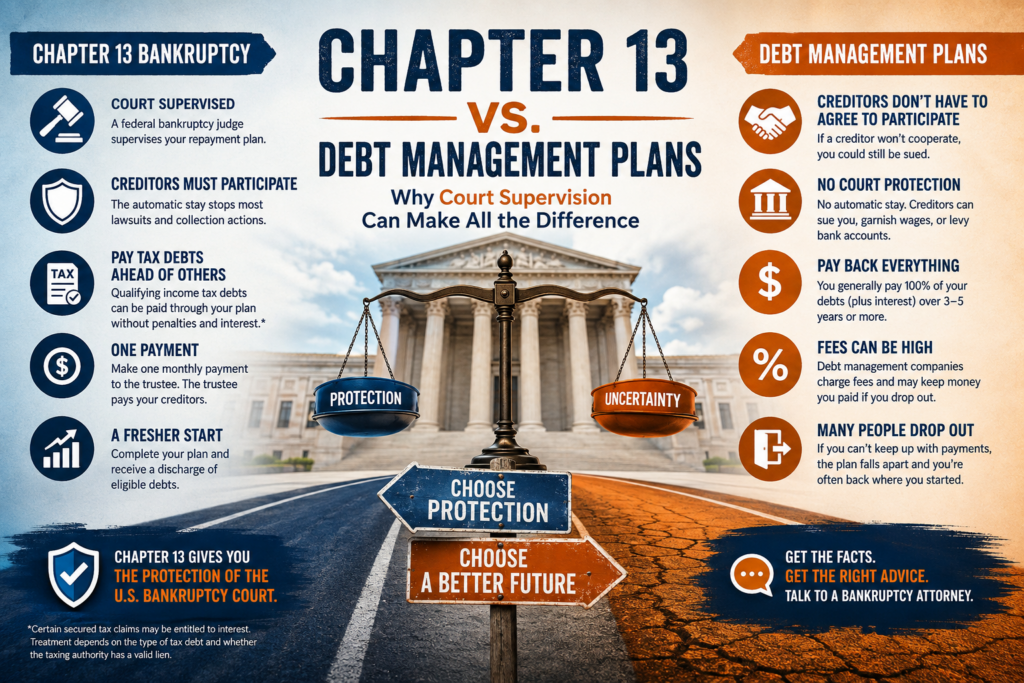
A debt management company does not have the power of the United States Bankruptcy Court behind its agreement.
Your Creditors Don’t Have to Participate in a DMP
This is something I think consumers frequently misunderstand.
When you enter a debt management program, you have not filed a lawsuit against your creditors. You have not obtained an order from a federal bankruptcy judge. You have not invoked the automatic stay of the Bankruptcy Code.
Your creditors generally have to agree to the proposed arrangement.
And if a creditor doesn’t agree—or later decides to stop participating—you may have a problem.
Most importantly, the creditor may still have the ability to pursue collection remedies, including filing a lawsuit.
I have had many people come into my office after telling me:
“I thought the debt management company was taking care of everything.”
Unfortunately, sometimes it wasn’t.
The debtor had been faithfully sending money to the debt management company while interest continued to accumulate on certain accounts, or a creditor was no longer cooperating, or a lawsuit had been filed.
The debtor is then faced with a difficult decision: continue trying to negotiate with the creditor or finally consider bankruptcy.
Chapter 13 Is Different
Chapter 13 is a court-supervised repayment plan.
That distinction is extremely important.
When a Chapter 13 bankruptcy is filed, the automatic stay generally stops creditors from continuing collection actions. The United States Courts explain that Chapter 13 allows an individual with regular income to repay some or all of his or her debts over a period that is generally three to five years, while creditors are prohibited from starting or continuing collection efforts during the case.
Instead of voluntarily asking your creditors to cooperate, you are using a federal bankruptcy law that requires your creditors to participate in the bankruptcy process.
The Chapter 13 trustee receives your plan payments and distributes the money to your creditors according to the Bankruptcy Code and the court-approved plan.
The plan is submitted to the Bankruptcy Court for confirmation.
The creditors receive notice.
They have an opportunity to file claims and object when appropriate.
And once the plan is confirmed, everyone knows what is supposed to happen.
That is a tremendous difference from simply hoping that every creditor will voluntarily cooperate with a debt management company.
You Don’t Have to Pay Everyone the Same Amount
Another important advantage of Chapter 13 is that bankruptcy law establishes different categories of debts.
There are generally secured debts, priority debts and unsecured debts.
The Bankruptcy Code requires priority claims to receive special treatment. Section 1322 requires a Chapter 13 plan to provide for payment in full of priority claims, unless the priority creditor agrees to different treatment.
This can be particularly important when someone owes income taxes.
Chapter 13 Can Be an Excellent Way to Deal With Back Income Taxes
I have represented many people who were overwhelmed not only by credit cards and other consumer debts, but also by unpaid income taxes.
Tax debts can be particularly troublesome because many tax obligations are not dischargeable in bankruptcy.
That doesn’t mean bankruptcy cannot help.
In fact, Chapter 13 can provide a very effective way of paying qualifying priority income tax debts over time while dealing with other unsecured debts at the same time.
Certain qualifying income tax claims are priority claims under the Bankruptcy Code. The IRS recognizes that Chapter 13 allows these priority tax claims to be paid through the Chapter 13 plan over time.
This can be enormously helpful to someone who simply cannot afford to write a check to the IRS for thousands—or tens of thousands—of dollars.
Instead, the tax debt can be incorporated into the Chapter 13 plan.
There is another important consideration.
The treatment of tax debt in bankruptcy is governed by the Bankruptcy Code, rather than by whatever payment arrangement you might be able to negotiate with the taxing authority.
However, I want to make an important qualification: it is not correct to say that every tax debt in Chapter 13 is automatically interest-free. Certain secured tax claims can be entitled to interest, and the treatment depends upon the type of tax debt and whether the taxing authority has a valid lien.
But properly structured Chapter 13 cases can provide significant relief from the accumulation of penalties and the collection pressure associated with old tax debts, while allowing qualifying priority tax claims to be paid through the plan.
That is something a typical debt management program cannot accomplish through the Bankruptcy Code.
What Happens to Your Credit Cards in Chapter 13?
Suppose you have $50,000 in credit card debt.
Under a debt management plan, you generally still owe that $50,000.
The debt management company may negotiate lower interest rates, but you are still attempting to pay the debts according to the negotiated arrangements.
In a Chapter 13 case, the treatment can be dramatically different.
Depending upon your income, expenses, assets, exemptions, applicable Bankruptcy Code requirements and the nature of your debts, you may not have to repay 100% of your unsecured debt.
Instead, the Chapter 13 plan determines how much money is available to unsecured creditors after the required payments are made to secured and priority creditors and the other expenses of the case are addressed.
The creditors receive what the Bankruptcy Code and the confirmed plan require—not necessarily what they originally demanded.
And after you successfully complete the Chapter 13 plan, qualifying remaining debts can be discharged.
The Trustee Is the Middleman
One of the things I like about Chapter 13 is the structure.
You make your required plan payment to the Chapter 13 trustee.
The trustee then distributes the money according to the confirmed plan.
You don’t have to send twenty different checks to twenty different creditors every month.
You don’t have to negotiate separately with every credit card company.
You don’t have to worry about whether one creditor has decided to stop accepting the debt management company’s arrangement.
The Chapter 13 plan establishes the rules.
The Bankruptcy Court supervises the process.
And the trustee administers the payments.
What If You Are Sued While You Are in a Debt Management Program?
This is one of the biggest problems I see.
A person enters a debt management program because they are trying to avoid bankruptcy.
They make their monthly payments.
They believe they are doing everything right.
Then they receive a summons from a creditor.
Now they have to defend a lawsuit while simultaneously continuing to make their debt management payments.
If the creditor obtains a judgment, the situation can become even more serious.
Depending upon the circumstances, the creditor may pursue collection remedies available under state law.
A Chapter 13 bankruptcy is different because the filing of the bankruptcy petition generally invokes the automatic stay, which prohibits most creditors from continuing collection actions while the stay remains in effect.
That is one of the most powerful protections available to someone who is financially overwhelmed.
What Happens If You Can’t Finish the Debt Management Program?
Another issue that deserves careful consideration is what happens if you simply cannot complete the program.
People sometimes enter debt management plans believing they will be able to make the payments for three, four or five years.
Then life happens.
They lose a job.
Their car breaks down.
They become sick.
Their mortgage payment increases.
They have an unexpected family expense.
Their income changes.
They simply cannot continue making the required monthly payment.
When a debt management program fails, the creditors may still be owed substantial amounts of money.
And the money already paid to the debt management company does not necessarily mean that you have eliminated your underlying debt.
There can also be fees associated with debt management services. The FTC specifically advises consumers to obtain written information concerning fees and to understand exactly what services they are paying for before entering into a program.
This is why I tell people to carefully examine the contract before committing to a debt management program.
Chapter 13 Is Not a “Debt Management Company”
Chapter 13 is something entirely different.
It is a federal bankruptcy proceeding.
You file a petition with the United States Bankruptcy Court.
A Chapter 13 trustee is appointed.
A repayment plan is proposed.
Creditors receive notice and have an opportunity to file claims and object.
The Court determines whether the plan can be confirmed.
And the trustee administers the payments.
The Bankruptcy Code specifically provides that the debtor’s future income necessary to fund the plan can be placed under the supervision and control of the trustee.
That court supervision is the key.
You are no longer simply asking your creditors to cooperate.
They are now dealing with a federal bankruptcy proceeding.
Which Is Better?
There is no universal answer.
Some people can successfully repay their debts through a debt management program and may have no need to file bankruptcy.
But I believe consumers should understand the difference before signing up for one.
If you are seriously behind on your debts, if creditors are threatening lawsuits, if you already have judgments, if you have significant tax debt, or if your monthly debt payments are simply more than you can afford, Chapter 13 may provide protections and benefits that a debt management program cannot provide.
Chapter 13 can allow you to:
- Stop most collection lawsuits through the automatic stay.
- Stop most creditor collection activity.
- Repay qualifying priority tax debts through the plan.
- Deal with secured debts and arrearages in a structured manner.
- Potentially repay only a portion of your unsecured debt.
- Make one court-supervised plan payment rather than negotiating separately with each creditor.
- Receive a discharge of qualifying debts after successfully completing the plan.
Most importantly, Chapter 13 gives you something that a debt management company cannot give you:
the protection and authority of the United States Bankruptcy Court.
Don’t Let a Television Advertisement Make the Decision for You
Debt management companies spend a great deal of money advertising because there is a huge market of people who are struggling with debt.
There is nothing wrong with investigating your alternatives.
But don’t assume that avoiding the word “bankruptcy” automatically makes a debt management program better.
Sometimes bankruptcy is exactly what the law was designed to provide.
I have been representing people in bankruptcy for more than 30 years. I have seen people spend years trying to manage debts that were simply too large for their income.
If you are considering a debt management program, talk to a bankruptcy attorney before you sign the contract.
You may discover that Chapter 13 is not the financial failure you thought it was.
It may actually be the legal tool that allows you to finally get control of your finances.
This article is for general informational purposes only. Every Chapter 13 case is different, particularly when tax debts, tax liens, secured debts and priority claims are involved. You should consult with a qualified bankruptcy attorney about your particular circumstances before deciding how to deal with your debts.