Is the Chapter 7 Means Test Unfair to People Who Live Frugally?

Published
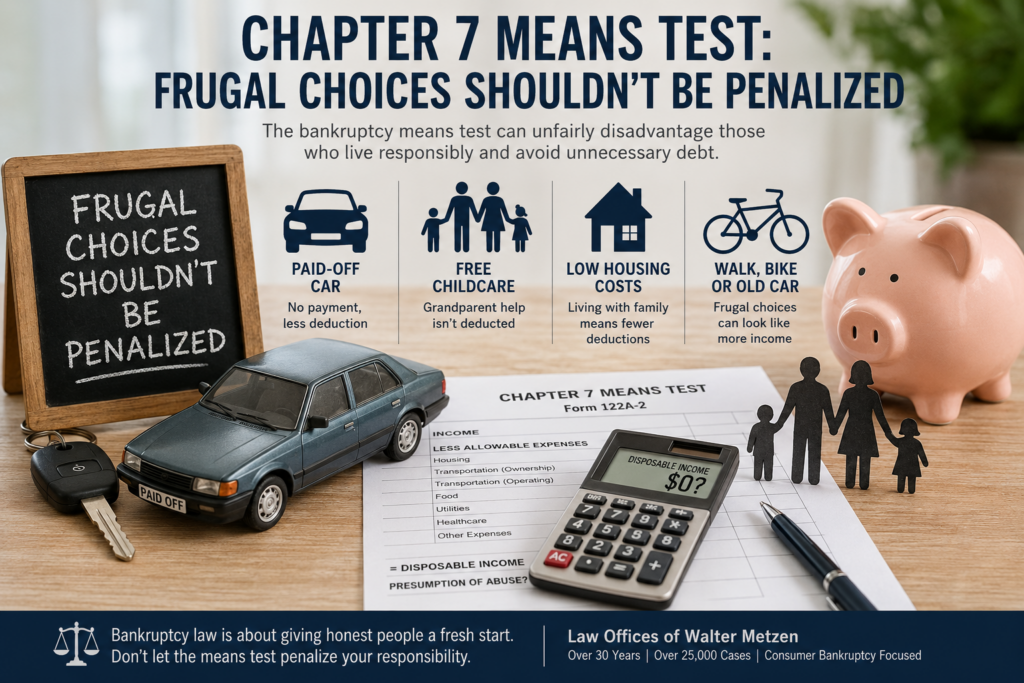
One of the most frustrating things I see in my bankruptcy practice is a situation where a person or married couple has done exactly what most of us were taught to do: live within their means, avoid unnecessary debt, keep an old car running, and make do with what they have.
Then they come to my office and discover that their frugality can actually make it harder to qualify for Chapter 7 bankruptcy.
That may sound strange, but it can happen because of the way Congress designed the Chapter 7 means test.
The means test is supposed to determine whether a person has enough disposable income to repay a meaningful portion of his or her unsecured debts. If the calculation produces enough disposable income, there can be a presumption that filing Chapter 7 would be an abuse of the bankruptcy system. The Bankruptcy Code specifically directs the calculation to use IRS National and Local Standards for many expenses.
The problem is that these standardized calculations do not always reflect the economic reality of an individual family.
And sometimes, the people who have been the most financially responsible can be the ones who get hurt.
Table of Contents
- The Paid-Off Car Problem
- The Couple With One Car
- Ownership Expense and Operating Expense Are Different
- What About the Family That Provides Free Childcare?
- The Person Who Lives With a Relative
- The Person Who Walks, Bikes or Uses an Old Car
- The Family That Avoids Debt
- Not Every Frugal Choice Hurts You
- What If You Fail the Means Test?
- The Bottom Line
The Paid-Off Car Problem
Let me give you a very common example.
Suppose a married couple has two older cars. They have maintained those cars for years, paid them off long ago, and continue driving them because there is nothing wrong with them.
They do not have car payments.
They are probably spending far less each month on transportation than a couple who has recently purchased two new vehicles.
You might think that would help them pass the means test.
Unfortunately, it can work the other way.
The transportation portion of the means test has two different components:
- Vehicle ownership or lease expense, and
- Vehicle operating expense.
Those are not the same thing.
The operating expense is intended to account for things such as gasoline, maintenance, repairs, insurance, registration, licensing, inspections, parking and tolls.
The ownership expense is a separate standardized expense associated with the financing or leasing of a vehicle.
The current bankruptcy means-test form expressly provides that a debtor may not claim the vehicle ownership or lease expense if the debtor does not make a loan or lease payment on the vehicle.
That means someone who owns an older vehicle free and clear may receive less of a transportation deduction than someone who has a newer vehicle with a substantial monthly payment.
That is a difficult result to explain to a client.
The Couple With One Car
The situation can be even more striking with a married couple.
Suppose a husband and wife have always shared one older vehicle.
They have arranged their schedules around that one vehicle. One spouse takes the other to work, they use the vehicle for shopping and appointments, and they have managed to avoid taking on another car loan.
Compare that with another couple with similar income who each have a newer vehicle with a monthly loan or lease payment.
The second couple may have significantly greater transportation deductions available in the means-test calculation.
The first couple has been frugal.
The second couple has taken on substantially more debt.
Yet the means-test calculation can make the first couple look as though it has more disposable income.
That is one of the reasons I tell clients that the means test is a legal formula—not a perfect measurement of how much money a family actually has available to pay its creditors.
Ownership Expense and Operating Expense Are Different
This distinction is important.
The IRS transportation standards separate the costs of operating a vehicle from the ownership component. The U.S. Trustee Program explains that the transportation standards contain both a nationwide ownership component and regional operating-cost component.
Operating costs include expenses such as:
- gasoline;
- maintenance;
- repairs;
- insurance;
- registration and licensing;
- inspections;
- parking; and
- tolls.
The ownership component is treated differently.
Under the current rules used for bankruptcy means testing, if you have a vehicle but do not have a loan or lease payment, you generally cannot claim the ownership portion of the transportation standard.
And this is not simply an issue of what the IRS does when collecting taxes. The bankruptcy statute incorporates the IRS National and Local Standards into the means test. The U.S. Trustee Program specifically publishes the figures for use in completing bankruptcy forms.
The Ransom Case Changed the Law
There is an interesting history behind this.
The Sixth Circuit Bankruptcy Appellate Panel had previously concluded in In re Kimbro that a debtor could claim the vehicle ownership expense even when the vehicle was owned free and clear.
That decision made sense from a practical standpoint. The court recognized that owning a vehicle involves costs even if there is no loan payment.
But the United States Supreme Court subsequently decided Ransom v. FIA Card Services, N.A.
The Supreme Court held that a debtor who owns a vehicle free and clear and makes no loan or lease payments cannot claim the ownership-cost deduction under the means test.
The Sixth Circuit subsequently recognized that Ransom had resolved the issue against the earlier Kimbro interpretation.
So today, a person who has worked hard to pay off an old car does not receive the same ownership deduction that someone making a qualifying loan or lease payment may receive.
That is simply the law as it currently stands.
What About the Family That Provides Free Childcare?
The automobile situation is not the only example of this problem.
Consider another very common family.
A husband and wife have two young children.
Instead of paying $1,500, $2,000 or more each month for daycare, the children’s grandmother watches the children while the parents work.
The grandmother does it for free.
From the family’s perspective, this is a tremendous financial benefit.
They are doing what families have done for generations—helping one another.
But if the family instead had to pay a daycare center $1,500 a month, that would be an actual necessary expense that could potentially be reflected in the means-test calculation.
The family receiving free childcare does not have a $1,500 expense to deduct.
Again, the family that has found a frugal solution can end up with a higher calculated disposable income.
That does not necessarily mean the family will fail the means test. There are many factors that go into the calculation. But it illustrates the larger problem: the means test is not necessarily measuring the family’s actual economic situation dollar for dollar.
The Person Who Lives With a Relative
Here is another example.
Suppose a person has been struggling financially and moves into a parent’s home.
The parent allows the debtor to live there for a modest amount of rent—or perhaps even allows the debtor to live there temporarily without paying rent.
The debtor is being responsible. Instead of taking on a $2,000 monthly apartment or mortgage obligation, the debtor is making do with what is available.
Housing and utilities are part of the Local Standards used in the means-test calculation, and the rules generally compare actual expenses with applicable standards.
As a result, a person with very inexpensive housing may have fewer actual housing expenses to account for than someone carrying a much larger housing expense.
Once again, the person who is spending less may appear to have more money available.
The Person Who Walks, Bikes or Uses an Old Car
Transportation provides another interesting illustration.
Someone who lives close to work may walk or ride a bicycle.
Another person may drive 40 miles each way in a newer vehicle with a substantial loan payment.
The first person is obviously spending less money.
But the means test is built around standardized categories rather than simply asking, “How much money did this person actually spend this month?”
The U.S. Trustee Program explains that the transportation standards are divided between ownership and operating expenses, and the rules differ depending upon whether the debtor owns a vehicle and whether there is a loan or lease payment.
This is one of the unavoidable limitations of a standardized test.
The Family That Avoids Debt
I see a similar issue with people who have made a conscious decision not to borrow money.
One family may put furniture, appliances and other necessities on credit cards.
Another family may buy used furniture, wait until it can afford an appliance, or simply do without.
The second family may have fewer monthly debt payments.
That is obviously good financial behavior.
But the means test is not designed to reward someone for having fewer financial obligations. It is designed to calculate disposable income using the categories and formulas established by Congress.
This is an important distinction.
The means test does not ask whether you have been financially responsible. It asks what your disposable income looks like under a very specific statutory formula.
Not Every Frugal Choice Hurts You
I do want to make an important clarification.
It would be incorrect to say that every person who spends less money automatically receives fewer deductions under the means test.
Some of the National Standards are specifically designed to operate as standardized allowances rather than simply reimbursing a debtor for every dollar actually spent.
For example, the U.S. Trustee Program explains that National Standards for food and clothing are standardized amounts based upon family size, and the bankruptcy standards also provide standardized amounts for certain out-of-pocket health-care expenses.
The problem is that different categories are treated differently.
That is why you cannot simply look at your household budget and assume that the means test will treat every expense—or lack of expense—the same way.
What If You Fail the Means Test?
This is perhaps the most important point I want to make.
Failing the means test does not necessarily mean that you cannot file Chapter 7.
The means test creates a presumption of abuse when the statutory calculation produces the required level of presumed disposable income. The Bankruptcy Code also provides circumstances in which that presumption may be rebutted, and the overall Chapter 7 analysis is more complicated than simply looking at one number on Form 122A-2.
There can also be situations in which a debtor’s circumstances have changed since the six-month income period used to calculate current monthly income.
For example:
- income may have recently decreased;
- overtime may have disappeared;
- a spouse may have lost employment;
- medical expenses may have increased;
- a necessary expense may have recently arisen;
- a vehicle may need substantial repairs;
- a debtor may have experienced a separation or other significant change in household circumstances.
These are matters that need to be carefully reviewed by an experienced bankruptcy attorney.
And if Chapter 7 ultimately is not available, Chapter 13 may provide another path to dealing with overwhelming debt.
The Bottom Line
I have been practicing bankruptcy law for more than 30 years, and I have seen thousands of people come into my office who have done their best to live within their means.
They bought an older car and paid it off.
They shared a vehicle with their spouse.
A grandparent watched their children rather than paying daycare.
They lived with a relative rather than taking on a large mortgage or rent payment.
They bought used rather than new.
They avoided borrowing whenever possible.
These are generally things we would encourage people to do.
Yet the bankruptcy means test is not designed to determine who has made the best financial decisions. It is a statutory formula that uses standardized expense categories and rules established by Congress.
Sometimes those rules produce results that seem counterintuitive.
A person who has a $700 car payment may have a transportation deduction that is unavailable to someone driving a 15-year-old car that is paid for.
A family paying substantial daycare may have an expense that a family relying upon free grandparent childcare does not have.
A person paying substantial housing expenses may have deductions that are unavailable to someone who has reduced housing costs by living with family.
That can seem unfair—and, from the standpoint of ordinary household economics, sometimes it is.
But this is exactly why I do not recommend that someone determine whether bankruptcy is right for them simply by filling out an online means-test calculator.
The means test is complicated, and the consequences of getting the analysis wrong can be significant.
If you are considering bankruptcy and are concerned that you make too much money to qualify for Chapter 7, do not assume that you are automatically disqualified. Your income, household size, debts, expenses, vehicles, housing situation and other circumstances all need to be examined together.
The 2026 bankruptcy standards have been updated by the U.S. Trustee Program, with the current IRS expense data applying to cases filed on or after July 15, 2026.
In my office, I take the time to look beyond the headline number and determine how the bankruptcy laws actually apply to the individual situation.
After more than 30 years of practicing bankruptcy law and handling more than 25,000 consumer bankruptcy cases, I have learned that there is rarely a substitute for sitting down with an experienced bankruptcy attorney and going through the numbers carefully.
This article is intended for general informational purposes and is not legal advice. Bankruptcy law is highly fact-specific, and the application of the means test can vary depending upon the debtor’s circumstances and the date the case is filed.