Can I Get Rid of My Car Loan in Bankruptcy Without Giving Up My Car?

Published
One of the most common misconceptions I hear from people considering Chapter 7 bankruptcy is that they can eliminate their car loan, stop making payments, and continue driving the same vehicle.
It sounds like a pretty good deal. After all, if bankruptcy can wipe out credit card debt, medical bills, personal loans, and other unsecured debts, why can’t you simply get rid of the debt on your automobile and keep the car?
Unfortunately, it doesn’t quite work that way.
The short answer is that you can usually eliminate your personal obligation to pay a car loan in Chapter 7 bankruptcy, but that does not necessarily eliminate the lender’s lien on your vehicle. And if you stop making payments, the lender will generally have the right to repossess the vehicle.
There are some exceptions, and there are several ways to deal with an automobile loan in Chapter 7 bankruptcy. Let’s look at how this works.
Table of Contents
- Why Can’t I Just Discharge My Car Loan and Keep My Car?
- Why Do Some Lenders Never Repossess Older Vehicles?
- Four Ways to Deal With an Automobile Loan in Chapter 7 Bankruptcy
- 1. Reaffirmation: Agreeing to Keep Paying the Car Loan
- 2. Redemption: Paying the Actual Value of the Vehicle
- 3. Ride-Through: Keeping the Car and Continuing to Make Payments
- 4. The Bankruptcy Discharge: What Happens to the Car Loan?
- What I Usually Recommend to My Clients
- The Bottom Line: You Can Eliminate the Car Loan, But You May Not Be Able to Keep the Car
- Need Help With an Automobile Loan and Chapter 7 Bankruptcy?
Why Can’t I Just Discharge My Car Loan and Keep My Car?
The important distinction is between the debt you owe and the lien the lender has on your automobile.
When you purchase a vehicle using financing, the lender typically receives a security interest (lien) in the vehicle. This lien gives the lender the right to repossess the automobile if you default on the loan.
When you file Chapter 7 bankruptcy, the discharge order generally eliminates your personal legal obligation to pay the loan. However, the discharge does not automatically eliminate the lender’s lien.
In other words, bankruptcy can eliminate your obligation to pay the debt, but it doesn’t necessarily eliminate the lender’s right to take the collateral securing that debt.
This is a fundamental concept in bankruptcy law.
For example, let’s assume you owe $18,000 on a vehicle that is worth $12,000. You file Chapter 7 bankruptcy and receive your discharge.
The $18,000 personal obligation is discharged. However, the lender still has a lien against the vehicle. If you stop making payments, the lender can generally repossess it, subject to applicable bankruptcy and state-law requirements.
You cannot simply tell the lender that you no longer owe the money and that you intend to keep the car anyway.
Why Do Some Lenders Never Repossess Older Vehicles?
There is an interesting exception that sometimes causes confusion.
Occasionally, a debtor files Chapter 7 bankruptcy, stops making payments on an older automobile, and the lender never comes to pick it up.
Why?
Because repossessing a vehicle costs money.
The lender may have to pay for:
- The repossession company.
- Towing and transportation.
- Storage fees.
- Auction fees.
- Reconditioning and preparation for sale.
- Administrative expenses associated with the repossession and sale.
If the vehicle is old, has high mileage, or is in poor condition, the lender may determine that the amount it expects to recover at auction isn’t worth the expense of repossession.
For example, if a vehicle might bring only $1,500 at auction, the lender may decide that spending several hundred dollars or more to repossess, transport, store, and sell it simply doesn’t make economic sense.
I have seen situations where a debtor stops making payments, receives a bankruptcy discharge, and continues driving the vehicle for months or even years without the lender ever picking it up.
However, this is a business decision made by the lender, not a legal right given to the debtor by bankruptcy.
Most automobile lenders will eventually repossess a vehicle when the borrower stops making payments. You should never file bankruptcy assuming that your lender will decide not to pick up your automobile.
If you want to keep your vehicle, you need to understand the options available under the Bankruptcy Code.
Four Ways to Deal With an Automobile Loan in Chapter 7 Bankruptcy
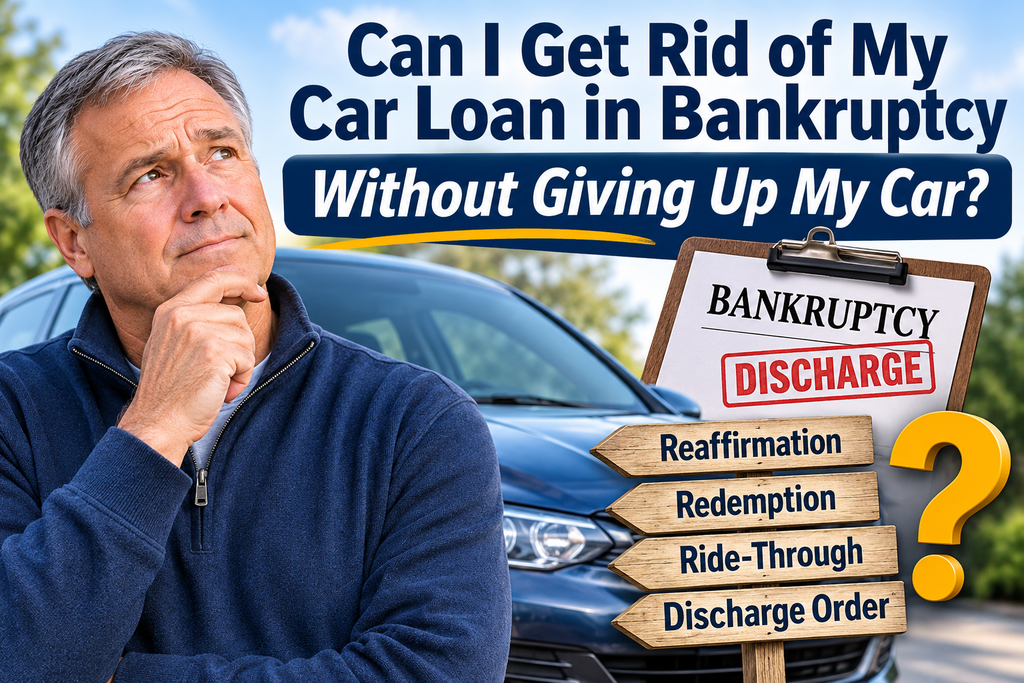
There are four terms you should understand when dealing with an automobile loan in Chapter 7:
- Reaffirmation.
- Redemption.
- Ride-through.
- Bankruptcy discharge.
Let’s examine each one.
1. Reaffirmation: Agreeing to Keep Paying the Car Loan
A reaffirmation agreement is an agreement between the debtor and the automobile lender in which the debtor agrees that the automobile loan will not be discharged in bankruptcy.
In exchange, the lender generally agrees to allow the debtor to retain the vehicle as long as the payments are maintained and the other loan obligations are satisfied.
Essentially, you are agreeing to remain personally responsible for the automobile loan even after your bankruptcy discharge.
This is an important decision because reaffirming a debt means that if you later default and the vehicle is repossessed, the lender may pursue you for the remaining deficiency balance.
For example:
- You owe $20,000 on your automobile.
- You reaffirm the $20,000 loan.
- You continue making payments after bankruptcy.
- Six months later, you lose your job and cannot afford the payments.
- The lender repossesses the vehicle and sells it for $12,000.
You could potentially remain personally responsible for the $8,000 deficiency, plus allowable costs and expenses.
Had you not reaffirmed the loan, your personal obligation to pay that deficiency generally would have been discharged in bankruptcy.
This is why I am often cautious about recommending reaffirmation agreements.
I have represented thousands of people in bankruptcy, and I have seen how circumstances can change. Someone who can comfortably afford a car payment today may not be able to afford it six months from now.
Reaffirmation should be considered carefully because it gives up one of the most important benefits of the bankruptcy discharge: protection from personal liability for the automobile debt.
There are circumstances where reaffirmation makes sense, but it should not be automatic.
2. Redemption: Paying the Actual Value of the Vehicle
Redemption is another option available under Section 722 of the Bankruptcy Code.
It allows an individual Chapter 7 debtor to keep certain personal property, including an automobile, by paying the secured creditor the vehicle’s current replacement value in a lump sum rather than paying the full loan balance.
Let’s say you owe $22,000 on your automobile, but its current replacement value is only $13,000.
Under the redemption provisions of the Bankruptcy Code, you may be able to pay the lender $13,000 and eliminate the remaining secured debt, assuming the statutory requirements are satisfied.
The lender’s lien is then released upon completion of the redemption.
This can be an excellent option for someone who owes substantially more than the vehicle is worth.
The problem?
You generally have to come up with the redemption amount in one lump sum.
Most people filing Chapter 7 bankruptcy don’t have an extra $13,000 sitting in their bank account.
There are companies that specialize in providing redemption financing, although the availability and terms of that financing will depend on the circumstances.
Redemption can be particularly attractive when someone has a relatively expensive automobile loan and is significantly upside down on the vehicle.
3. Ride-Through: Keeping the Car and Continuing to Make Payments
This is probably the most commonly used approach for people who want to keep their automobile in Chapter 7 bankruptcy.
A ride-through generally means that the debtor continues making the regular automobile payments but does not sign a reaffirmation agreement.
In practical terms:
- You file Chapter 7 bankruptcy.
- Your personal obligation to pay the automobile loan is discharged.
- You continue making the monthly payments.
- You maintain the required insurance.
- You keep the vehicle as long as the lender permits you to do so.
The advantage is significant.
You retain the protection of the bankruptcy discharge because you have not agreed to reaffirm the debt.
If something happens down the road and you can no longer afford the payments, the lender can repossess the automobile, but generally cannot pursue you personally for a deficiency balance because that liability was discharged.
This is one of the reasons I frequently prefer the ride-through approach over reaffirmation when a client wants to retain a vehicle.
However, there is an important legal qualification.
The Bankruptcy Code does not expressly establish a universal right to ride through an automobile loan. The treatment of ride-through arrangements has been affected by amendments to the Bankruptcy Code and court interpretations.
Section 521(a)(2) requires individual debtors to state their intentions regarding secured personal property and generally to perform that intention within the statutory time period.
Courts have not treated ride-through identically in every jurisdiction, and individual lenders may have different policies concerning whether they will continue accepting payments and allowing the debtor to retain the vehicle without reaffirmation.
In practice, however, continuing to make payments without reaffirming remains a commonly used approach in Chapter 7 cases.
Before deciding on this approach, it is important to understand how the particular lender handles bankruptcy filings.
4. The Bankruptcy Discharge: What Happens to the Car Loan?
This brings us to the most important document you receive in a Chapter 7 bankruptcy case: the discharge order.
The discharge order is the federal court order that eliminates your personal legal obligation to pay dischargeable debts.
If you have an automobile loan and do not reaffirm it, the discharge generally eliminates your personal liability for the loan.
But remember the distinction we discussed earlier.
The discharge does not automatically eliminate the lien.
The lender generally retains its security interest in the vehicle and can enforce that lien if you default, subject to applicable law.
Here is how the different approaches compare:
| Option | Keep the vehicle? | Personal liability after bankruptcy? |
|---|---|---|
| Reaffirmation | Yes, if loan obligations are maintained | Yes |
| Redemption | Yes, after paying the redemption amount | No remaining personal liability on the redeemed debt |
| Ride-through | Generally, if lender permits and payments remain current | No, assuming no reaffirmation |
| Stop paying | Generally no; lender can repossess | Generally discharged |
What I Usually Recommend to My Clients
There is no one-size-fits-all answer when dealing with an automobile loan in Chapter 7 bankruptcy.
I look at several factors:
- How much do you owe on the automobile?
- What is the vehicle actually worth?
- Can you comfortably afford the monthly payment?
- Is the interest rate reasonable?
- Is the vehicle relatively reliable?
- Do you have significant negative equity?
- Are you current on the payments?
- Does the lender permit a ride-through without reaffirmation?
If the vehicle is worth approximately what you owe, and the payment is affordable, continuing to make payments without reaffirming may be the best approach.
If you owe substantially more than the vehicle is worth, redemption may be worth investigating.
If the payment is unaffordable, it may make more sense to surrender the vehicle, discharge the debt, and obtain a more affordable automobile after bankruptcy.
What I generally caution against is reaffirming an automobile loan simply because the lender wants you to sign the agreement.
Remember, the purpose of Chapter 7 bankruptcy is to give you a fresh financial start. Reaffirming a debt means voluntarily taking on personal liability that bankruptcy would otherwise eliminate.
You should have a good reason before giving up that protection.
The Bottom Line: You Can Eliminate the Car Loan, But You May Not Be Able to Keep the Car
One of the biggest misconceptions about Chapter 7 bankruptcy is that you can simply discharge your automobile loan and continue driving the vehicle without making payments.
That is generally not how it works.
You can eliminate your personal obligation to pay the automobile loan, but the lender’s lien generally survives the bankruptcy. If you stop making payments, the lender will usually repossess the vehicle.
On the other hand, if you want to keep your automobile and can afford the payments, there may be ways to do so without reaffirming the debt and giving up the protection of your bankruptcy discharge.
Understanding the difference between reaffirmation, redemption, and ride-through can make a substantial difference in your financial future.
Before signing a reaffirmation agreement, make sure you understand exactly what you are agreeing to. Once you reaffirm a debt, you may be giving up an important benefit of bankruptcy.
Need Help With an Automobile Loan and Chapter 7 Bankruptcy?
At the Law Offices of Walter Metzen, I have concentrated exclusively on bankruptcy law for more than 35 years. I have represented more than 25,000 people in bankruptcy matters and regularly help individuals throughout the Eastern District of Michigan deal with automobile loans, repossessions, reaffirmation agreements, and the decision of whether to keep or surrender a vehicle.
Every situation is different. The right decision depends on the vehicle, the loan balance, the lender, and your financial circumstances.
If you are considering Chapter 7 bankruptcy and have questions about keeping your automobile, I invite you to contact my office for a consultation.
Law Offices of Walter Metzen
Detroit Bankruptcy Lawyer
Phone: 313-962-4656
Website: www.detroitbankruptcylawyer.com
Attorney’s note: This article discusses general Chapter 7 principles. The treatment of automobile loans, reaffirmation agreements, and ride-through arrangements can depend on the applicable bankruptcy law, court decisions, and lender practices. An individual review of your circumstances is important before making a decision.