Personal Injury Attorneys: What You Need to Know About Bankruptcy Exemptions and Allocating Personal Injury Settlements Under 11 U.S.C. § 522(d)(11)(D)

Published
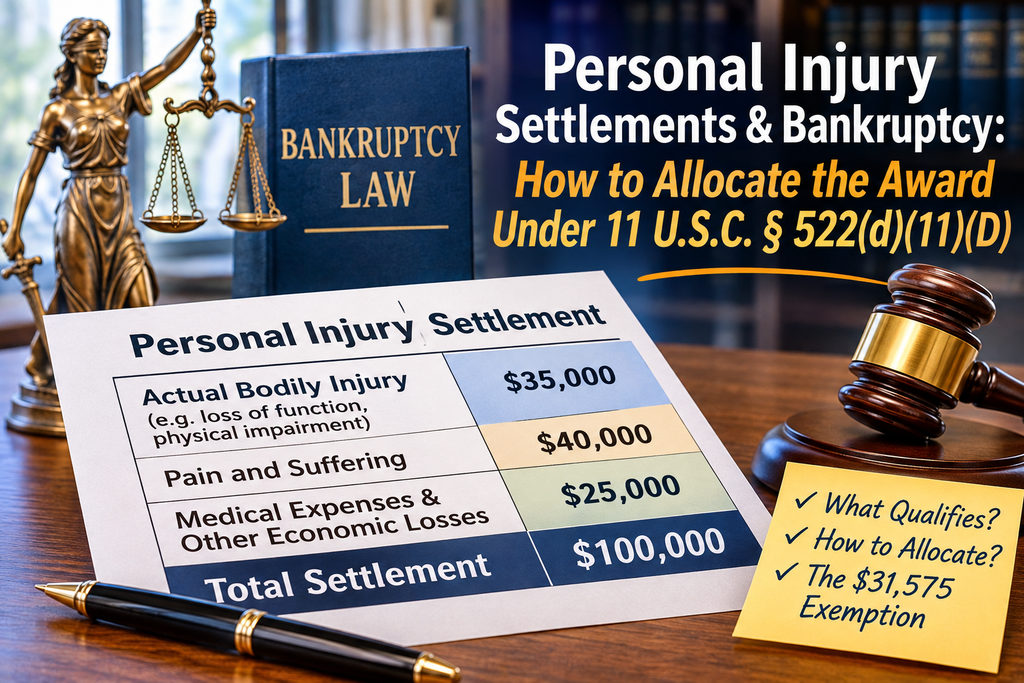
Table of Contents
- 1. Understanding the Federal Bankruptcy Exemption: 11 U.S.C. § 522(d)(11)(D)
- 2. Understanding the Difference Between Bodily Injury and the Other Elements of Damages
- 3. Why Settlement Allocation Is So Important
- 4. How Should a Personal Injury Attorney Allocate the Settlement?
- 5. Should You Allocate the Settlement Using Percentages?
- 6. What Documentation Should the Personal Injury Attorney Maintain?
- 7. What If the Client Has Already Filed Bankruptcy?
- 8. A Few Important Cautions
- 9. The Bottom Line: Personal Injury Attorneys Should Think About Bankruptcy Before Finalizing the Settlement
Why the way you allocate a personal injury settlement can make a significant difference when your client files bankruptcy.
Most personal injury attorneys understand how to evaluate an automobile accident claim, negotiate a settlement, and allocate damages among medical expenses, lost wages, pain and suffering, and other elements of a client’s injury.
But there is another issue that personal injury attorneys should understand, particularly when representing someone who has filed bankruptcy or may need to file bankruptcy: How is the personal injury settlement allocated, and what portion of that settlement might qualify for protection under the federal bankruptcy exemption found in 11 U.S.C. § 522(d)(11)(D)?
This is an area where personal injury law and bankruptcy law intersect, and the distinction can be extremely important to the client.
I have practiced bankruptcy law exclusively for more than 35 years, and I regularly encounter personal injury claims involving clients who are considering or have already filed Chapter 7 bankruptcy. Unfortunately, many personal injury attorneys are unfamiliar with the bankruptcy exemption rules, and settlement agreements frequently fail to distinguish between the different categories of damages in a way that is helpful when a bankruptcy trustee later examines the settlement.
This article is intended as a practical primer for personal injury attorneys. My goal is to explain what the exemption protects, what it does not protect, and why the allocation of settlement proceeds should be carefully considered before a settlement agreement is finalized.
1. Understanding the Federal Bankruptcy Exemption: 11 U.S.C. § 522(d)(11)(D)
The federal bankruptcy exemption provides protection for certain payments received because of personal bodily injury.
Specifically, 11 U.S.C. § 522(d)(11)(D) permits a debtor to exempt:
“A payment, not to exceed $31,575, on account of personal bodily injury, not including pain and suffering or compensation for actual pecuniary loss, of the debtor or an individual of whom the debtor is a dependent.”
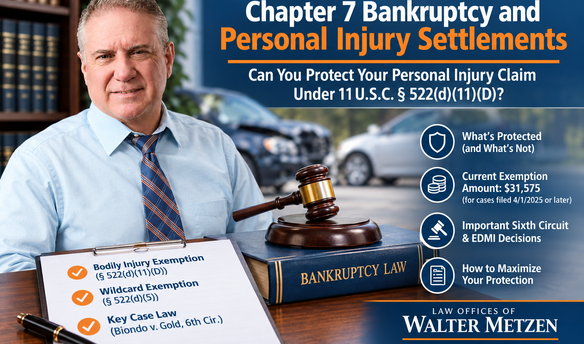
The current exemption limit is $31,575 for bankruptcy cases filed on or after April 1, 2025.
There are three important components to this statute:
- The payment must be on account of personal bodily injury.
- Compensation for pain and suffering is expressly excluded.
- Compensation for actual pecuniary loss is also expressly excluded.
The important point is that Congress did not intend this exemption to protect every dollar received in a personal injury settlement simply because the underlying claim involved physical injuries.
Instead, the exemption is directed toward compensation attributable to the actual bodily injury itself.
In the legislative history accompanying this provision, Congress used the loss of a limb as an example of the type of injury the exemption was intended to cover. The legislative history also makes clear that medical expenses, pain and suffering, and lost earnings are separate categories that are not protected under this particular exemption.
2. Understanding the Difference Between Bodily Injury and the Other Elements of Damages
This is probably the most important part of this discussion for personal injury attorneys.
A personal injury claim can involve several different categories of damages, all arising from the same accident. However, those damages are not necessarily treated the same way under the Bankruptcy Code.
Consider someone involved in a serious automobile accident who sustains a significant injury to an arm.
The claim might involve:
Actual bodily injury:
- Loss of a limb or body part.
- Loss of use of a body part.
- Physical impairment.
- Damage resulting in the loss or impairment of bodily function.
- Other actual physical injuries.
Pain and suffering:
- Physical pain.
- Emotional distress.
- Mental anguish.
- Discomfort associated with the injury.
- The loss of enjoyment of life attributable to the injury.
Actual pecuniary losses:
- Hospital and emergency room expenses.
- Medical treatment and physical therapy expenses.
- Prescription medication expenses.
- Out-of-pocket medical expenses.
- Lost wages and other actual economic losses.
Although all of these damages may arise from the same automobile accident, they are legally distinguishable for purposes of § 522(d)(11)(D).
The distinction is particularly important because the statute expressly excludes pain and suffering and actual pecuniary loss.
For example, if an individual sustains a permanent impairment of an arm, the physical impairment itself may constitute a qualifying bodily injury. The medical bills associated with treating that injury, the wages lost while recovering, and the pain and suffering experienced are separate categories.
The bankruptcy exemption is directed toward the bodily injury component, not all of the damages that flow from the injury.
I discussed this distinction in greater detail in my earlier article:
That article also discusses whether an injury must be permanent to qualify. The answer is no. The statute does not impose a permanency requirement, although the debtor must establish an actual bodily injury rather than merely subjective complaints or emotional distress.
3. Why Settlement Allocation Is So Important
Here is where personal injury attorneys can make a real difference for their clients.
Many settlement agreements simply provide for a lump-sum payment in exchange for a release of all claims. Others contain general language indicating that the settlement compensates the plaintiff for all injuries, damages, medical expenses, lost wages, pain and suffering, and other losses.
From a personal injury perspective, this may be perfectly understandable.
From a bankruptcy perspective, however, it can create a problem.
Suppose a client receives a $100,000 personal injury settlement. The client subsequently files Chapter 7 bankruptcy, and the bankruptcy trustee determines that the settlement proceeds constitute property of the bankruptcy estate.
The client claims the maximum $31,575 exemption under § 522(d)(11)(D).
But what portion of that $100,000 actually represents compensation on account of personal bodily injury?
If the settlement agreement does not identify the different elements of damages, the bankruptcy trustee may question whether any particular portion of the settlement qualifies for the exemption.
This is not merely a theoretical concern.
In Biondo v. Gold, Lange, Majoros & Smalarz, P.C., No. 22-1666 (6th Cir. 2023), the Sixth Circuit addressed personal injury settlements arising from an automobile accident and the availability of the § 522(d)(11)(D) exemption.
The settlements included compensation for medical expenses, attorney fees, lost wages, and other economic and noneconomic losses. The Sixth Circuit recognized that the trustee had reasonable grounds to question whether the settlements qualified for the bodily injury exemption because the settlement documentation did not specifically identify compensation for bodily injuries.
The court discussed the distinction between actual bodily injury and excluded damages, including medical expenses and pain and suffering.
Although Biondo did not establish a mandatory settlement-allocation formula, it illustrates precisely why the issue should be addressed before a settlement is finalized.
A personal injury attorney should not assume that a bankruptcy court will automatically accept the debtor’s position that the first $31,575 of any personal injury settlement is exempt.
4. How Should a Personal Injury Attorney Allocate the Settlement?
There is no universal percentage that applies to every personal injury settlement.
A settlement involving a broken arm, surgical repair, and permanent loss of function is obviously different from a settlement involving relatively minor soft-tissue injuries that resolve after several weeks of treatment.
The allocation should be based upon the actual injuries sustained and the evidence supporting the damages.
When negotiating or preparing a settlement agreement, personal injury attorneys should consider separately identifying:
A. Compensation attributable to actual bodily injury
This is the category relevant to § 522(d)(11)(D).
The attorney should evaluate the actual physical injury, its severity, the nature of the physical damage, any impairment or loss of function, and the medical evidence supporting the injury.
B. Compensation for pain and suffering
This category is expressly excluded from § 522(d)(11)(D).
Even though pain and suffering may represent a substantial portion of a personal injury settlement, it should not simply be included in the bodily injury allocation.
C. Compensation for medical expenses and other actual pecuniary losses
These amounts should also be separately identified.
Medical bills, physical therapy, prescription expenses, lost wages, and other actual economic losses are not protected by § 522(d)(11)(D).
Future lost earnings may present a separate question under § 522(d)(11)(E), which has its own requirements and limitations.
5. Should You Allocate the Settlement Using Percentages?
In many cases, a percentage allocation may be a practical way to document the different elements of a settlement.
For example, assume a personal injury attorney negotiates a $100,000 settlement.
The attorney might determine, based upon the actual injuries, medical records, treatment, and other available evidence, that the settlement reasonably reflects the following allocation:
| Category of damages | Allocation |
|---|---|
| Actual bodily injury | $35,000 |
| Pain and suffering | $40,000 |
| Medical expenses and other actual economic losses | $25,000 |
| Total settlement | $100,000 |
Under this hypothetical allocation, $35,000 would be attributable to actual bodily injury.
If the debtor otherwise qualifies to use the federal exemptions, § 522(d)(11)(D) could potentially protect up to $31,575 of that amount.
The remaining $3,425 attributable to bodily injury would not be protected by this particular exemption, although another available exemption might apply.
The important point is not the particular percentages used in this example. There is no statutory percentage, schedule, or formula that determines how much of a settlement constitutes actual bodily injury.
The allocation must be reasonable and supported by the circumstances of the particular case.
An attorney should not simply designate 35% of every settlement as bodily injury compensation. Nor should an attorney assume that identifying a particular amount in the settlement agreement automatically makes that amount exempt in bankruptcy.
The allocation should reflect a genuine evaluation of the damages being compensated.
6. What Documentation Should the Personal Injury Attorney Maintain?
If there is a possibility that the client may file bankruptcy, or if the client is already involved in a bankruptcy proceeding, I would encourage the personal injury attorney to maintain documentation supporting the allocation.
This may include:
- Medical records identifying the actual physical injuries.
- Diagnostic imaging and other objective medical findings.
- Surgical reports and treatment records.
- Documentation of any physical impairment or loss of function.
- Medical opinions concerning the nature and extent of the injuries.
- A breakdown of medical expenses and other economic damages.
- Documentation of lost wages.
- Settlement demand packages identifying the separate elements of damages.
- Settlement negotiations and correspondence explaining the basis for the settlement.
- A settlement agreement that separately identifies the agreed-upon allocation, when appropriate.
The more clearly the settlement documents distinguish between actual bodily injury and the excluded categories of damages, the easier it may be to evaluate and defend the exemption later.
This is particularly important where the bankruptcy trustee questions the allocation.
The attorney should be able to explain why a particular amount was attributed to the bodily injury itself rather than simply relying on a general statement in the settlement agreement.
7. What If the Client Has Already Filed Bankruptcy?
The timing of the settlement is important.
If a personal injury claim existed when the client filed Chapter 7 bankruptcy, the claim generally becomes property of the bankruptcy estate, even if the lawsuit has not yet been filed or the settlement has not yet been negotiated.
In that situation, the Chapter 7 trustee may have an interest in pursuing the claim for the benefit of creditors.
The debtor’s right to claim an exemption does not disappear simply because the claim is being pursued by the trustee. However, the debtor and the trustee may disagree about what portion of the eventual settlement qualifies for exemption.
This is why communication between the personal injury attorney, bankruptcy attorney, and Chapter 7 trustee is so important.
If the bankruptcy has already been filed, the personal injury attorney should not assume that the client has authority to independently settle the claim or that an allocation made after the bankruptcy filing will necessarily bind the trustee.
The bankruptcy attorney should be involved before settlement terms are finalized.
Ideally, the allocation should be addressed as part of the settlement negotiations and approved or otherwise properly documented through the bankruptcy process when necessary.
8. A Few Important Cautions
There are several things personal injury attorneys should keep in mind.
First, the exemption has a dollar limit.
The current federal exemption under § 522(d)(11)(D) is $31,575. Even if the entire settlement is attributable to qualifying bodily injury, the debtor cannot exempt more than the statutory maximum under this provision.
Second, the exemption is not available simply because the client has a personal injury claim.
The debtor must actually establish that the payment is attributable to personal bodily injury and not one of the excluded categories.
Third, a settlement allocation is not automatically binding on the bankruptcy trustee.
The trustee may challenge an allocation that appears arbitrary, unsupported, or inconsistent with the medical evidence and the actual damages being compensated.
Fourth, the debtor’s choice of exemptions matters.
The federal exemptions must be available to the debtor under the applicable exemption law. Michigan debtors should have their bankruptcy attorney evaluate the applicable exemption system and whether other exemptions may be available for settlement proceeds.
9. The Bottom Line: Personal Injury Attorneys Should Think About Bankruptcy Before Finalizing the Settlement
Personal injury attorneys do not need to become bankruptcy attorneys.
However, understanding the basic requirements of § 522(d)(11)(D) can help protect a client’s financial recovery.
When a client has a potential bankruptcy issue, the settlement should not simply be treated as one undifferentiated lump sum.
The attorney should consider the different elements of damages, identify the actual bodily injury component, and document a reasonable allocation supported by the facts and medical evidence.
This is especially important because the distinction between actual bodily injury, pain and suffering, and actual pecuniary loss is not always obvious.
A carefully prepared settlement agreement may help avoid unnecessary disputes with a Chapter 7 trustee and may preserve an exemption that otherwise could be difficult to establish.
My recommendation is simple: If your personal injury client has filed bankruptcy, is considering bankruptcy, or has a substantial amount of settlement proceeds that may become involved in a bankruptcy proceeding, consult with an experienced bankruptcy attorney before finalizing the settlement allocation.
I have practiced bankruptcy law exclusively for more than 35 years and have represented more than 25,000 individuals in bankruptcy matters. I regularly deal with Chapter 7 trustees throughout the Eastern District of Michigan and understand how these issues arise in actual bankruptcy cases.
Walter Metzen
Board-Certified Specialist in Consumer Bankruptcy
Law Offices of Walter Metzen
313-962-4656
DetroitBankruptcyLawyer.com