Myth vs. Reality: You Have to Be Completely Broke to File Bankruptcy

Published
One of the biggest misconceptions I hear about bankruptcy is that you have to be completely broke, own virtually nothing, and have no money in the bank before you can file. After practicing bankruptcy law for 35 years, I can tell you that nothing could be further from the truth.
In fact, many of my clients own homes, drive newer vehicles, have good jobs, and earn a respectable income. They are not necessarily poor. They are people who have found themselves in a financial situation where their debts have become unmanageable, and they need a fresh start.
Let’s take a closer look at this common bankruptcy myth and the reality behind it.
Table of Contents
- The Myth: You Have to Be Penniless to File Bankruptcy
- The Reality: You Can Own a Home, Have a Good Job, and Still File Bankruptcy
- Bankruptcy Is Designed to Give You a Fresh Start, Not Leave You With Nothing
- What Happens to My House and Car if I File Bankruptcy?
- Chapter 7 Bankruptcy Does Not Require You to Own Nothing
- What About People Who Earn a Good Income?
- Do Not Wait Until Creditors Have Taken Everything You Own
- Myth vs. Reality: The Bottom Line
The Myth: You Have to Be Penniless to File Bankruptcy
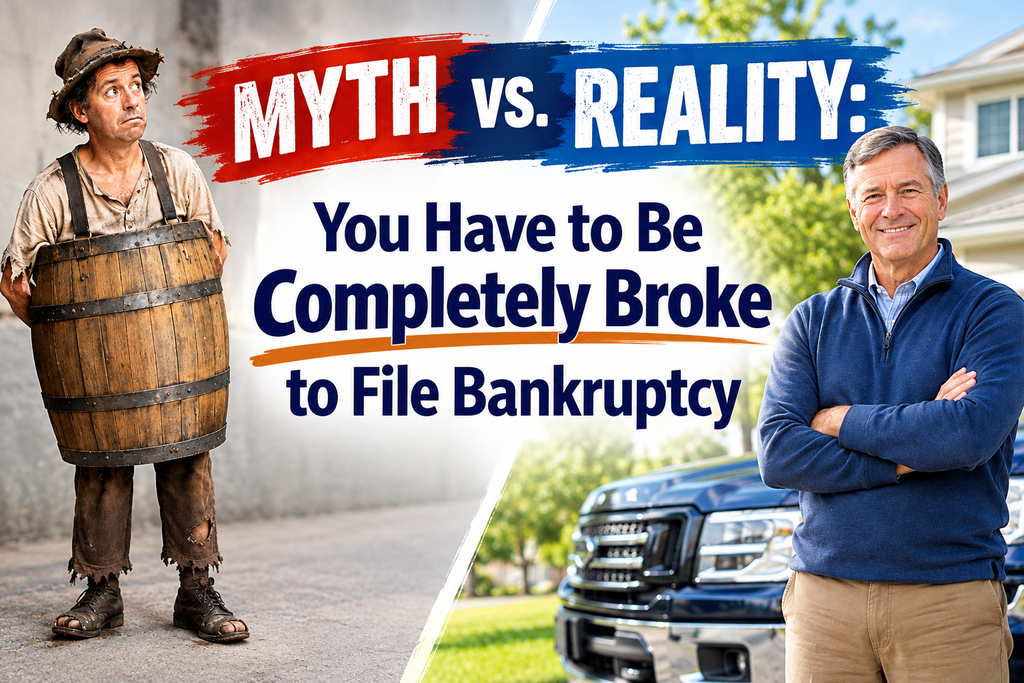
When I was younger, I remember seeing cartoons that depicted someone who was bankrupt or deeply in debt as a person who had lost absolutely everything. The cartoon character would be standing on the street wearing nothing but a wooden barrel held up by straps over the shoulders, serving as suspenders.
That image stuck with me. As a young person, I came away with the impression that bankruptcy was something you could only do after you had lost your home, your car, your savings, and practically every other possession you owned.
I thought you had to be virtually penniless before you could file bankruptcy.
Unfortunately, that kind of imagery helped create a misconception that still exists today. People are afraid to consult a bankruptcy attorney because they believe they have too many assets, earn too much money, or own too much property to qualify.
Some people even delay seeking legal advice until their financial situation has deteriorated so badly that they are facing foreclosure, repossession, or garnishment of their wages.
The reality is that you do not have to lose everything before you can file bankruptcy. Waiting until you are completely broke may actually make your situation much worse.
The Reality: You Can Own a Home, Have a Good Job, and Still File Bankruptcy
Over the course of my 35-year career practicing bankruptcy law exclusively, I have represented thousands of people who had jobs, owned homes, drove vehicles, and had other assets when they filed bankruptcy.
These clients were not living in barrels. They were ordinary people trying to support themselves and their families while dealing with overwhelming financial obligations.
Some had experienced a divorce or a medical problem. Others had accumulated credit card debt over many years, fallen behind on personal loans, or found that rising living expenses had left them unable to keep up with their monthly payments.
Many had steady employment and were doing everything they could to meet their obligations. The problem was that their income was no longer sufficient to cover their mortgage or rent, vehicle payments, utilities, groceries, insurance, and minimum payments on their unsecured debts.
Having a job does not mean you cannot file bankruptcy. Owning a home does not automatically disqualify you. Having a vehicle, furniture, retirement savings, or money in a bank account does not necessarily prevent you from obtaining bankruptcy relief.
The important questions are whether you qualify under the applicable bankruptcy rules, what property you own, what exemptions are available to protect that property, and which bankruptcy chapter is appropriate for your circumstances.
Bankruptcy Is Designed to Give You a Fresh Start, Not Leave You With Nothing
One of the most important things I explain to prospective clients is that bankruptcy law includes protections designed to prevent creditors from taking everything a debtor owns.
The law recognizes that people need certain property to maintain a home, get to work, support their families, and rebuild their financial lives. That is why bankruptcy exemptions exist.
An exemption is a legal protection that allows you to keep qualifying property rather than having it taken to pay your creditors.
Depending on your circumstances and the applicable exemption system, protected property may include:
- Equity in your home, up to the applicable homestead exemption.
- Equity in your automobile, up to the applicable motor vehicle exemption.
- Household furniture, appliances, clothing, and other personal belongings.
- Qualifying retirement accounts and certain other financial assets.
- Other property covered by applicable federal or Michigan exemptions.
The specific amount of protection available depends on the type of property, its value, the amount of debt secured by it, the applicable exemption rules, and other facts about your case.
For Michigan residents, choosing between the available state and federal exemption systems can be an important part of bankruptcy planning. The right approach depends on your individual financial circumstances.
The goal is not to strip you of everything you own. The goal is to determine whether bankruptcy can eliminate or manage your debts while allowing you to retain the property the law protects.
What Happens to My House and Car if I File Bankruptcy?
This is one of the most common concerns I hear from people considering bankruptcy.
They have worked for years to buy a home or pay down a vehicle loan. They may have built up equity in their property, and they understandably do not want to lose it simply because they have fallen behind on credit card bills.
The good news is that filing bankruptcy does not automatically mean you will lose your house or car.
Your Home
If you own a home, the important considerations include its current market value, the balances of your mortgages and other liens, the equity you have accumulated, and the homestead exemption available to you.
For example, a homeowner may have substantial debt on credit cards and personal loans but relatively little equity in a home after accounting for the mortgage. Depending on the applicable exemption and other circumstances, the homeowner may be able to file Chapter 7 bankruptcy and retain the home.
If you are behind on your mortgage payments, Chapter 13 bankruptcy may offer another option in appropriate cases by allowing eligible debtors to address mortgage arrears through a repayment plan while maintaining ongoing mortgage payments.
Every case is different, and exemptions do not automatically protect all home equity. That is why it is important to have an experienced bankruptcy attorney review your circumstances before deciding what to do.
Your Vehicles
The same general principle applies to automobiles and trucks.
Many of my clients own their vehicles and need them to get to work, take their children to school, and manage everyday responsibilities. The bankruptcy exemption system may protect some or all of the equity in a vehicle, depending on its value and the applicable rules.
If you have a vehicle loan, you must also consider the lender’s lien and whether you can afford the ongoing payments. Protecting your equity and deciding what to do about a vehicle loan are separate issues.
The bottom line is that owning a vehicle does not automatically prevent you from filing bankruptcy or mean that you must surrender it.
Chapter 7 Bankruptcy Does Not Require You to Own Nothing
Chapter 7 bankruptcy is often misunderstood as a process reserved for people who have already lost everything.
That is not how it works.
A Chapter 7 bankruptcy trustee reviews the debtor’s assets, liabilities, financial disclosures, and applicable exemptions. If the debtor owns nonexempt property that can be administered for creditors, the trustee may have the authority to take steps to liquidate that property.
However, when the debtor’s assets are fully protected by applicable exemptions, there may be nothing for the trustee to liquidate.
In fact, in upwards of 98% of the Chapter 7 cases filed by my office, the trustee takes nothing to distribute to creditors. These are commonly called no-asset cases.
My clients do not have to sell their furniture, give up their cars, or move out of their homes simply because they have filed bankruptcy. The outcome depends on the facts of the case and the property protections available under the law.
It is also important to understand that not everyone qualifies for Chapter 7. Income, household size, expenses, the means test, prior bankruptcy filings, and other legal considerations can affect eligibility.
But the notion that you must first become completely broke is simply wrong.
What About People Who Earn a Good Income?
You may be surprised to learn that some people who file bankruptcy earn a reasonable income.
A good salary does not necessarily mean that a person can afford to pay all their debts. Consider someone who earns a decent living but must make substantial mortgage payments, pay for health insurance, maintain two vehicles, support children, and cover the rising cost of groceries, utilities, and other necessities.
If that person also has tens of thousands of dollars in credit card debt, the minimum payments alone may consume a significant portion of the household budget.
The problem can become even worse when interest charges and late fees cause the balances to grow despite regular payments.
Whether someone with that financial profile qualifies for Chapter 7 depends on the applicable eligibility requirements, including the means test and any relevant exceptions or presumptions. Other individuals may benefit from Chapter 13 or another debt-management approach.
The point is that bankruptcy eligibility is not determined by whether you look poor or whether you own a home. It requires a careful analysis of your income, expenses, debts, assets, and the applicable law.
Do Not Wait Until Creditors Have Taken Everything You Own
One of the biggest mistakes people make is waiting too long to speak with a bankruptcy attorney.
They drain their savings trying to keep up with minimum payments. They borrow money from relatives. They use retirement funds to pay credit cards. They fall behind on their mortgage or vehicle payments while attempting to satisfy unsecured creditors.
Eventually, they may face a lawsuit, a bank account levy, wage garnishment, or the threat of foreclosure or repossession.
In many situations, seeking legal advice earlier may provide more options than waiting until the financial damage becomes severe.
Bankruptcy can provide an automatic stay that generally stops many collection activities when a case is filed, although exceptions apply and some actions may proceed with court permission. Depending on the circumstances, bankruptcy may also eliminate qualifying unsecured debts and provide an opportunity to reorganize certain obligations.
The law is intended to give honest debtors a meaningful opportunity for a fresh start. It is not necessary to wait until you have lost your home, your vehicle, and everything else you have worked to acquire.
Myth vs. Reality: The Bottom Line
The myth is that you must be completely broke, own nothing, and have no assets before you can file bankruptcy.
The reality is that many people who file bankruptcy have jobs, homes, vehicles, furniture, savings, and other possessions. Bankruptcy law provides exemptions that may allow them to protect qualifying property while obtaining relief from overwhelming debt.
After 35 years of practicing bankruptcy law exclusively, I have seen how financial problems can affect people from all walks of life. A person can work hard, earn a good income, and make responsible decisions yet still find themselves in a financial situation they cannot reasonably overcome without help.
You should not assume that bankruptcy is unavailable to you simply because you own a home, drive a vehicle, or have a steady job.
If you are struggling with credit card debt, medical bills, personal loans, wage garnishments, or other financial obligations, the best first step is to find out what options the law provides for your particular situation.
At the Law Offices of Walter Metzen, I help individuals throughout the Eastern District of Michigan understand their bankruptcy options, evaluate the property exemptions available to them, and determine whether Chapter 7 or Chapter 13 may be appropriate.
You do not have to be standing on the street wearing a barrel to file bankruptcy. You simply need to understand your rights, your options, and how bankruptcy law may help you protect what you have worked so hard to earn.
Call my office at 313-962-4656 to discuss your situation and learn whether bankruptcy may be right for you.