Myth vs. Reality: Bankruptcy Filers Are Financially Irresponsible

Published
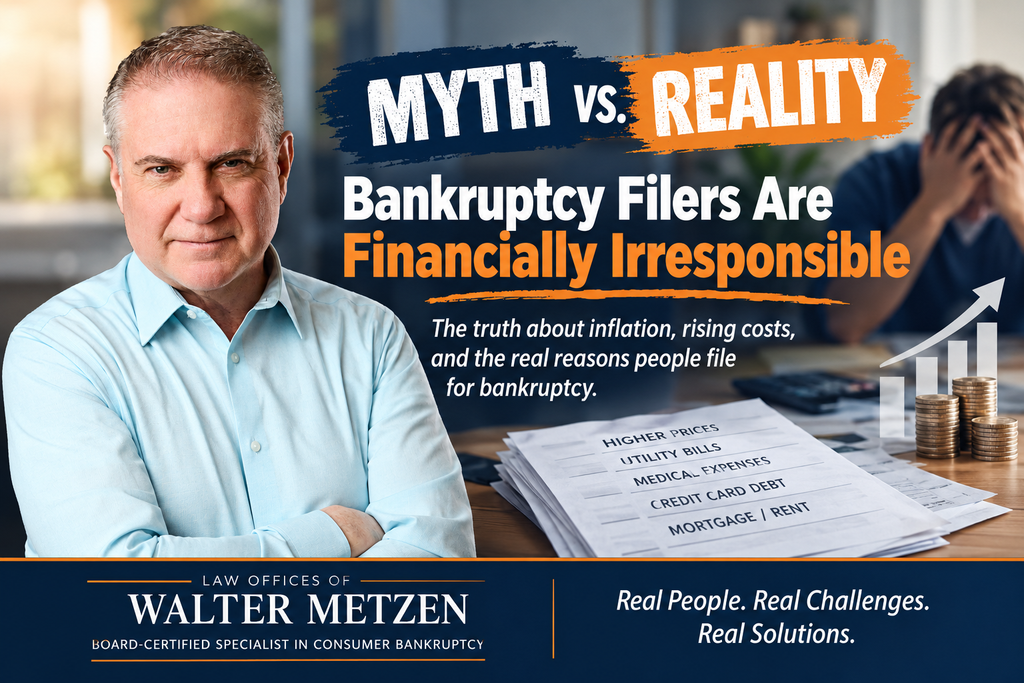
One of the most damaging myths about bankruptcy is that people who file must be financially irresponsible. The assumption is that they spent too much money, lived beyond their means, or simply failed to manage their finances properly.
After 35 years of practicing bankruptcy law and helping thousands of individuals and families throughout Michigan, I can tell you that this stereotype does not reflect the reality I see in my office.
Many people who file bankruptcy are hardworking individuals who tried to do everything right. They worked, paid their bills, raised their families, and did their best to make ends meet. Then something changed. A divorce, a serious medical problem, a job loss, or a series of unexpected expenses pushed them into financial trouble.
And in recent years, there has been another major factor: the dramatically higher cost of living that Americans have experienced since the COVID-19 pandemic.
Table of Contents
- Myth: People File Bankruptcy Because They Are Bad With Money
- Reality: Inflation Has Made Everyday Life Much More Expensive
- Myth: People Who File Bankruptcy Must Have Been Living Beyond Their Means
- The Three Major Financial Crises I See in My Bankruptcy Practice
- Why Do People Feel Ashamed About Filing Bankruptcy?
- Bankruptcy Exists for a Reason
- My Advice to People Struggling With Debt in Michigan
- The Bottom Line: Financial Hardship Does Not Define You
Myth: People File Bankruptcy Because They Are Bad With Money
The reality is that financial problems can happen to responsible people.
Consider a family that has two incomes, a mortgage or rent payment, car payments, insurance premiums, utility bills, groceries, and expenses for their children. They may have enough income to cover those expenses when they first take on their financial obligations.
But what happens when groceries cost substantially more, car insurance premiums increase, utility bills rise, and housing expenses consume a larger portion of their income? What happens when one spouse loses a job or a family member develops a serious medical condition?
Even a family that carefully manages its money can find itself falling behind.
In my practice, I have seen people who worked for decades and paid their bills on time before circumstances beyond their control left them unable to keep up. They did not necessarily make reckless financial decisions. They simply reached a point where their income could no longer cover their expenses and existing debt.
There is a significant difference between being financially irresponsible and being unable to pay debts that have become unmanageable.
Reality: Inflation Has Made Everyday Life Much More Expensive
The pandemic changed the financial circumstances of millions of American households. Supply-chain disruptions, changing consumer demand, housing costs, and other economic factors contributed to a sharp increase in prices.
Although the rate of inflation later slowed, that does not mean prices returned to their pre-pandemic levels. It means that prices generally continued rising at a slower rate.
According to the U.S. Bureau of Labor Statistics, consumer prices increased approximately 20% between February 2020 and February 2024 alone. Over that same period, average hourly earnings for private-sector workers increased approximately 21.1%. Although that represented a small overall gain in average purchasing power, it concealed significant differences among workers and households. The BLS also documented a prolonged period from April 2021 through April 2023 when inflation outpaced hourly earnings on a year-over-year basis. Source: U.S. Bureau of Labor Statistics.
What does this mean for an ordinary family?
It means that a paycheck that once covered the mortgage, groceries, utilities, and transportation may no longer stretch as far. And if that family already has credit card debt, a car loan, or medical bills, there may be very little room in the budget to absorb higher prices.
Inflation does not have to make a family poor overnight to cause serious financial trouble. It can gradually eliminate the small amount of money left over each month until the family begins relying on credit cards to pay for necessities.
Eventually, the minimum payments themselves can become unaffordable.
Look at how much everyday expenses have increased
The following figures illustrate the cumulative price increases for selected household expenses between February 2020 and November 2024, based on Consumer Price Index data from the Bureau of Labor Statistics, as reported by the Peterson Institute for International Economics. These figures describe that specific period, not the latest prices in October 2026.
- Groceries: approximately 26.2% higher.
- Rent for a primary residence: approximately 26.0% higher.
- Household energy: approximately 31.7% higher.
- Used cars and trucks: approximately 30.9% higher.
- Medical care: approximately 10.7% higher.
Source: Peterson Institute for International Economics, The Worst Inflation Outbreak in 40 Years.
Think about what those increases mean for a family already struggling to pay its bills. If groceries and housing consume hundreds of dollars more each month than they did before the pandemic, the family must find that additional money somewhere.
Some families cut back on everything they can. Others use savings. Still others charge groceries, utilities, car repairs, and medical expenses to credit cards.
Those credit cards may provide temporary relief, but they also create additional interest and monthly payments. What begins as an effort to keep the household afloat can eventually turn into a debt burden that the family simply cannot overcome.
That is not necessarily financial irresponsibility. It can be the consequence of trying to maintain a household when expenses have risen faster than a particular family’s ability to pay them.
Myth: People Who File Bankruptcy Must Have Been Living Beyond Their Means
This is another misconception I encounter regularly.
Some people assume that anyone who files bankruptcy must have purchased expensive cars, taken extravagant vacations, or run up credit card balances buying things they did not need.
Certainly, some people make poor financial decisions. But it is a mistake to assume that everyone who files bankruptcy fits that description.
Many of my clients have accumulated debt because they were trying to pay ordinary living expenses. They used credit cards to buy groceries, cover utility bills, pay for car repairs, or bridge the gap between paychecks. Others accumulated debt because they could not work for an extended period or because a family emergency depleted their savings.
The Federal Reserve Bank of New York reported that total U.S. household debt reached approximately $18.04 trillion at the end of 2024, including approximately $1.21 trillion in credit card debt. Its research has also documented rising credit card and auto loan delinquency rates following the pandemic. These figures illustrate the scale of household borrowing and repayment pressures, although they do not establish why any particular person files bankruptcy. Source: Federal Reserve Bank of New York.
When people use credit to cover a persistent shortfall between their income and necessary expenses, their debt can grow even if they are trying to be responsible.
The real problem may not be that they are spending too much on luxuries. It may be that their available income is insufficient to cover the cost of living and their existing financial obligations.
The Three Major Financial Crises I See in My Bankruptcy Practice
In my experience, three recurring circumstances can contribute significantly to personal bankruptcy: divorce, serious illness, and job loss. These are common situations I encounter in my practice, not a statistically ranked list of the causes of bankruptcy nationwide.
1. Divorce
Divorce can turn one household into two, often without doubling the income available to support them.
Both spouses may suddenly need separate housing, separate utility accounts, separate transportation arrangements, and money to pay attorneys. One spouse may also be required to pay child support or spousal support.
Even couples who were financially stable before their separation can struggle to maintain two households while meeting their existing debt obligations.
For some people, bankruptcy becomes a practical way to address unsecured debts and obtain a fresh financial start after divorce.
2. Serious Illness and Medical Expenses
A serious illness can affect a family’s finances in several ways. There may be medical bills, insurance deductibles, prescription costs, travel expenses for treatment, and lost income when someone cannot work.
Even individuals with health insurance can face substantial out-of-pocket expenses. And when an illness affects a person’s ability to earn a living, the financial consequences can extend far beyond the cost of medical treatment.
A family may exhaust its savings, fall behind on other bills, and rely on credit cards to cover ordinary expenses.
Filing bankruptcy under those circumstances does not mean the person was financially irresponsible. It may mean that an illness created expenses and lost income that the family could not reasonably absorb.
3. Job Loss or Prolonged Unemployment
Losing a job can quickly undermine an otherwise sound financial plan.
Unemployment benefits may replace only a portion of a person’s former income. Finding another job at the same salary can take time, particularly for older workers or people employed in industries undergoing significant changes.
Meanwhile, the mortgage, rent, car payments, insurance premiums, and other bills continue to arrive.
Some people use their savings while looking for work. Others borrow money to get through the unemployment period. When they finally find another job, they may have a lower income and substantial new debt.
Bankruptcy can provide relief when those debts have become impossible to repay.
Why Do People Feel Ashamed About Filing Bankruptcy?
Unfortunately, the myth that bankruptcy filers are financially irresponsible causes many people to delay seeking help.
They may believe bankruptcy is an admission that they have failed as adults, failed their families, or failed to manage their money. They may worry about what friends, relatives, or coworkers will think.
I understand those concerns. Nobody wants to find themselves in a position where they cannot pay their bills.
But financial hardship is not a character defect.
You can work hard, live within your means, and make sensible financial decisions and still experience a divorce, a serious illness, unemployment, or a prolonged period of rising expenses. Sometimes several of these problems occur together.
When that happens, continuing to struggle with overwhelming debt does not necessarily improve the situation. It can make it harder to save money, maintain a household, or prepare for retirement.
Bankruptcy is not a moral judgment. It is a legal remedy established by federal law to help eligible individuals deal with debts they cannot repay.
Bankruptcy Exists for a Reason
The United States Bankruptcy Code provides legal procedures through which eligible individuals can obtain relief from qualifying debts.
For many individuals, Chapter 7 bankruptcy can eliminate qualifying unsecured debts, such as credit card balances and certain medical bills, subject to the applicable legal requirements and exceptions.
Chapter 13 bankruptcy may provide another option for people who have regular income and need a court-supervised repayment plan to address their debts.
The appropriate chapter depends on the individual’s income, assets, debts, goals, and circumstances. Bankruptcy does not eliminate every type of debt, and some property may be at risk depending on the applicable exemptions and other facts of the case.
In Michigan, understanding the available exemptions and how they apply to your home, vehicles, retirement accounts, and other property is an important part of evaluating whether Chapter 7 is appropriate.
After 35 years of practicing bankruptcy law, I believe people should understand their legal options before deciding that their financial situation is hopeless.
The purpose of bankruptcy is not to reward irresponsible behavior. It is to provide a legal framework for addressing debts that have become unmanageable and, where the law permits, giving people an opportunity to rebuild their financial lives.
My Advice to People Struggling With Debt in Michigan
If you are struggling to pay your bills, do not automatically assume that you have done something wrong.
Take an honest look at your financial circumstances. Consider how much your essential expenses have increased, whether your income has kept pace, and whether you can realistically repay your existing debt while covering your family’s needs.
If the numbers do not work, it may be time to explore your options.
I have represented more than 25,000 people in bankruptcy matters over the course of my career. I have seen firsthand how financial problems can affect hardworking individuals and families from all walks of life.
Many of the people who come to my office are embarrassed about their circumstances. They often believe they should have been able to solve their financial problems on their own.
But asking for legal advice is not a sign of failure. It is a way to understand the choices available to you.
At the Law Offices of Walter Metzen, I help individuals throughout the Eastern District of Michigan evaluate their financial situations and determine whether Chapter 7 or Chapter 13 bankruptcy may be appropriate.
The Bottom Line: Financial Hardship Does Not Define You
The myth that bankruptcy filers are financially irresponsible overlooks the economic realities facing many American households.
Inflation has raised the cost of essential goods and services. Divorce can create two households where there was once one. Serious illness can generate medical expenses and lost income. Job loss can make ordinary monthly obligations impossible to maintain.
Sometimes people make financial mistakes. But that does not mean everyone who files bankruptcy is reckless, careless, or incapable of managing money.
Bankruptcy filers are people facing financial difficulties, not a single stereotype.
If rising living expenses, medical bills, divorce, unemployment, or credit card debt have made it difficult to keep up with your obligations, you do not have to assume that there is no solution.
Contact the Law Offices of Walter Metzen to discuss your circumstances and learn whether bankruptcy may provide a path toward a fresh financial start.
Walter Metzen, Attorney at Law
Board-Certified Specialist in Consumer Bankruptcy
Law Offices of Walter Metzen
Phone: 313-962-4656
This article provides general information about bankruptcy law and is not legal advice for any particular situation.